Pinacidil hydrate
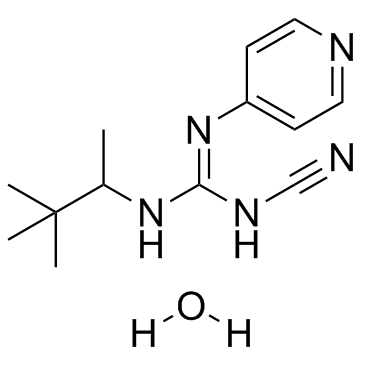
Pinacidil hydrate structure
|
Common Name | Pinacidil hydrate | ||
|---|---|---|---|---|
| CAS Number | 85371-64-8 | Molecular Weight | 263.34 | |
| Density | N/A | Boiling Point | 356.7ºC at 760 mmHg | |
| Molecular Formula | C13H21N5O | Melting Point | 164-165ºC | |
| MSDS | Chinese USA | Flash Point | 169.5ºC | |
| Symbol |

GHS07 |
Signal Word | Warning | |
|
Evidence against a systemic arterial defect in patients with inflammatory bowel disease.
J. Surg. Res. 191(2) , 318-22, (2014) Despite increasing interest in local microvascular alterations associated with inflammatory bowel disease (IBD), the potential contribution of a primary systemic vascular defect in the etiology of IBD is unknown. We compared reactivity of large diameter mesen... |
|
|
Kcnh2 and Kcnj8 interactively regulate skin wound healing and regeneration.
Wound Repair Regen. 23 , 797-806, (2015) Previous studies indicate that ion channels are mediators of bioelectricity promoting wound closure/regeneration in nonmammalian, lower vertebrate systems. The role of ion channels however in regeneration of wounds in mammalian systems that do not regenerate ... |
|
|
Potassium ion channels and allergic asthma.
Adv. Exp. Med. Biol. 838 , 35-45, (2015) High-conductive calcium-sensitive potassium channels (BK+Ca) and ATP-sensitive potassium (K+ATP) channels play a significant role in the airway smooth muscle cell and goblet cell function, and cytokine production. The present study evaluated the therapeutic p... |
|
|
CYP-epoxygenases contribute to A2A receptor-mediated aortic relaxation via sarcolemmal KATP channels.
Am. J. Physiol. Regul. Integr. Comp. Physiol. 303(10) , R1003-10, (2012) Previously, we have shown that A(2A) adenosine receptor (A(2A)AR) mediates aortic relaxation via cytochrome P-450 (CYP)-epoxygenases. However, the signaling mechanism is not understood properly. We hypothesized that ATP-sensitive K(+) (K(ATP)) channels play a... |
|
|
Hypoxia and reoxygenation modulate the arrhythmogenic activity of the pulmonary vein and atrium.
Clin. Sci. 122(3) , 121-32, (2012) Ischaemia and reperfusion contribute to the genesis of AF (atrial fibrillation). PVs (pulmonary veins) and the atria are important foci for AF initiation and maintenance. However, the effect of ischaemia and reperfusion on PVs and the atria has not yet been f... |
|
|
NMR and fluorescence studies of drug binding to the first nucleotide binding domain of SUR2A.
Biochemistry 51(45) , 9211-22, (2012) ATP sensitive potassium (K(ATP)) channels are composed of four copies of a pore-forming inward rectifying potassium channel (Kir6.1 or Kir6.2) and four copies of a sulfonylurea receptor (SUR1, SUR2A, or SUR2B) that surround the pore. SUR proteins are members ... |
|
|
Fibroblast KATP currents modulate myocyte electrophysiology in infarcted hearts.
Am. J. Physiol. Heart Circ. Physiol. 304(9) , H1231-9, (2013) Cardiac metabolism remains altered for an extended period of time after myocardial infarction. Studies have shown fibroblasts from normal hearts express KATP channels in culture. It is unknown whether fibroblasts from infarcted hearts express KATP channels an... |
|
|
ATP-sensitive potassium channel (K(ATP))-dependent regulation of cardiotropic viral infections.
Proc. Natl. Acad. Sci. U. S. A. 108(29) , 12024-9, (2011) The effects of the cellular environment on innate immunity remain poorly characterized. Here, we show that in Drosophila ATP-sensitive potassium channels (K(ATP)) mediate resistance to a cardiotropic RNA virus, Flock House virus (FHV). FHV viral load in the h... |
|
|
Vasodilation of retinal arterioles induced by activation of BKCa channels is attenuated in diabetic rats.
Eur. J. Pharmacol. 669(1-3) , 94-9, (2011) The large-conductance Ca(2+)-activated K(+) (BK(Ca)) channels modulate the retinal vascular tone, but question of whether the impairment of the channel function contributes to abnormalities of retinal circulation has not yet been completely elucidated. The pu... |
|
|
Pinacidil enhances survival of cryopreserved human embryonic stem cells
Cryobiology 63(3) , 298-305, (2011) Human embryonic stem cells (hESCs) can be maintained as undifferentiated cells in vitro and induced to differentiate into a variety of somatic cell types. Thus, hESCs provide a source of differentiated cell types that could be used to replace diseased cells o... |