Sulfolane
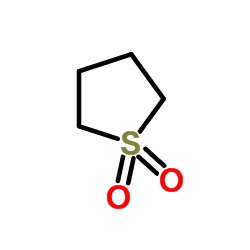
Sulfolane structure
|
Common Name | Sulfolane | ||
|---|---|---|---|---|
| CAS Number | 126-33-0 | Molecular Weight | 120.170 | |
| Density | 1.3±0.1 g/cm3 | Boiling Point | 285.6±8.0 °C at 760 mmHg | |
| Molecular Formula | C4H8O2S | Melting Point | 27.4 °C | |
| MSDS | Chinese USA | Flash Point | 165.6±0.0 °C | |
| Symbol |

GHS07 |
Signal Word | Warning | |
|
Remarkably regioselective deacylation of cellulose esters using tetraalkylammonium salts of the strongly basic hydroxide ion.
Carbohydr. Polym. 111 , 25-32, (2014) Tetraalkylammonium hydroxides have been found to mediate regioselective deacylation of cellulose esters. This deacylation surprisingly shows substantial selectivity for the removal of the acyl groups at O-2/3, affording cellulose-6-O-esters by a simple, effic... |
|
|
Impurity profiling of ibandronate sodium by HPLC-CAD.
J. Pharm. Biomed. Anal. 114 , 254-64, (2015) The modern bisphosphonate drug ibandronate sodium, a challenging candidate for impurity profiling, was analyzed using high performance liquid chromatography (HPLC) combined with corona charged aerosol detection (CAD). Separation was achieved on a mixed mode c... |
|
|
Interaction of High Flash Point Electrolytes and PE-Based Separators for Li-Ion Batteries.
Int. J. Mol. Sci. 16 , 20258-76, (2015) In this study, promising electrolytes for use in Li-ion batteries are studied in terms of interacting and wetting polyethylene (PE) and particle-coated PE separators. The electrolytes are characterized according to their physicochemical properties, where the ... |
|
|
Fabrication and evaluation of tumor-targeted positive MRI contrast agent based on ultrasmall MnO nanoparticles.
Colloids Surf. B Biointerfaces 131 , 148-54, (2015) Gd(III) chelate is currently used as positive magnetic resonance imaging (MRI) contrast agent in clinical diagnosis, but generally induces the risk of nephrogenic systemic fibrosis (NSF) due to the dissociated Gd(3+) from Gd(III) chelates. To develop a novel ... |
|
|
New reagents for enhanced liquid chromatographic separation and charging of intact protein ions for electrospray ionization mass spectrometry.
Anal. Chem. 82 , 7515-7519, (2010) Electrospray ionization produces multiply charged ions, thereby lowering the mass-to-charge ratio for peptides and small proteins to a range readily accessed by quadrupole ion trap, orbitrap, and ion cyclotron resonance (ICR) mass analyzers (m/z = 400-2000). ... |
|
|
New reagents for increasing ESI multiple charging of proteins and protein complexes.
J. Am. Soc. Mass Spectrom. 21(1) , 127-31, (2010) The addition of m-nitrobenzyl alcohol (m-NBA) was shown previously (Lomeli et al., J. Am. Soc. Mass Spectrom. 2009, 20, 593-596) to enhance multiple charging of native proteins and noncovalent protein complexes in electrospray ionization (ESI) mass spectra. A... |
|
|
Phenylene ethynylene diazonium salts as potential self-assembling molecular devices.
Org. Lett. 3(7) , 993-5, (2001) [reaction: see text]. Functionalized diazonium salts for molecular electronic devices are prepared by the reaction of the corresponding anilines with NOBF4 in sulfolane-acetonitrile solvent. |
|
|
Conversion of fructose into 5-(hydroxymethyl)furfural in sulfolane.
ChemSusChem 4(3) , 353-6, (2011)
|
|
|
A review of analytical methods for the determination of sulfolane and alkanolamines in environmental studies.
J. AOAC Int. 85(1) , 154-62, (2002) Sulfolane and alkanolamines are used extensively in the processing of sour natural gases. Over many years of operation, there have been inadvertent leaks of these chemicals to groundwater and wetlands surrounding gas processing facilities, leading to uptake b... |
|
|
Sulfolane degradation by mixed cultures and a bacterial isolate identified as a Variovorax sp.
Arch. Microbiol. 174(1-2) , 111-9, (2000) Sulfolane (tetrahydrothiophene-1,1-dioxide) is used in the Sulfinol process for natural gas sweetening. At many sour-gas processing plants spills, landfills and leakage from unlined surface storage ponds have contaminated groundwaters with sulfolane. Due to i... |