1,6-DIPHENYL-1,3,5-HEXATRIENE
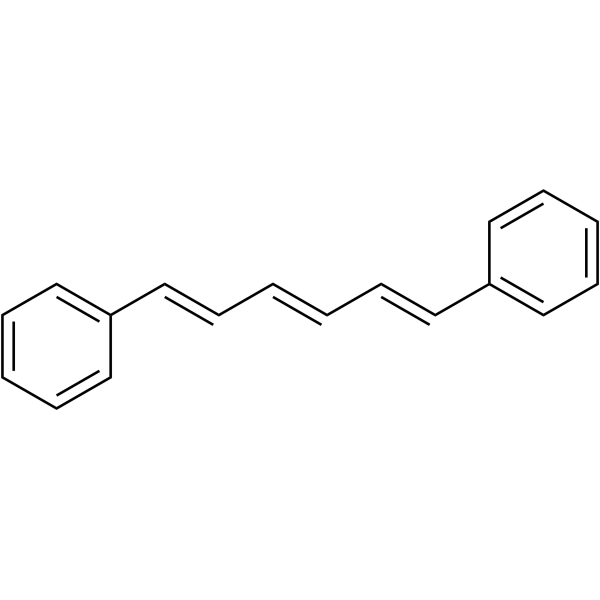
1,6-DIPHENYL-1,3,5-HEXATRIENE structure
|
Common Name | 1,6-DIPHENYL-1,3,5-HEXATRIENE | ||
|---|---|---|---|---|
| CAS Number | 1720-32-7 | Molecular Weight | 232.32000 | |
| Density | 1.028g/cm3 | Boiling Point | 407.2ºC at 760mmHg | |
| Molecular Formula | C18H16 | Melting Point | 199-203 °C(lit.) | |
| MSDS | Chinese USA | Flash Point | 221ºC | |
| Symbol |

GHS07 |
Signal Word | Warning | |
|
An antifungal mechanism of curcumin lies in membrane-targeted action within Candida albicans.
IUBMB Life 66(11) , 780-5, (2015) The aim of this study is to investigate the antifungal mechanism of curcumin. This polyphenolic compound has been used traditionally in Asia for medicinal, culinary, and other purposes. Although antifungal effect of curcumin has been reported, this is the fir... |
|
|
Cranberry flavonoids prevent toxic rat liver mitochondrial damage in vivo and scavenge free radicals in vitro.
Cell Biochem. Funct. 33 , 202-10, (2015) The present study was undertaken for further elucidation of the mechanisms of flavonoid biological activity, focusing on the antioxidative and protective effects of cranberry flavonoids in free radical-generating systems and those on mitochondrial ultrastruct... |
|
|
Regulation of SREBPs by Sphingomyelin in Adipocytes via a Caveolin and Ras-ERK-MAPK-CREB Signaling Pathway.
PLoS ONE 10 , e0133181, (2015) Sterol response element binding protein (SREBP) is a key transcription factor in insulin and glucose metabolism. We previously demonstrated that elevated levels of membrane sphingomyelin (SM) were related to peroxisome proliferator-activated receptor-γ (PPARγ... |
|
|
The direct anti-MRSA effect of emodin via damaging cell membrane.
Appl. Microbiol. Biotechnol. 99 , 7699-709, (2015) Methicillin-resistant Staphylococcus aureus (MRSA) has become an important bacterium for nosocomial infection. Only a few antibiotics can be effective against MRSA. Therefore, searching for new drugs against MRSA is important. Herein, anti-MRSA activities of ... |
|
|
Cytotoxic bile acids, but not cytoprotective species, inhibit the ordering effect of cholesterol in model membranes at physiologically active concentrations.
Biochim. Biophys. Acta 1828(9) , 2152-63, (2013) Submillimolar concentrations of cytotoxic bile acids (BAs) induce cell death via apoptosis. On the other hand, several cytoprotective BAs were shown to prevent apoptosis in the same concentration range. Still, the mechanisms by which BAs trigger these opposit... |
|
|
Folding and Intramembraneous BRICHOS Binding of the Prosurfactant Protein C Transmembrane Segment.
J. Biol. Chem. 290 , 17628-41, (2015) Surfactant protein C (SP-C) is a novel amyloid protein found in the lung tissue of patients suffering from interstitial lung disease (ILD) due to mutations in the gene of the precursor protein pro-SP-C. SP-C is a small α-helical hydrophobic protein with an un... |
|
|
Molecular mechanism of action of chlorogenic acid on erythrocyte and lipid membranes.
Mol. Membr. Biol. 32 , 46-54, (2015) The high antioxidant capacity of chlorogenic acid (CGA) in respect to biological systems is commonly known, though the molecular mechanism underlying that activity is not known. The aim of the study was to determine that mechanism at the molecular and cell le... |
|
|
Degradation of lipid droplet-associated proteins by chaperone-mediated autophagy facilitates lipolysis.
Nat. Cell Biol. 17 , 759-70, (2015) Chaperone-mediated autophagy (CMA) selectively degrades a subset of cytosolic proteins in lysosomes. A potent physiological activator of CMA is nutrient deprivation, a condition in which intracellular triglyceride stores or lipid droplets (LDs) also undergo h... |
|
|
Albumin-based micro-composite drug carriers with dual chemo-agents for targeted breast cancer treatment.
J. Biomater. Appl. 30 , 38-49, (2015) Albumin-based drug-carrying micro-composite spheres were fabricated and studied to evaluate their potentials for breast cancer treatment. Magnetic nanoparticles and albumin were incorporated within poly(D l-lactide-co-glycolide) microspheres to increase accum... |
|
|
Experimental resistance to drug combinations in Leishmania donovani: metabolic and phenotypic adaptations.
Antimicrob. Agents Chemother. 59 , 2242-55, (2015) Together with vector control, chemotherapy is an essential tool for the control of visceral leishmaniasis (VL), but its efficacy is jeopardized by growing resistance and treatment failure against first-line drugs. To delay the emergence of resistance, the use... |