sRANKL-IN-3
Modify Date: 2025-08-26 18:38:28
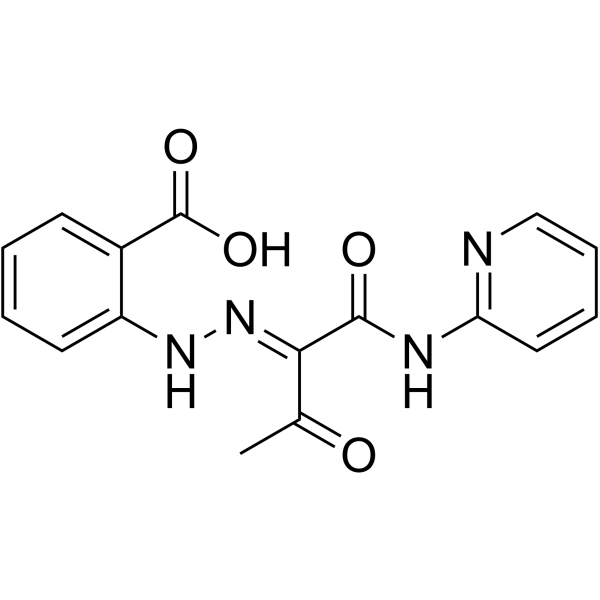
sRANKL-IN-3 structure
|
Common Name | sRANKL-IN-3 | ||
|---|---|---|---|---|
| CAS Number | 2412947-15-8 | Molecular Weight | 326.31 | |
| Density | N/A | Boiling Point | N/A | |
| Molecular Formula | C16H14N4O4 | Melting Point | N/A | |
| MSDS | N/A | Flash Point | N/A | |
Use of sRANKL-IN-3sRANKL-IN-3 (Compound S3-15) is a potent, orally active and selective soluble RANKL (sRANKL) inhibitor with an IC50 of 0.19 μM. sRANKL-IN-3 can be targeted to inhibit soluble RANK-RANKL interactions. sRANKL-IN-3 can be used for the research of osteoporosis[1]. |
| Name | sRANKL-IN-3 |
|---|
| Description | sRANKL-IN-3 (Compound S3-15) is a potent, orally active and selective soluble RANKL (sRANKL) inhibitor with an IC50 of 0.19 μM. sRANKL-IN-3 can be targeted to inhibit soluble RANK-RANKL interactions. sRANKL-IN-3 can be used for the research of osteoporosis[1]. |
|---|---|
| Related Catalog | |
| In Vitro | sRANKL-IN-3 (Compound S3-15) selectively binds sRANKL. sRANKL-IN-3 has a high binding affinity to sRANKL (KD=5.78 μM) and is significantly stronger than binary-RANKL (KD=124 μM)[1]. sRANKL-IN-3 (0.01-100 μM; 5 d; osteoclast) inhibits osteoclastogenesis in a dose-dependent manner[1]. sRANKL-IN-3 (5 μM; 24 h; osteoclast) suppresses RANKL mediated NF-κB and MAPK signaling pathway[1]. sRANKL-IN-3 (0.003-33 μM; 24 h; osteoclast) induces mature osteoclasts apoptosis and attenuates bone resorption in a dose-dependent manner[1]. sRANKL-IN-3 (0.1-10 μM; 14 days) increases cell proliferation and mineralization in mouse embryonic mesenchymal stem cell line C3H10T1/2 or human primary osteoblasts cells with osteogenic differentiation medium[1]. Cell Viability Assay[1] Cell Line: Osteoclast Concentration: 0.01, 0.1, 1, 10, and 100 μM Incubation Time: 5 days Result: Inhibited osteoclastogenesis with an IC50 value of 0.19 μM. Apoptosis Analysis[1] Cell Line: Mature osteoclasts Concentration: 0.003, 0.01, 0.03, 0.1, 0.3, 1, 3 10 and 33 μM Incubation Time: 24 hours Result: Significantly increased apoptosis of mature osteoclasts with an EC50 of 0.55 μM. Apoptosis Analysis[1] Cell Line: C3H10T12 cells Concentration: 0.1,1 and 10 μM Incubation Time: 14 days Result: Increased cell proliferation and mineralization in mouse embryonic mesenchymal stem cell line Western Blot Analysis[1] Cell Line: Osteoclast Concentration: 5 μM Incubation Time: 24 hours Result: Reduced NF-κB and NFATC-luciferase expression and suppresses osteoclast markers (DC-stamp, Ctsk, MMP9, Tracp, Oscar, and Calcr) expression. |
| In Vivo | sRANKL-IN-3 (Compound S3-15, 10 mg/kg/d; i.g.; 12 weeks) shows anti-osteoporosis activity in ovariectomy rats[1]. Animal Model: Female SD ovariectomy (OVX) rats[1] Dosage: 10 mg/kg/d Administration: Oral administraton, 12 weeks Result: Reduced bone loss, improved trabecular osteoporosis parameters, increased the bone volume / total volume (BV/TV). Animal Model: 28-week-old and 280 g∼370 g weight male SD (Sprague Dawley) rats[1] Dosage: 10 mg/kg Administration: Oral gavage (Pharmacokinetic Study) Result: The pharmacokinetic parameters of sRANKL-IN-3[1] sRANKL-IN-2 AUC (hr*μg/mL) 113.59 Cmax (μg/mL) 9.52 T1/2 (h) 15.55 |
| References |
| Molecular Formula | C16H14N4O4 |
|---|---|
| Molecular Weight | 326.31 |
| InChIKey | POMSQYBRHUFFDO-AOENBVNLSA-N |
| SMILES | CC(O)=C(N=Nc1ccccc1C(=O)O)C(=O)Nc1ccccn1 |