Shikonin
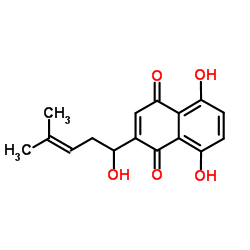
Shikonin structure
|
Common Name | Shikonin | ||
|---|---|---|---|---|
| CAS Number | 54952-43-1 | Molecular Weight | 288.295 | |
| Density | 1.4±0.1 g/cm3 | Boiling Point | 567.4±50.0 °C at 760 mmHg | |
| Molecular Formula | C16H16O5 | Melting Point | 149 °C | |
| MSDS | Chinese USA | Flash Point | 311.0±26.6 °C | |
| Symbol |


GHS07, GHS09 |
Signal Word | Warning | |
|
Inhibitory effect of Shikonin on Candida albicans growth.
Biol. Pharm. Bull. 35(11) , 1956-63, (2012) Our study showed that Shikonin (SK) could provide an action against almost all Candida albicans isolates tested. More importantly, to some Fluconazole (FCZ)-resistant Candida albicans, the action of SK (MIC(80) value 4 µg/mL) was shown to be >16 times higher ... |
|
|
Screening for novel quorum-sensing inhibitors to interfere with the formation of Pseudomonas aeruginosa biofilm.
J. Med. Microbiol. 60(Pt 12) , 1827-34, (2011) The objective of this study was to screen for novel quorum-sensing inhibitors (QSIs) from traditional Chinese medicines (TCMs) that inhibit bacterial biofilm formation. Six of 46 active components found in TCMs were identified as putative QSIs based on molecu... |
|
|
Optimization of shikonin homogenate extraction from Arnebia euchroma using response surface methodology.
Molecules 18(1) , 466-81, (2013) An efficient homogenate extraction technique was employed for extracting shikonin from Arnebia euchroma. The homogenate extraction procedure was optimized and compared with other conventional extraction techniques. The proposed method gave the best result wit... |
|
|
Glutathione-S-transferase enhances proliferation-migration and protects against shikonin-induced cell death in breast cancer cells.
Kaohsiung J. Med. Sci. 27(11) , 477-84, (2011) Glutathione-S-transferase (GST) is a cytoplasmic protein responsible for detoxification, but the effect of the enzyme on cell biological events, including proliferation and migration, has never been reported. Thus, we evaluated the detoxification effect of in... |
|
|
Ionization of shikonin derivatives using negative-ion electrospray mass spectrometry: [M-H]- versus [M + e]•-.
J. Mass Spectrom. 47(5) , 581-5, (2012)
|
|
|
Chemical inducers of heat shock proteins derived from medicinal plants and cytoprotective genes response.
Int. J. Hyperthermia 28(1) , 1-8, (2012) Environmental stress induces damage that activates an adaptive response in any organism. The cellular stress response is based on the induction of cytoprotective proteins, the so-called stress or heat shock proteins (HSPs). HSPs are known to function as molec... |
|
|
Shikonin enhances efficacy of a gene-based cancer vaccine via induction of RANTES.
J. Biomed. Sci. 19 , 42, (2012) Shikonin, a phytochemical purified from Lithospermum erythrorhizon, has been shown to confer diverse pharmacological activities, including accelerating granuloma formation, wound healing, anti-inflammation and others, and is explored for immune-modifier activ... |
|
|
Traditional chinese medicine remedy to jury: the pharmacological basis for the use of shikonin as an anticancer therapy.
Curr. Med. Chem. 20(23) , 2892-8, (2013) Shikonin is the major constituent of the root of Lithospermum erythrorhizon, which has been used in traditional Chinese medicine to treat external wounds, burns, or dermatitis for centuries. Nowadays, this root is commonly used as an herbal medicine against c... |
|
|
Shikonin attenuates lung cancer cell adhesion to extracellular matrix and metastasis by inhibiting integrin β1 expression and the ERK1/2 signaling pathway.
Toxicology 308 , 104-12, (2013) Integrin β1 facilitates cancer cell adhesion, migration and metastasis by activating intracellular signaling pathways including the ERK and PI3K signaling pathways. In previous studies, shikonin, an active naphthoquinone isolated from the Chinese medicine Zi ... |
|
|
Shikonin and its derivatives: a patent review.
Expert Opin. Ther. Pat. 22(9) , 977-97, (2012) Shikonin and its derivatives are the main components of red pigment extracts from Lithospermum erythrorhizon, whose medicinal properties have been confirmed for a long history, and have aroused great interest as the hallmark molecules responsible for their si... |