2-ETHYL-9,10-DIMETHOXYANTHRACENE
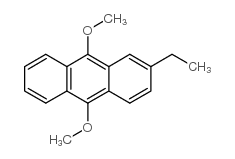
2-ETHYL-9,10-DIMETHOXYANTHRACENE structure
|
Common Name | 2-ETHYL-9,10-DIMETHOXYANTHRACENE | ||
|---|---|---|---|---|
| CAS Number | 26708-04-3 | Molecular Weight | 266.33400 | |
| Density | 1.116g/cm3 | Boiling Point | 435.2ºC at 760 mmHg | |
| Molecular Formula | C18H18O2 | Melting Point | 117-119ºC(lit.) | |
| MSDS | USA | Flash Point | 177.6ºC | |
| Symbol |


GHS08, GHS09 |
Signal Word | Danger | |
|
Application of a mathematical topological pattern of antihistaminic activity for the selection of new drug candidates and pharmacology assays.
J. Med. Chem. 49(12) , 3667-73, (2006) Molecular topology was used to achieve a mathematical model capable of classifying compounds according to their antihistaminic activity and low sedative effects. By application of this model of activity to databases containing chemical reagents and drugs exhi... |
|
|
Quantum yields lower than unity in photo- induced dissociative electron transfers: the reductive cleavage of carbon tetrachloride.
ChemPhysChem 1(4) , 199-205, (2000) It has been shown recently that the electrochemical reduction of carbon tetrachloride in N,N'-dimethylformamide follows a mechanism in which electron transfer and bond cleavage are concerted. We report here results concerning photoinduced electron transfer fr... |
|
|
Photocationic and radical polymerizations of epoxides and acrylates by novel sulfonium salts. Takahashi E, et al.
J. Polym. Sci. A Polym. Chem. 41(23) , 3816-27, (2003)
|
|
|
Photosensitized reduction of sulfonium salts: Evidence for nondissociative electron transfer. Wang X, et al.
J. Am. Chem. Soc. 121(8) , 4364-68, (1999)
|
|
|
Novel N-methylbenzothiazolium salts as hardeners for epoxy and acrylate monomers. Takahashi E, et al.
J. Polym. Sci. A Polym. Chem. 41(23) , 3828-37, (2003)
|
|
|
Anthracene electron-transfer photosensitizers for onium salt induced cationic photopolymerizations. Crivello JV and Jang M.
J. Photochem. Photobiol. A: Chem. 159(2) , 173-188, (2003)
|
|
|
Stepwise and concerted pathways in photoinduced and thermal electron-transfer/bond-breaking reactions. Experimental illustration of similarities and contrasts. Pause L, et al.
J. Am. Chem. Soc. 123(21) , 4886-4895, (2001)
|