3-(2-呋喃基)喹啉-2-甲醛
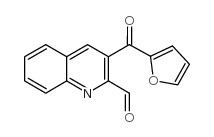
3-(2-呋喃基)喹啉-2-甲醛结构式

|
常用名 | 3-(2-呋喃基)喹啉-2-甲醛 | 英文名 | 3-(2-Furoyl)quinoline-2-carboxaldehyde |
|---|---|---|---|---|
| CAS号 | 126769-01-5 | 分子量 | 251.23700 | |
| 密度 | 1.326g/cm3 | 沸点 | 491.7ºC at 760mmHg | |
| 分子式 | C15H9NO3 | 熔点 | N/A | |
| MSDS | 中文版 美版 | 闪点 | 251.2ºC | |
| 符号 |

GHS07 |
信号词 | Warning |
|
A comparative study of LED-induced fluorescence and laser-induced fluorescence in SDS-CGE: application to the analysis of antibodies.
Electrophoresis 33(12) , 1709-14, (2012) LEDs present an alternative to lasers in LIF detection with CE, resulting in LED-induced fluorescence (LEDIF). LEDs are much less expensive, consume less energy and are more stable. In addition, LED light sources allow a greater range of wavelengths to better... |
|
|
Protein fingerprinting of Staphylococcus species by capillary electrophoresis with on-capillary derivatization and laser-induced fluorescence detection.
Anal. Chim. Acta 658(1) , 81-6, (2010) Capillary electrophoresis (CE) coupled with laser-induced fluorescence detection (LIF) has allowed to obtain protein fingerprints, which have demonstrated to be useful in microorganisms characterization. In this work, protein fingerprints of two species of St... |
|
|
Fluorescein thiocarbamyl amino acids as internal standards for migration time correction in capillary sieving electrophoresis.
J. Chromatogr. A. 1216(15) , 3418-20, (2009) A number of algorithms have been developed to correct for migration time drift in capillary electrophoresis. Those algorithms require identification of common components in each run. However, not all components may be present or resolved in separations of com... |
|
|
Picomolar analysis of proteins using electrophoretically mediated microanalysis and capillary electrophoresis with laser-induced fluorescence detection.
Anal. Chem. 70 , 4546, (1998) We report a method for the analysis of picomolar concentration proteins using electrophoretically mediated microanalysis (EMMA) to label proteins on-column with a fluorogenic reagent. Labeling is followed by capillary zone electrophoresis separation and postc... |
|
|
Sodium dodecyl sulfate-capillary electrophoresis of proteins in a sieving matrix utilizing two-spectral channel laser-induced fluorescence detection.
Electrophoresis 19 , 2175, (1998) We report a method for protein labeling, separation by capillary electrophoresis in a polymer sieving matrix, and detection by laser-induced fluorescence. Different dyes are used to label standard and sample proteins. A two-spectral channel detector resolves ... |
|
|
Labeling effects on the isoelectric point of green fluorescent protein.
J. Chromatogr. A. 853(1-2) , 21-5, (1999) We studied the effects of fluorescent labeling on the isoelectric points (pI values) of proteins using capillary isoelectric focusing with laser-induced fluorescence detection (cIEF-LIF). Specifically, we labeled green fluorescent protein (GFP) from the jelly... |
|
|
Solid-phase fluorescent labeling reaction of picomole amounts of insulin in very dilute solutions and their analysis by capillary electrophoresis.
Electrophoresis 16(4) , 534-40, (1995) The fluorescent labeling of peptides at concentrations as low as 10(-8) M can be achieved by using a solid-phase reactor. Using oxidized insulin chain B as a test peptide, we demonstrate the use of an Immobilon CD membrane to capture and preconcentrate peptid... |
|
|
Protein fingerprinting of Staphylococcus aureus by capillary electrophoresis with on-capillary derivatization and laser-induced fluorescence detection.
Methods Mol. Biol. 984 , 237-51, (2013) This chapter describes a complete procedure for obtaining protein fingerprints of microorganisms using capillary electrophoresis (CE) with laser-induced fluorescence detection (LIF). Staphylococcus aureus, a human pathogen responsible of frequent and resistan... |
|
|
Capillary electrophoresis with laser-induced fluorescence detection of proteins from two types of complex sample matrices: food and biological fluids.
Methods Mol. Biol. 984 , 207-25, (2013) Sample preparation and laser-induced fluorescence detection are two key steps of the analytical methodology to determine by capillary electrophoresis low concentrations of proteins in complex sample matrices. In this chapter the options of performing both ste... |
|
|
Application of 3-(2-furoyl)quinoline-2-carbaldehyde as a fluorogenic reagent for the analysis of primary amines by liquid chromatography with laser-induced fluorescence detection.
J. Chromatogr. A. 499 , 579-87, (1990) 3-(2-Furoyl)quinoline-2-carbaldehyde (FQCA) has been synthesized and characterized as a fluorogenic derivatizing reagent for liquid chromatography. The reagent forms highly fluorescent isoindoles upon reaction with primary amines. The spectral properties and ... |