Solid-phase fluorescent labeling reaction of picomole amounts of insulin in very dilute solutions and their analysis by capillary electrophoresis.
D M Pinto, E A Arriaga, S Sia, Z Li, N J Dovichi
文献索引:Electrophoresis 16(4) , 534-40, (1995)
全文:HTML全文
摘要
The fluorescent labeling of peptides at concentrations as low as 10(-8) M can be achieved by using a solid-phase reactor. Using oxidized insulin chain B as a test peptide, we demonstrate the use of an Immobilon CD membrane to capture and preconcentrate peptides. Insulin chain B can then be labeled with a fluorogenic reagent, 3-(2-furoyl)quinoline-2-carboxaldehyde, while it is still attached to the membrane. Unwanted fluorescent products (attributed to secondary reactions) can be washed away with methanol without significant removal of the labeled insulin chain B, which then can be extracted with a low pH buffer. The analysis by micellar electrokinetic capillary chromatography with post-column laser-induced fluorescence detection (mass limit of detection of 2.4 x 10(-21) moles insulin chain B) results in electropherograms that show great improvement in terms of unwanted peaks and high number of theoretical plates (up to 20 million). The use of the solid-phase reactor allows easy handling of as little as 5 picomoles of insulin chain B.
相关化合物
| 结构式 | 名称/CAS号 | 分子式 | 全部文献 |
|---|---|---|---|
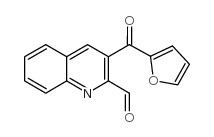 |
3-(2-呋喃基)喹啉-2-甲醛
CAS:126769-01-5 |
C15H9NO3 |
|
A comparative study of LED-induced fluorescence and laser-in...
2012-07-01 [Electrophoresis 33(12) , 1709-14, (2012)] |
|
Protein fingerprinting of Staphylococcus species by capillar...
2010-01-18 [Anal. Chim. Acta 658(1) , 81-6, (2010)] |
|
Fluorescein thiocarbamyl amino acids as internal standards f...
2009-04-10 [J. Chromatogr. A. 1216(15) , 3418-20, (2009)] |
|
Picomolar analysis of proteins using electrophoretically med...
1998-11-01 [Anal. Chem. 70 , 4546, (1998)] |
|
Sodium dodecyl sulfate-capillary electrophoresis of proteins...
1998-09-01 [Electrophoresis 19 , 2175, (1998)] |