N-(3- 氨丙基)甲基丙烯酰胺 盐酸盐
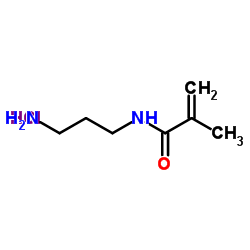
N-(3- 氨丙基)甲基丙烯酰胺 盐酸盐结构式

|
常用名 | N-(3- 氨丙基)甲基丙烯酰胺 盐酸盐 | 英文名 | N-(3-Aminopropyl)methacrylamide hydrochloride |
|---|---|---|---|---|
| CAS号 | 72607-53-5 | 分子量 | 178.660 | |
| 密度 | N/A | 沸点 | 311.4ºC at 760 mmHg | |
| 分子式 | C7H15ClN2O | 熔点 | 128 °C | |
| MSDS | 中文版 美版 | 闪点 | 142.1ºC | |
| 符号 |

GHS07 |
信号词 | Warning |
|
Immunogenicity of coiled-coil based drug-free macromolecular therapeutics
Biomaterials 35(22) , 5886-96, (2014) A two-component CD20 (non-internalizing) receptor crosslinking system based on the biorecognition of complementary coiled-coil forming peptides was evaluated. Exposure of B cells to Fab’-peptide1 conjugate decorates the cell surface with peptide1; further exp... |
|
|
Expression and function of connexin 43 in human gingival wound healing and fibroblasts.
PLoS ONE 10(1) , e0115524, (2015) Connexins (C×s) are a family of transmembrane proteins that form hemichannels and gap junctions (GJs) on the cell membranes, and transfer small signaling molecules between the cytoplasm and extracellular space and between connecting cells, respectively. Among... |
|
|
Near IR fluorescent conjugated poly(ethylene glycol)bisphosphonate nanoparticles for in vivo bone targeting in a young mouse model.
J. Nanobiotechnology 13 , 80, (2015) Bisphosphonate (BP) compounds are widely used in the treatment of bone disorders. This group of drugs with a high affinity to Ca(+2) ions is rapidly attracted to bone mineral, especially in areas of high resorption. We have engineered unique biodegradable BP ... |
|
|
The influence of linker length on the properties of cathepsin S cleavable177Lu-labeled HPMA copolymers for pancreatic cancer imaging
Biomaterials 35(22) , 5760-70, (2014) N-(2-hydroxypropyl)-methacrylamide (HPMA) copolymers have shown promise for application in the detection and staging of cancer. However, non-target accumulation, particularly in the liver and spleen, hinders the detection of resident or nearby metastatic lesi... |
|
|
Galactosylated 2-hydroxypropyl methacrylamide-s-3-guanidinopropyl methacrylamide copolymer as a small hairpin RNA carrier for inhibiting human telomerase reverse transcriptase expression.
J. Gene Med. 16(5-6) , 109-21, (2014) In the present study, a well-defined glucose and guanidine based copolymer, galactosylated 2-hydroxypropyl methacrylamide-s-3-guanidinopropyl methacrylamide (HPMA-s-GPMA) abbreviated as GGH was prepared and self-assembled with small hairpin RNA (shRNA) to inh... |
|
|
Glycated collagen decreased endothelial cell fibronectin alignment in response to cyclic stretch via interruption of actin alignment.
J. Biomech. Eng. 136(10) , 101010, (2014) Hyperglycemia is a defining characteristic of diabetes, and uncontrolled blood glucose in diabetes is associated with accelerated cardiovascular disease. Chronic hyperglycemia glycates extracellular matrix (ECM) collagen, which can lead to endothelial cell dy... |
|
|
Reduction of mouse atherosclerosis by urokinase inhibition or with a limited-spectrum matrix metalloproteinase inhibitor.
Cardiovasc. Res. 105(3) , 372-82, (2015) Elevated activity of urokinase plasminogen activator (uPA) and MMPs in human arteries is associated with accelerated atherosclerosis, aneurysms, and plaque rupture. We used Apoe-null mice with macrophage-specific uPA overexpression (SR-uPA mice; a well-charac... |
|
|
Lumican: a new inhibitor of matrix metalloproteinase-14 activity.
FEBS Lett. 588(23) , 4319-24, (2014) We previously showed that lumican regulates MMP-14 expression. The aim of this study was to compare the effect of lumican and decorin on MMP-14 activity. In contrast to decorin, the glycosylated form of lumican was able to significantly decrease MMP-14 activi... |
|
|
Plasminogen activation by staphylokinase enhances local spreading of S. aureus in skin infections.
BMC Microbiol. 14 , 310, (2015) Staphylococcus aureus (S. aureus) is a frequent cause of skin and soft tissue infections. A unique feature of S. aureus is the combined presence of coagulases that trigger fibrin formation and of the plasminogen activator staphylokinase (SAK). Whereas the imp... |
|
|
Correlations between Photodegradation of Bisretinoid Constituents of Retina and Dicarbonyl Adduct Deposition.
J. Biol. Chem. 290 , 27215-27, (2015) Non-enzymatic collagen cross-linking and carbonyl adduct deposition are features of Bruch's membrane aging in the eye, and disturbances in extracellular matrix turnover are considered to contribute to Bruch's membrane thickening. Because bisretinoid constitue... |