Nicotinamide
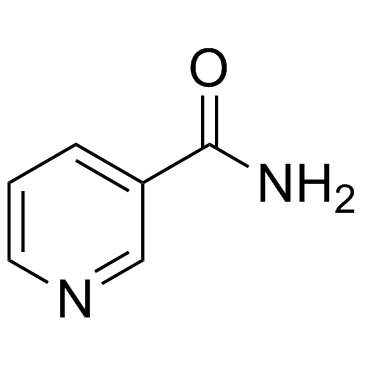
Nicotinamide structure
|
Common Name | Nicotinamide | ||
|---|---|---|---|---|
| CAS Number | 98-92-0 | Molecular Weight | 122.125 | |
| Density | 1.2±0.1 g/cm3 | Boiling Point | 257.7±32.0 °C at 760 mmHg | |
| Molecular Formula | C6H6N2O | Melting Point | 128-131 °C(lit.) | |
| MSDS | Chinese USA | Flash Point | 109.7±25.1 °C | |
| Symbol |

GHS07 |
Signal Word | Warning | |
Use of NicotinamideNicotinamide is a form of vitamin B3 that plays essential roles in cell physiology through facilitating NAD+ redox homeostasis and providing NAD+ as a substrate to a class of enzymes that catalyze non-redox reactions. Nicotinamide is an inhibitor of SIRT1. |
| Name | 3-Pyridinecarboxamide |
|---|---|
| Synonym | More Synonyms |
| Description | Nicotinamide is a form of vitamin B3 that plays essential roles in cell physiology through facilitating NAD+ redox homeostasis and providing NAD+ as a substrate to a class of enzymes that catalyze non-redox reactions. Nicotinamide is an inhibitor of SIRT1. |
|---|---|
| Related Catalog | |
| Target |
PARP-1 Human Endogenous Metabolite |
| In Vitro | Pretreatment with the poly (ADP-ribose) polymerase (PARP) inhibitor nicotinamide is able to prevent HCN2 cell death. When nicotinamide is added prior to t-BuOOH, it is able to prevent neuronal cell death and inhibit apoptosis. Nicotinamide-pretreated neurons have higher expression levels of inhibitors of apoptosis (IAP) genes[1]. Nicotinamide inhibits vasoconstriction by ET. Nicotinamide also alleviates oxidative stress, which exacerbates PE and FGR[3]. |
| In Vivo | Normal and streptozotocin-nicotinamide induced adult male diabetic rats receive quercetin (10, 25 and 50 mg/kg/bw) orally, and cause significant decrease in FBG and cardiac injury marker levels with increased in insulin levels[2]. Nicotinamide improves maternal hypertension, proteinuria, and glomerular endotheliosis in RUPP mice. Moreover, nicotinamide prolongs pregnancies, and improves survival and growth of the embryos in RUPP PE mice[3]. |
| Animal Admin | DM is induced via a single intraperitoneal (i.p) injection of nicotinamide (110 mg/kg/body weight) dissolved in normal saline 15 min prior to streptozotocin (STZ) (55 mg/kg/body weight) injection, which is dissolved in a freshly prepared 0.1mol/Lcitrate buffer (pH 4.5). These injections are given following an overnight fast. Control rats (n=6) are injected with the same amount of solvent. In order to prevent hypoglycemia in the first 24 h following STZ injection, rats are allowed to have free access to water with 5% dextrose (D5W). Three days after STZ-nicotinamide injection, rats with FBG levels greater than 7.0 mM are considered as diabetic. |
| References |
| Density | 1.2±0.1 g/cm3 |
|---|---|
| Boiling Point | 257.7±32.0 °C at 760 mmHg |
| Melting Point | 128-131 °C(lit.) |
| Molecular Formula | C6H6N2O |
| Molecular Weight | 122.125 |
| Flash Point | 109.7±25.1 °C |
| Exact Mass | 122.048012 |
| PSA | 55.98000 |
| LogP | -0.24 |
| Appearance of Characters | powder | white |
| Vapour Pressure | 0.0±0.6 mmHg at 25°C |
| Index of Refraction | 1.590 |
| InChIKey | DFPAKSUCGFBDDF-UHFFFAOYSA-N |
| SMILES | NC(=O)c1cccnc1 |
| Storage condition | 0-6°C |
| Stability | Stable. Incompatible with strong oxidizing agents. |
| Water Solubility | 1000 g/L (20 ºC) |
CHEMICAL IDENTIFICATION
HEALTH HAZARD DATAACUTE TOXICITY DATA
MUTATION DATA
|
| Symbol |
GHS07 |
|---|---|
| Signal Word | Warning |
| Hazard Statements | H315-H319-H335 |
| Precautionary Statements | P261-P305 + P351 + P338 |
| Personal Protective Equipment | dust mask type N95 (US);Eyeshields;Gloves |
| Hazard Codes | Xi |
| Risk Phrases | R36/37/38 |
| Safety Phrases | S26;S36 |
| RIDADR | NONH for all modes of transport |
| WGK Germany | 1 |
| RTECS | QS3675000 |
| HS Code | 2933399090 |
| HS Code | 2933399090 |
|---|---|
| Summary | 2933399090. other compounds containing an unfused pyridine ring (whether or not hydrogenated) in the structure. VAT:17.0%. Tax rebate rate:13.0%. . MFN tariff:6.5%. General tariff:20.0% |
|
Epigenetic reprogramming of the type III interferon response potentiates antiviral activity and suppresses tumor growth.
PLoS Biol. 12(1) , e1001758, (2014) Type III interferon (IFN-λ) exhibits potent antiviral activity similar to IFN-α/β, but in contrast to the ubiquitous expression of the IFN-α/β receptor, the IFN-λ receptor is restricted to cells of ep... |
|
|
Alisertib, an Aurora kinase A inhibitor, induces apoptosis and autophagy but inhibits epithelial to mesenchymal transition in human epithelial ovarian cancer cells.
Drug Des. Devel. Ther. 9 , 425-64, (2015) Ovarian cancer is a leading killer of women, and no cure for advanced ovarian cancer is available. Alisertib (ALS), a selective Aurora kinase A (AURKA) inhibitor, has shown potent anticancer effects, ... |
|
|
Functionalized tetrahydro-1H-pyrido[4,3-b]indoles: a novel chemotype with Sirtuin 2 inhibitory activity.
Eur. J. Med. Chem. 92 , 145-55, (2015) Sirtuins are protein deacylases with regulatory roles in metabolism and stress response. Functionalized tetrahydro-1H-pyrido[4,3-b]indoles were identified as preferential sirtuin 2 inhibitors, with in... |
| Niacinamide |
| MFCD00006395 |
| Nicotinic acid amide |
| Vitamin- B3 |
| Witamina PP |
| 3-Pyridinecarboxamide |
| Nicotinamide |
| Pyridine-3-carboxamide |
| T6NJ CVZ |
| Dipigyl |
| EINECS 202-713-4 |
| Vi-noctyl |
The content on this webpage is sourced from various professional data sources. If you have any questions or concerns regarding the content, please feel free to contact service1@chemsrc.com.
- Shanghai Nianxing Industrial Co., Ltd
- China
- Product Name: Nicotinamide
- Price: Check
- Purity: 98.0%
- Delivery: 10 Day
- Contact: Yang
- Email: sales@echemcloud.com
- Shanghai Jizhi Biochemical Technology Co., Ltd
- China
- Product Name: Nicotinamide
- Price: ¥88.0/50mg ¥138.0/500g
- Purity: 98.0%
- Delivery: Inquiry
- Contact: Liu jia


- Email: 2130147988@qq.com
- DC Chemicals Limited
- China
- Product Name: Nicotinamide
- Price: $280.0/20mg
- Purity: 98.0%
- Delivery: 3 Day
- Contact: Tony Cao
- Email: sales@dcchemicals.com
- Dayang Chem (Hangzhou) Co., Ltd.
- China
- Product Name: Nicotinamide
- Price: $Inquiry/100g $Inquiry/1kg $Inquiry/100kg $Inquiry/1000kg
- Purity: 98.0%
- Delivery: Inquiry
- Contact: Ms Wang
- Email: enquiry@dycnchem.com
- Henan Tianfu Chemical Co., Ltd.
- China
- Product Name: Nicotinamide
- Price: $Inquiry/1kg $Inquiry/25kg $Inquiry/1000kg $Inquiry/10ton
- Purity: 99.0%
- Delivery: Inquiry
- Contact: Anson
- Email: info@tianfuchem.com
Get all suppliers and price by the below link:
Reference only. check more Nicotinamide price