(+)-TUBOCURARINE CHLORIDE PENTAHYDRATE
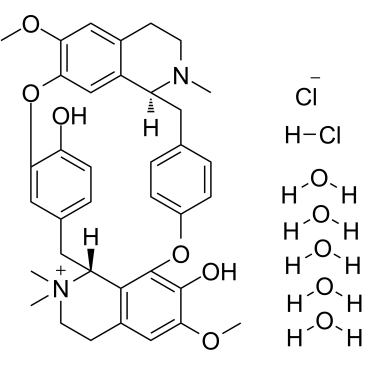
(+)-TUBOCURARINE CHLORIDE PENTAHYDRATE structure
|
Common Name | (+)-TUBOCURARINE CHLORIDE PENTAHYDRATE | ||
|---|---|---|---|---|
| CAS Number | 6989-98-6 | Molecular Weight | 771.72200 | |
| Density | 1.2074 (rough estimate) | Boiling Point | N/A | |
| Molecular Formula | C37H52Cl2N2O11 | Melting Point | 275-280ºC (dec.)(lit.) | |
| MSDS | Chinese USA | Flash Point | N/A | |
| Symbol |

GHS06 |
Signal Word | Danger | |
Use of (+)-TUBOCURARINE CHLORIDE PENTAHYDRATED-Tubocurarine chloride pentahydrate is the chloride salt form of Tubocurarine, a nicotinic acetylcholine receptors (AChR) antagonist, and can be used as a skeletal muscle relaxant during surgery or mechanical ventilation. D-Tubocurarine chloride pentahydrate is also a potent neuromuscular blocking agent[1][2][3]. |
| Name | Tubocurarine Chloride Pentahydrate |
|---|---|
| Synonym | More Synonyms |
| Description | D-Tubocurarine chloride pentahydrate is the chloride salt form of Tubocurarine, a nicotinic acetylcholine receptors (AChR) antagonist, and can be used as a skeletal muscle relaxant during surgery or mechanical ventilation. D-Tubocurarine chloride pentahydrate is also a potent neuromuscular blocking agent[1][2][3]. |
|---|---|
| Related Catalog | |
| In Vitro | Treatment of Caco-2 cells with the AChR antagonist Tubocurarine (10 µM) induces a disorganization of adherents junctions. Buffalo milk-derived products (MBCP) (18 µM) attenuates Tubocurarine AChR antagonist effects on Caco-2 cells adherens junctions[1]. |
| References |
| Density | 1.2074 (rough estimate) |
|---|---|
| Melting Point | 275-280ºC (dec.)(lit.) |
| Molecular Formula | C37H52Cl2N2O11 |
| Molecular Weight | 771.72200 |
| Exact Mass | 770.29500 |
| PSA | 126.77000 |
| LogP | 4.08220 |
| Index of Refraction | 193 ° (C=1, H2O) |
| Storage condition | 2-8°C |
| Water Solubility | H2O: soluble50 mg/ml, with heating as required, clear to slightly hazy, colorless to yellow | Soluble in water to 50mg/ml, with warming as needed. Also soluble in ethanol or methanol |
CHEMICAL IDENTIFICATION
HEALTH HAZARD DATAACUTE TOXICITY DATA
|
| Symbol |
GHS06 |
|---|---|
| Signal Word | Danger |
| Hazard Statements | H301 |
| Precautionary Statements | P301 + P310 |
| Personal Protective Equipment | Eyeshields;Faceshields;Gloves;type P2 (EN 143) respirator cartridges |
| Hazard Codes | T |
| Risk Phrases | R25 |
| Safety Phrases | S22;S45;S36/S37/S39 |
| RIDADR | UN 1544 6.1/PG 3 |
| WGK Germany | 3 |
| RTECS | YO5100000 |
| Packaging Group | III |
|
Acetylcholine induces Ca2+ signaling in chicken retinal pigmented epithelial cells during dedifferentiation.
Am. J. Physiol. Cell Physiol. 296 , C1195-206, (2009) Retinal pigmented epithelial cells exchange their cellular phenotypes into lens cells and neurons, via depigmented and non-epithelial-shaped dedifferentiated intermediates. Because these dedifferentia... |
|
|
Interaction of d-tubocurarine analogs with the mouse nicotinic acetylcholine receptor. Ligand orientation at the binding site.
J. Biol. Chem. 272 , 24891-24898, (1997) The binding of d-tubocurarine and several of its analogs to the mouse nicotinic acetylcholine receptor (AChR) was measured by competition against the initial rate 125I-alpha-bungarotoxin binding to BC... |
|
|
Acetylcholine receptor inhibition by d-tubocurarine involves both a competitive and a noncompetitive binding site as determined by stopped-flow measurements of receptor-controlled ion flux in membrane vesicles.
Biochemistry 25 , 1786, (1986) The issue of whether d-tubocurarine, the classical acetylcholine receptor inhibitor, inhibits the receptor by a competitive or noncompetitive mechanism has long been controversial. d-Tubocurarine, in ... |
| MFCD00150157 |
| (+)-tubocurarine chloride pentahydrate |