6-Gingerol
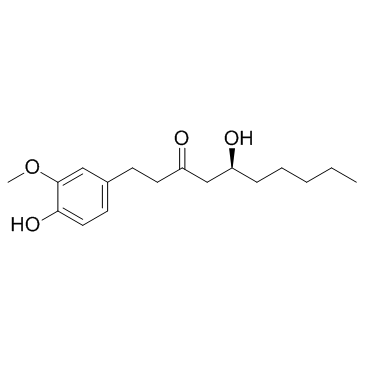
6-Gingerol structure
|
Common Name | 6-Gingerol | ||
|---|---|---|---|---|
| CAS Number | 23513-14-6 | Molecular Weight | 294.386 | |
| Density | 1.1±0.1 g/cm3 | Boiling Point | 453.0±35.0 °C at 760 mmHg | |
| Molecular Formula | C17H26O4 | Melting Point | 30 - 32ºC | |
| MSDS | Chinese USA | Flash Point | 159.0±19.4 °C | |
| Symbol |

GHS06 |
Signal Word | Danger | |
Use of 6-Gingerol[6]-Gingerol is an active compound isolated from Ginger (Zingiber officinale Rosc), exhibits a variety of biological activities including anticancer, anti-inflammation, and anti-oxidation. |
| Name | gingerol |
|---|---|
| Synonym | More Synonyms |
| Description | [6]-Gingerol is an active compound isolated from Ginger (Zingiber officinale Rosc), exhibits a variety of biological activities including anticancer, anti-inflammation, and anti-oxidation. |
|---|---|
| Related Catalog | |
| Target |
AMPK Apoptosis |
| In Vitro | [6]-gingerol inhibits colon cancer cell proliferation and induced apoptosis, while the normal colon cells are unaffected. [6]-gingerol down-regulates phorbol myristate acetate induced phosphorylation of ERK1/2 and JNK MAP kinases and activation of AP-1 transcription factor, but has only little effects on phosphorylation of p38 MAP kinase and activation of NF-kappa B[1]. [6]-gingerol treatment is shown to restore impaired intestinal barrier function and to suppress proinflammatory responses in DSS-treated Caco-2 monolayers. AMPK is activated on [6]-gingerol treatment[2]. Treatment with [6]-gingerol results in a significant decrease in the viability of osteosarcoma cells in a dose-dependent fashion. In parallel, the number of cells arrested at the sub-G1 cell cycle phase is significantly increased. [6]-gingerol induces activation of caspase cascades and regulates cellular levels of Bcl2 and Bax[3]. |
| In Vivo | In animal studies, [6]-gingerol significantly ameliorates DSS-induced colitis by restoration of body weight loss, reduction in intestinal bleeding, and prevention of colon length shortening. In addition, [6]-gingerol suppresses DSS-elevated production of proinflammatory cytokines (IL-1β, TNFα, and IL-12)[2]. |
| Cell Assay | [6]-gingerol stock (20 mg/mL) is prepared in ethanol and the working concentrations are prepared by diluting this stock in dimethyl sufoxide (DMSO). For MTT assay, 5×10³ cells/well of human colon cancer cells and 104 cells/well of mouse IECs are seeded in 96-well plates. Cells are treated with [6]-gingerol for 48 h,72 h or 96 h before performing MTT assay and for 16 h before Annexin-V staining[1]. |
| Animal Admin | Mice: Mice with DSS-induced colitis are given different oral dosages of [6]-gingerol daily for 14 days. Body weight and colon inflammation are evaluated, and level of proinflammatory cytokines in colon tissues is measured[2]. |
| References |
| Density | 1.1±0.1 g/cm3 |
|---|---|
| Boiling Point | 453.0±35.0 °C at 760 mmHg |
| Melting Point | 30 - 32ºC |
| Molecular Formula | C17H26O4 |
| Molecular Weight | 294.386 |
| Flash Point | 159.0±19.4 °C |
| Exact Mass | 294.183105 |
| PSA | 66.76000 |
| LogP | 2.48 |
| Vapour Pressure | 0.0±1.2 mmHg at 25°C |
| Index of Refraction | 1.523 |
| InChIKey | NLDDIKRKFXEWBK-AWEZNQCLSA-N |
| SMILES | CCCCCC(O)CC(=O)CCc1ccc(O)c(OC)c1 |
| Storage condition | ?20°C |
CHEMICAL IDENTIFICATION
HEALTH HAZARD DATAACUTE TOXICITY DATA
MUTATION DATA
|
| Symbol |
GHS06 |
|---|---|
| Signal Word | Danger |
| Hazard Statements | H301-H315-H319-H335 |
| Precautionary Statements | P261-P301 + P310-P305 + P351 + P338 |
| Personal Protective Equipment | dust mask type N95 (US);Eyeshields;Faceshields;Gloves |
| Hazard Codes | Xi |
| Risk Phrases | R36/37/38:Irritating to eyes, respiratory system and skin . |
| Safety Phrases | S26-S36 |
| RIDADR | UN 2811 6.1 / PGIII |
| RTECS | HE0757000 |
| HS Code | 2914509090 |
| HS Code | 2914509090 |
|---|---|
| Summary | HS:2914509090 other ketones with other oxygen function VAT:17.0% Tax rebate rate:9.0% Supervision conditions:none MFN tariff:5.5% General tariff:30.0% |
|
Acute toxicity and genotoxicity study of fermented traditional herb formula Guibi-tang.
J. Ethnopharmacol. 156 , 182-9, (2014) Guibi-tang (Guipi-tang in Chinese and Kihi-to in Japanese) is a multi-herb traditional medicine commonly prescribed to treat psychoneurosis in East Asia. Although this medicine has been widely used, t... |
|
|
Integrated LC-MS/MS Analytical Systems and Physical Inspection for the Analysis of a Botanical Herbal Preparation.
Molecules 20 , 10641-56, (2015) The herbal decoction process is generally inconvenient and unpleasant. To avoid using herbal medicine decoctions, various high-quality industrial and pharmaceutical herbal decoction products have been... |
|
|
6-Shogaol enhances renal carcinoma Caki cells to TRAIL-induced apoptosis through reactive oxygen species-mediated cytochrome c release and down-regulation of c-FLIP(L) expression.
Chem. Biol. Interact. 228 , 69-78, (2015) 6-Shogaol, a potent bioactive compound in ginger (Zingiber officinale Roscoe), has been reported for anti-inflammatory and anti-cancer activity. In this study, we investigated the effect of 6-shogaol ... |
| 3-Decanone, 5-hydroxy-1-(4-hydroxy-3-methoxyphenyl)-, (S)-(+)- |
| (S)-5-Hydroxy-1-(4-hydroxy-3-methoxyphenyl)decan-3-one |
| 3-Decanone (5-hydroxy-1-(4-hydroxy-3-methoxyphenyl) |
| (+)-Gingerol |
| (S)-[6]Gingerol |
| (S)-5-Hydroxy-1-(4-hydroxy-3-methoxyphenyl)-3-decanone |
| 3-Decanone, 5-hydroxy-1-(4-hydroxy-3-methoxyphenyl)-, (S)- |
| 3-Decanone, 5-hydroxy-1-(4-hydroxy-3-methoxyphenyl)-, (5S)- |
| (+)-5-Hydroxy-1-(4-hydroxy-3-methoxyphenyl)-3-decanone |
| (S)-(+)-[6]Gingerol |
| (+)-[6]-Gingerol |
| 6-Gingerol |
| (S)-(6)-Gingerol |
| (5S)-5-Hydroxy-1-(4-hydroxy-3-methoxy-phenyl)decan-3-one |
| Gingerol |
| UNII-925QK2Z900 |
| (5S)-5-Hydroxy-1-(4-hydroxy-3-methoxyphenyl)-3-decanone |
| (5S)-5-Hydroxy-1-(4-hydroxy-3-methoxyphenyl)decan-3-one |
| MFCD00210507 |
| [6]-Gingerol |
The content on this webpage is sourced from various professional data sources. If you have any questions or concerns regarding the content, please feel free to contact service1@chemsrc.com.
- Shanghai Nianxing Industrial Co., Ltd
- China
- Product Name: 6-Gingerol
- Price: Check
- Purity: 98.0%
- Delivery: 10 Day
- Contact: Yang
- Email: sales@echemcloud.com
- Shanghai Jizhi Biochemical Technology Co., Ltd
- China
- Product Name: 6-Gingerol
- Price: ¥778.0/20mg
- Purity: 98.0%
- Delivery: Inquiry
- Contact: Liu jia


- Email: 2130147988@qq.com
- DC Chemicals Limited
- China
- Product Name: 6-Gingerol
- Price: $280.0/20mg
- Purity: 98.0%
- Delivery: 3 Day
- Contact: Tony Cao
- Email: sales@dcchemicals.com
- Dayang Chem (Hangzhou) Co., Ltd.
- China
- Product Name: 6-Gingerol
- Price: $Inquiry/100g $Inquiry/1kg $Inquiry/100kg $Inquiry/1000kg
- Purity: 98.0%
- Delivery: Inquiry
- Contact: Ms Wang
- Email: enquiry@dycnchem.com
- Shanghai Amole Biotechnology Co., Ltd.
- China
- Product Name: 6-Gingerol
- Price: ¥Inquiry/100mg ¥Inquiry/10mg ¥Inquiry/1g ¥Inquiry/1mg
- Purity: 98.0%
- Delivery: Inquiry
- Contact: Xiyao Wang
- Email: 3623107365@qq.com
- Henan Tianfu Chemical Co., Ltd.
- China
- Product Name: [6]-Gingerol
- Price: $Inquiry/1kg $Inquiry/25kg $Inquiry/1000kg $Inquiry/10ton
- Purity: 99.0%
- Delivery: Inquiry
- Contact: Anson
- Email: info@tianfuchem.com
Get all suppliers and price by the below link:
Reference only. check more 6-Gingerol price