Alitretinoin
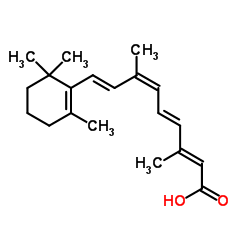
Alitretinoin structure
|
Common Name | Alitretinoin | ||
|---|---|---|---|---|
| CAS Number | 5300-03-8 | Molecular Weight | 300.435 | |
| Density | 1.0±0.1 g/cm3 | Boiling Point | 462.8±14.0 °C at 760 mmHg | |
| Molecular Formula | C20H28O2 | Melting Point | 189-191ºC | |
| MSDS | Chinese USA | Flash Point | 350.6±11.0 °C | |
| Symbol |


GHS07, GHS08 |
Signal Word | Danger | |
|
Modulators of hepatic lipoprotein metabolism identified in a search for small-molecule inducers of tribbles pseudokinase 1 expression.
PLoS ONE 10 , e0120295, (2015) Recent genome wide association studies have linked tribbles pseudokinase 1 (TRIB1) to the risk of coronary artery disease (CAD). Based on the observations that increased expression of TRIB1 reduces secretion of VLDL and is associated with lower plasma levels ... |
|
|
Cheminformatics analysis of assertions mined from literature that describe drug-induced liver injury in different species.
Chem. Res. Toxicol. 23 , 171-83, (2010) Drug-induced liver injury is one of the main causes of drug attrition. The ability to predict the liver effects of drug candidates from their chemical structures is critical to help guide experimental drug discovery projects toward safer medicines. In this st... |
|
|
Developmental regulation and induction of cytochrome P450 2W1, an enzyme expressed in colon tumors.
PLoS ONE 10(4) , e0122820, (2015) Cytochrome P450 2W1 (CYP2W1) is expressed predominantly in colorectal and also in hepatic tumors, whereas the levels are insignificant in the corresponding normal human adult tissues. CYP2W1 has been proposed as an attractive target for colorectal cancer (CRC... |
|
|
A temporal gate for viral enhancers to co-opt Toll-like-receptor transcriptional activation pathways upon acute infection.
PLoS Pathog. 11 , e1004737, (2015) Viral engagement with macrophages activates Toll-Like-Receptors (TLRs) and viruses must contend with the ensuing inflammatory responses to successfully complete their replication cycle. To date, known counter-strategies involve the use of viral-encoded protei... |
|
|
Three-dimensional co-culture of hepatic progenitor cells and mesenchymal stem cells in vitro and in vivo.
Microsc. Res. Tech. 78 , 688-96, (2015) Here we co-cultured hepatic progenitor cells (HPCs) and mesenchymal stem cells (MSCs) to investigate whether the co-culture environments could increase hepatocytes form.Three-dimensional (3D) co-culture model of HPCs and MSCs was developed and morphological f... |
|
|
Self-assembled polymeric nanocarriers for the targeted delivery of retinoic acid to the hair follicle.
Nanoscale 7 , 18651-62, (2015) Acne vulgaris is a highly prevalent dermatological disease of the pilosebaceous unit (PSU). An inability to target drug delivery to the PSU results in poor treatment efficacy and the incidence of local side-effects. Cutaneous application of nanoparticulate sy... |
|
|
Polyunsaturated Branched-Chain Fatty Acid Geranylgeranoic Acid Induces Unfolded Protein Response in Human Hepatoma Cells.
PLoS ONE 10 , e0132761, (2015) The acyclic diterpenoid acid geranylgeranoic acid (GGA) has been reported to induce autophagic cell death in several human hepatoma-derived cell lines; however, the molecular mechanism for this remains unknown. In the present study, several diterpenoids were ... |
|
|
CINPA1 is an inhibitor of constitutive androstane receptor that does not activate pregnane X receptor.
Mol. Pharmacol. 87(5) , 878-89, (2015) Constitutive androstane receptor (CAR) and pregnane X receptor (PXR) are xenobiotic sensors that enhance the detoxification and elimination of xenobiotics and endobiotics by modulating the expression of genes encoding drug-metabolizing enzymes and transporter... |
|
|
Amiodarone and bepridil inhibit anthrax toxin entry into host cells.
Antimicrob. Agents Chemother. 51 , 2403-11, (2007) Anthrax lethal toxin is one of the fundamental components believed to be responsible for the virulence of Bacillus anthracis. In order to find novel compounds with anti-lethal toxin properties, we used a cell-based assay to screen a collection of approximatel... |
|
|
Retinoic Acid Signaling Regulates Differential Expression of the Tandemly-Duplicated Long Wavelength-Sensitive Cone Opsin Genes in Zebrafish.
PLoS Genet. 11 , e1005483, (2015) The signaling molecule retinoic acid (RA) regulates rod and cone photoreceptor fate, differentiation, and survival. Here we elucidate the role of RA in differential regulation of the tandemly-duplicated long wavelength-sensitive (LWS) cone opsin genes. Zebraf... |