(R)-CR8
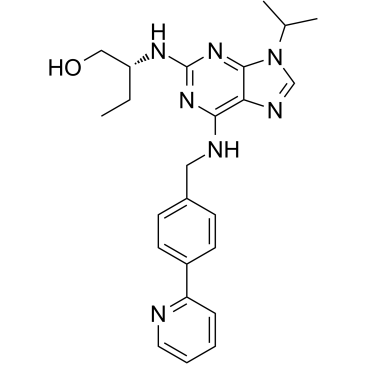
(R)-CR8 structure
|
Common Name | (R)-CR8 | ||
|---|---|---|---|---|
| CAS Number | 294646-77-8 | Molecular Weight | 431.533 | |
| Density | 1.3±0.1 g/cm3 | Boiling Point | 671.4±65.0 °C at 760 mmHg | |
| Molecular Formula | C24H29N7O | Melting Point | N/A | |
| MSDS | USA | Flash Point | 359.8±34.3 °C | |
| Symbol |

GHS07 |
Signal Word | Warning | |
|
Natural product extracts of the Canadian prairie plant, Thermopsis rhombifolia, have anti-cancer activity in phenotypic cell-based assays.
Nat. Prod. Res. 29 , 1026-34, (2015) Many plant species within the terrestrial ecological zones of Canada have not yet been investigated for anti-cancer activity. We examined the scientific literature describing the endemic flora from the prairie ecological zone and selected the species, Thermop... |
|
|
Substitutions in the Escherichia coli RNA polymerase inhibitor T7 Gp2 that allow inhibition of transcription when the primary interaction interface between Gp2 and RNA polymerase becomes compromised.
Microbiology 158 , 2753-64, (2012) The Escherichia coli-infecting bacteriophage T7 encodes a 7 kDa protein, called Gp2, which is a potent inhibitor of the host RNA polymerase (RNAp). Gp2 is essential for T7 phage development. The interaction site for Gp2 on the E. coli RNAp is the β' jaw domai... |
|
|
Delayed expression of cell cycle proteins contributes to astroglial scar formation and chronic inflammation after rat spinal cord contusion.
J. Neuroinflammation 9 , 169, (2012) Traumatic spinal cord injury (SCI) induces secondary tissue damage that is associated with astrogliosis and inflammation. We previously reported that acute upregulation of a cluster of cell-cycle-related genes contributes to post-mitotic cell death and second... |
|
|
Inhibition of E2F1/CDK1 pathway attenuates neuronal apoptosis in vitro and confers neuroprotection after spinal cord injury in vivo.
PLoS ONE 7 , e42129, (2012) Apoptosis of post-mitotic neurons plays a significant role in secondary tissue damage following traumatic spinal cord injury (SCI). Activation of E2F1-dependent transcription promotes expression of pro-apoptotic factors, including CDK1; this signal transducti... |