METHIOCARB
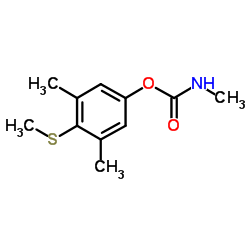
METHIOCARB structure
|
Common Name | METHIOCARB | ||
|---|---|---|---|---|
| CAS Number | 2032-65-7 | Molecular Weight | 225.307 | |
| Density | 1.1±0.1 g/cm3 | Boiling Point | 341.3±52.0 °C at 760 mmHg | |
| Molecular Formula | C11H15NO2S | Melting Point | 119°C | |
| MSDS | Chinese USA | Flash Point | 160.2±30.7 °C | |
| Symbol |


GHS06, GHS09 |
Signal Word | Danger | |
|
Determination of pesticides in soy-based infant formula using liquid chromatography with electrospray ionization tandem mass spectrometry.
J. AOAC Int. 89(1) , 214-24, (2006) A sensitive method using liquid chromatography with electrospray ionization tandem mass spectrometry (LC/ESI-MS/MS) was developed and validated to quantify and confirm 13 pesticides, including aldicarb sulfoxide, aldicarb sulfone, oxamyl, methomyl, formetanat... |
|
|
Relationship between esterase activity and acrinathrin and methiocarb resistance in field populations of western flower thrips, Frankliniella occidentalis.
Pest Manag. Sci. 62(12) , 1129-37, (2006) The western flower thrips, Frankliniella occidentalis (Pergande), is a serious pest in the south-east of Spain owing to its direct feeding on crops, transmission of the tomato spotted wilt virus and its very high level of resistance to insecticides. Mechanism... |
|
|
Esterase isoenzymes and insecticide resistance in Frankliniella occidentalis populations from the south-east region of Spain.
Pest Manag. Sci. 64(12) , 1258-66, (2008) Frankliniella occidentalis (Pergande) is among the most important crop pests in the south-east region of Spain; its increasing resistance to insecticides constitutes a serious problem, and understanding the mechanisms involved is therefore of great interest. ... |
|
|
Esterase inhibition by synergists in the western flower thrips Frankliniella occidentalis.
Pest Manag. Sci. 67(12) , 1549-56, (2011) Western flower thrips (WFT), Frankliniella occidentalis (Pergande), is among the most important crop pests in the south-eastern region of Spain. Its increasing resistance to insecticides constitutes a serious problem, and understanding the mechanisms involved... |
|
|
Life-stage variation in insecticide resistance of the western flower thrips (Thysanoptera: Thripidae).
J. Econ. Entomol. 103(6) , 2164-8, (2010) The life-stage variations in insecticide resistance of western flower thrips, Frankliniella occidentalis (Pergande) (Thysanoptera: Thripidae), to selective insecticides (acrinathrin, formetanate, and methiocarb) were studied using resistant laboratory strains... |
|
|
Impact of production system on development of insecticide resistance in Frankliniella occidentalis (Thysanoptera: Thripidae).
J. Econ. Entomol. 101(5) , 1685-90, (2008) The western flower thrips, Frankliniella occidentalis (Pergande) (Thysanoptera: Thripidae), has become one of the most difficult insects to control in the intensive agriculture of southeastern Spain. However, resistance problems are quite different in two nei... |
|
|
Ultra-high performance liquid chromatography-quadrupole time-of-flight mass spectrometry to identify contaminants in water: an insight on environmental forensics.
J. Chromatogr. A. 1345 , 86-97, (2014) Ultra-high pressure liquid chromatography-quadrupole time-of-flight mass spectrometry (UHPLC-QqTOF-MS) acquiring full scan MS data for quantification, and automatic data dependent information product ion spectra (IDA-MS/MS) without any predefinition of the io... |
|
|
Mining biologically-active molecules for inhibitors of fatty acid amide hydrolase (FAAH): Identification of phenmedipham and amperozide as FAAH inhibitors
Bioorg. Med. Chem. Lett. 19 , 6793-6, (2009) The screening of known medicinal agents against new biological targets has been shown to be a valuable approach for revealing new pharmacology of marketed compounds. Recently, carbamate, urea and ketone inhibitors of fatty acid amide hydrolase (FAAH) have bee... |
|
|
Histopathology of rainbow trout exposed to sublethal concentrations of methiocarb or endosulfan.
Toxicol. Pathol. 35(3) , 405-10, (2007) Liver, spleen, trunk kidney, gills, and brain of rainbow trout (Oncorhynchus mykiss) were examined histologically after exposure to different concentrations of methiocarb (2.5 and 3.75 mg/L) or endosulfan (0.6 and 1.3 micro g/L) for 21 days. Histological reco... |
|
|
Screening and evaluation of fruit samples for four pesticide residues.
J. AOAC Int. 88(3) , 847-53, (2005) The occurrence of 4 pesticide residues, imidacloprid, carbendazim, methiocarb, and hexythiazox, was assessed in several fruits (oranges, tangerines, watermelons, and date plums) from the Valencian Community (Spain). A total of 227 samples--56 oranges, 134 tan... |