3-acetylpyridine adenine dinucleotide
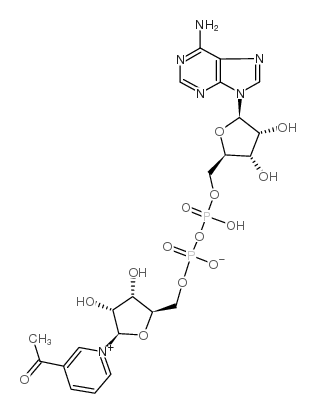
3-acetylpyridine adenine dinucleotide structure
|
Common Name | 3-acetylpyridine adenine dinucleotide | ||
|---|---|---|---|---|
| CAS Number | 86-08-8 | Molecular Weight | 662.44 | |
| Density | N/A | Boiling Point | N/A | |
| Molecular Formula | C22H28N6O14P2 | Melting Point | N/A | |
| MSDS | USA | Flash Point | N/A | |
| Symbol |

GHS07 |
Signal Word | Warning | |
|
Investigation of NADH binding, hydride transfer, and NAD(+) dissociation during NADH oxidation by mitochondrial complex I using modified nicotinamide nucleotides.
Biochemistry 52(23) , 4048-55, (2013) NADH:ubiquinone oxidoreductase (complex I) is a complicated respiratory enzyme that conserves the energy from NADH oxidation, coupled to ubiquinone reduction, as a proton motive force across the mitochondrial inner membrane. During catalysis, NADH oxidation b... |
|
|
Nowhere to hide: interrogating different metabolic parameters of Plasmodium falciparum gametocytes in a transmission blocking drug discovery pipeline towards malaria elimination.
Malaria Journal 14 , 213, (2015) The discovery of malaria transmission-blocking compounds is seen as key to malaria elimination strategies and gametocyte-screening platforms are critical filters to identify active molecules. However, unlike asexual parasite assays measuring parasite prolifer... |
|
|
A combination of new screening assays for prioritization of transmission-blocking antimalarials reveals distinct dynamics of marketed and experimental drugs.
J. Antimicrob. Chemother. 70 , 1357-66, (2015) The development of drugs to reduce malaria transmission is an important part of malaria eradication plans. We set out to develop and validate a combination of new screening assays for prioritization of transmission-blocking molecules.We developed high-through... |
|
|
Transhydrogenation reactions catalyzed by mitochondrial NADH-ubiquinone oxidoreductase (Complex I).
Biochemistry 46(49) , 14250-8, (2007) NADH-ubiquinone oxidoreductase (complex I) is the first enzyme of the respiratory electron transport chain in mitochondria. It conserves the energy from NADH oxidation, coupled to ubiquinone reduction, as a proton motive force across the inner membrane. Compl... |
|
|
Protein engineering tests of a homology model of Plasmodium falciparum lactate dehydrogenase.
Protein Eng. 10(1) , 39-44, (1997) This paper describes the testing of a homology model of Plasmodium falciparum lactate dehydrogenase (pfLDH) by protein engineering. The model had been validated in structural terms. It suggests explanations of the unusual properties of pfLDH (compared with al... |
|
|
The pH dependences of reactions catalyzed by the complete proton-translocating transhydrogenase from Rhodospirillum rubrum, and by the complex formed from its recombinant nucleotide-binding domains.
Biochim. Biophys. Acta 1322(1) , 19-32, (1997) Transhydrogenase couples the translocation of protons across a membrane to the transfer of reducing equivalents between NAD(H) and NADP(H). Using transhydrogenase from Rhodospirillum rubrum we have examined the pH dependences of the 'forward' and 'reverse' re... |
|
|
Mutations at tyrosine-235 in the mobile loop region of domain I protein of transhydrogenase from Rhodospirillum rubrum strongly inhibit hydride transfer.
Biochim. Biophys. Acta 1320(3) , 265-74, (1997) Transhydrogenase from mitochondrial and bacterial membranes couples proton translocation to hydride transfer between NAD(H) and NADP(H). The enzyme has three domains, of which domains I and III protrude from the membrane. These possess the NAD(H)- and NADP(H)... |
|
|
Artificial electron carriers for photoenzymatic synthesis under visible light.
Chemistry 18(18) , 5490-5, (2012) NAD analogues can be employed as artificial electron carriers for photoenzymatic synthesis under visible light. Four different NAD analogues that have a 3-substituted pyridine ring have been investigated. 3-Acetylpyridine adenine dinucleotide and 3-pyridineal... |
|
|
Structure of lactate dehydrogenase from Plasmodium vivax: complexes with NADH and APADH.
Biochemistry 44(49) , 16221-8, (2005) Malaria caused by Plasmodium vivax is a major cause of global morbidity and, in rare cases, mortality. Lactate dehydrogenase is an essential Plasmodium protein and, therefore, a potential antimalarial drug target. Ideally, drugs directed against this target w... |
|
|
Structure of Toxoplasma gondii LDH1: active-site differences from human lactate dehydrogenases and the structural basis for efficient APAD+ use.
Biochemistry 43(4) , 879-89, (2004) While within a human host the opportunistic pathogen Toxoplasma gondii relies heavily on glycolysis for its energy needs. Lactate dehydrogenase (LDH), the terminal enzyme in anaerobic glycolysis necessary for NAD(+) regeneration, therefore represents an attra... |