CYCLOHEXYL METHYLPHOSPHONIC ACID
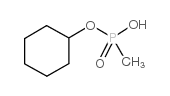
CYCLOHEXYL METHYLPHOSPHONIC ACID structure
|
Common Name | CYCLOHEXYL METHYLPHOSPHONIC ACID | ||
|---|---|---|---|---|
| CAS Number | 1932-60-1 | Molecular Weight | 178.16600 | |
| Density | 1.13g/cm3 | Boiling Point | 274ºC at 760mmHg | |
| Molecular Formula | C7H15O3P | Melting Point | N/A | |
| MSDS | N/A | Flash Point | 119.5ºC | |
| Symbol |


GHS02, GHS06, GHS08 |
Signal Word | Danger | |
|
Electro membrane isolation of nerve agent degradation products across a supported liquid membrane followed by capillary electrophoresis with contactless conductivity detection.
J. Chromatogr. A. 1214(1-2) , 17-22, (2008) In the present study, electro membrane isolation (EMI) of four nerve agent degradation products has been successfully explored. In the procedure, a polypropylene sheet membrane folded into an envelope with an open end with its wall pores impregnated with 1-oc... |
|
|
Ion-pair liquid-liquid-liquid microextraction of nerve agent degradation products followed by capillary electrophoresis with contactless conductivity detection.
J. Chromatogr. A. 1205(1-2) , 158-62, (2008) The four nerve agent degradation products methylphosphonic acid (MPA), ethyl methylphosphonic acid (EMPA), isopropyl methylphosphonic acid (IMPA) and cyclohexyl methylphosphonic acid (CMPA) have been successfully extracted from aqueous sample solution by ion-... |
|
|
Determination of nerve agent degradation products by capillary electrophoresis using field-amplified sample stacking injection with the electroosmotic flow pump and contactless conductivity detection.
J. Chromatogr. A. 1216(31) , 5911-6, (2009) In the present study, field-amplified sample stacking injection using the electroosmotic flow pump (FAEP) was developed for the capillary electrophoretic separation of the four nerve agent degradation products methylphosphonic acid (MPA), ethyl methylphosphon... |
|
|
Detection of metabolites of toxic alkylmethylphosphonates in biological samples.
Biol. Mass Spectrom. 20(11) , 717-23, (1991) The major metabolites and breakdown products of some toxic organophosphonates are their respective alkymethylphosphonic acids. These acids ionize at physiological pH and are not amenable to gas chromatographic analysis in their underivatized forms. Their dete... |
|
|
Derivatization of organophosphorus nerve agent degradation products for gas chromatography with ICPMS and TOF-MS detection.
Anal. Bioanal. Chem 388(4) , 809-23, (2007) Separation and detection of seven V-type (venomous) and G-type (German) organophosphorus nerve agent degradation products by gas chromatography with inductively coupled plasma mass spectrometry (GC-ICPMS) is described. The nonvolatile alkyl phosphonic acid de... |
|
|
Quantification of sarin and cyclosarin metabolites isopropyl methylphosphonic acid and cyclohexyl methylphosphonic acid in minipig plasma using isotope-dilution and liquid chromatography- time-of-flight mass spectrometry.
J. Anal. Toxicol. 32(1) , 78-85, (2008) An analysis method for determining isopropyl methylphosphonic acid (IMPA) and cyclohexyl methylphosphonic acid (CMPA), the metabolic hydrolysis products of toxic organophosphorus nerve agents isopropyl methylphosphonofluoridate (sarin, GB) and cyclohexyl meth... |
|
|
Elimination pathways of cyclosarin (GF) mediated by β-cyclodextrin in vitro: pharmacokinetic and toxicokinetic aspects.
Toxicol. Lett. 222(2) , 164-70, (2013) Cyclodextrins (CD) are promising small molecular scavengers showing favourable degradation of extremely toxic organophosphorus compounds (OP) such as tabun (GA), soman (GD) or cyclosarin (GF). For β-CD derivatives as potential OP antidotes with low intrinsic ... |
|
|
In vitro toxicokinetic studies of cyclosarin: molecular mechanisms of elimination.
Toxicol. Lett. 227(1) , 1-11, (2014) The toxicokinetics of in vitro elimination of highly toxic cyclosarin (GF) in biological systems revealed striking stereoselective differences in the range of 0.01μM to 1mM GF. While weak concentration dependency was detected for elimination of the toxic (-)-... |
|
|
Interaction of alpha-melanocyte stimulating hormone with binary phospholipid membranes: structural changes and relevance of phase behavior.
Biophys. J. 80(5) , 2273-83, (2001) The interaction of alpha-melanocyte stimulating hormone (alpha-MSH) with negatively charged binary membrane systems composed of either 1,2-dimyristoyl-sn-glycero-3-phosphocholine/1,2-dimyristoyl-sn-glycero-3-[phospho-rac-(1-glycerol)], (DMPC/DMPG) or DMPC/1,2... |