benedict's reagent for the qualitative
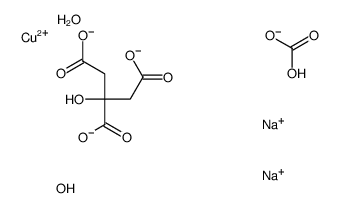
benedict's reagent for the qualitative structure
|
Common Name | benedict's reagent for the qualitative | ||
|---|---|---|---|---|
| CAS Number | 63126-89-6 | Molecular Weight | 475.73600 | |
| Density | 1.195 g/cm3 | Boiling Point | 309.6ºC at 760 mmHg | |
| Molecular Formula | C7H10CuNa2O15S | Melting Point | N/A | |
| MSDS | USA | Flash Point | 155.2ºC | |
| Symbol |


GHS07, GHS09 |
Signal Word | Warning | |
|
Home monitoring of diabetes mellitus--a quiet revolution.
Clin. Lab. Med. 6(2) , 215-39, (1986) Home monitoring of capillary blood glucose concentrations has changed diabetes care, giving physicians and patients a way to adjust their therapy and achieve better diabetic control. The practical strategies and equipment for home diabetic monitoring are disc... |
|
|
Fatal accidental ingestion of Clinitest in adult.
J. R. Soc. Med. 77(11) , 963-5, (1984)
|
|
|
Dry chemistry: its expanded role in doctor's office testing.
Clin. Lab. Med. 6(2) , 267-71, (1986) The physician's office laboratory is an important adjunct to quality patient care. Dry chemistry reagents and the instrumentation used with them provide an ideal mechanism to give the patient a timely, relatively inexpensive work-up. An office laboratory can ... |
|
|
Problems in hemodialysis.
N. Engl. J. Med. 306(25) , 1550, (1982)
|
|
|
Dangers of Clinitest ingestion.
J. R. Soc. Med. 78(3) , 271, (1985)
|
|
|
Response to a third-party evaluation of Clinitest® hCG sensitivity to various isoforms of human chorionic gonadotropin.
Expert Rev. Mol. Diagn. 11(2) , 131-2, (2011)
|
|
|
Lactose intolerance in infants: harder to investigate now following discontinuation of Clinitest.
Arch. Dis. Child. 96(6) , 611, (2011)
|
|
|
Enzyme-free amperometric sensing of hydrogen peroxide and glucose at a hierarchical Cu2O modified electrode.
Talanta 85(3) , 1260-4, (2011) In this paper, an enzyme-free amperometric electrochemical sensor was fabricated by casting Nafion-impregnated Cu(2)O particles onto a glassy carbon electrode. A dual dependence of peak current on sweeping rate, which can be attributed for the accumulation of... |
|
|
Phytoalexin synthesis by the sorghum mesocotyl in response to infection by pathogenic and nonpathogenic fungi.
Proc. Natl. Acad. Sci. U. S. A. 84(16) , 5520-4, (1987) Infection of the sorghum mesocotyl by Helminthosporium maydis (a nonpathogen) and Colletotrichum graminicola (a pathogen) resulted in the rapid accumulation of a pigment complex by two sorghum cultivars. The components of the complex were fungitoxic. The prin... |
|
|
R.L. Shriner, et al.
Systematic Identification of Organic Compounds 6th ed., New York , (1980)
|