Antipain
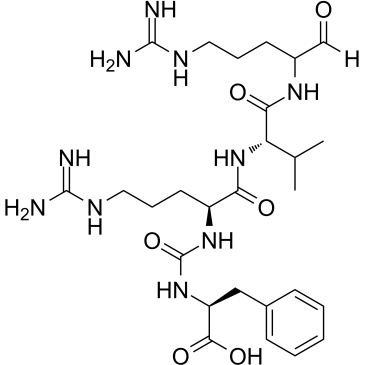
Antipain structure
|
Common Name | Antipain | ||
|---|---|---|---|---|
| CAS Number | 37691-11-5 | Molecular Weight | 604.70200 | |
| Density | 1.38 g/cm3 | Boiling Point | N/A | |
| Molecular Formula | C27H44N10O6 | Melting Point | N/A | |
| MSDS | Chinese USA | Flash Point | N/A | |
| Symbol |

GHS07 |
Signal Word | Warning | |
|
A kinetic characterization of the gill V(H(+))-ATPase in juvenile and adult Macrobrachium amazonicum, a diadromous palaemonid shrimp.
Comp. Biochem. Physiol. B Biochem. Mol. Biol. 181 , 15-25, (2015) Novel kinetic properties of a microsomal gill V(H(+))-ATPase from juvenile and adult Amazon River shrimp, Macrobrachium amazonicum, are described. While protein expression patterns are markedly different, Western blot analysis reveals a sole immunoreactive ba... |
|
|
Inhibition of cathepsin proteases attenuates migration and sensitizes aggressive N-Myc amplified human neuroblastoma cells to doxorubicin.
Oncotarget 6 , 11175-90, (2015) Neuroblastoma arises from the sympathetic nervous system and accounts for 15% of childhood cancer mortality. Amplification of the oncogene N-Myc is reported to occur in more than 20% of patients. While N-Myc amplification status strongly correlates with highe... |
|
|
Lysosomal membrane permeabilization: carbon nanohorn-induced reactive oxygen species generation and toxicity by this neglected mechanism.
Toxicol. Appl. Pharmacol. 280(1) , 117-26, (2014) Understanding the molecular mechanisms responsible for the cytotoxic effects of carbon nanomaterials is important for their future biomedical applications. Carbon nanotubular materials induce the generation of reactive oxygen species (ROS), which causes cell ... |
|
|
Acetylation of the c-MYC oncoprotein is required for cooperation with the HTLV-1 p30(II) accessory protein and the induction of oncogenic cellular transformation by p30(II)/c-MYC.
Virology 476 , 271-88, (2015) The human T-cell leukemia retrovirus type-1 (HTLV-1) p30(II) protein is a multifunctional latency-maintenance factor that negatively regulates viral gene expression and deregulates host signaling pathways involved in aberrant T-cell growth and proliferation. ... |
|
|
Effect of pH and temperature on stability and kinetics of novel extracellular serine alkaline protease (70 kDa).
Int. J. Biol. Macromol. 54 , 1-8, (2013) A novel extracellular serine protease (70 kDa by SDS-PAGE) was purified and characterized. This enzyme retained more than 93% of its initial activity after preincubation for 30 min at 37 °C in the presence of 25% (v/v) tested organic solvents and showed feath... |
|
|
Enzyme-responsive cell-penetrating peptide conjugated mesoporous silica quantum dot nanocarriers for controlled release of nucleus-targeted drug molecules and real-time intracellular fluorescence imaging of tumor cells.
Adv. Healthc. Mater. 3(8) , 1230-9, (2014) Here, a set of novel and personalized nanocarriers are presented for controlled nucleus-targeted antitumor drug delivery and real-time imaging of intracellular drug molecule trafficking by integrating an enzyme activatable cell penetrating peptide (CPP) with ... |
|
|
Kinetic and structural properties of two isoforms of trypsin isolated from the viscera of Japanese anchovy, Engraulis japonicus.
J. Protein Chem. 20(1) , 49-58, (2001) Two isoforms of anchovy trypsin (aT-I and aT-II) were purified from the visceral extracts by (NH4)2SO4 fractionation followed by affinity chromatography, gel filtration, and ion-exchange chromatography. The homogeneity of the purified preparation was evidence... |
|
|
Effects of ammonia stress in the Amazon river shrimp Macrobrachium amazonicum (Decapoda, Palaemonidae).
Aquat. Toxicol. 170 , 13-23, (2016) We evaluate the effects of total ammonia nitrogen-N (TAN) exposure for 72h on (Na(+),K(+))- and V(H(+))-ATPase activities and on their subunit expressions in gills of the diadromous freshwater shrimp Macrobrachium amazonicum. Specific (Na(+),K(+))- and V(H(+)... |
|
|
Antipain, a new protease inhibitor isolated from actinomycetes.
J. Antibiot. 25 , 263, (1972)
|
|
|
Der p 1 facilitates transepithelial allergen delivery by disruption of tight junctions.
J. Clin. Invest. 104(1) , 123-33, (1999) House dust mite (HDM) allergens are important factors in the increasing prevalence of asthma. The lung epithelium forms a barrier that allergens must cross before they can cause sensitization. However, the mechanisms involved are unknown. Here we show that th... |