4-Chloronitrobenzene
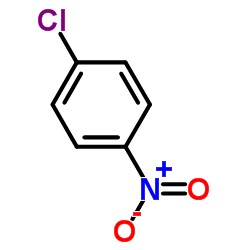
4-Chloronitrobenzene structure
|
Common Name | 4-Chloronitrobenzene | ||
|---|---|---|---|---|
| CAS Number | 100-00-5 | Molecular Weight | 157.555 | |
| Density | 1.4±0.1 g/cm3 | Boiling Point | 242.0±0.0 °C at 760 mmHg | |
| Molecular Formula | C6H4ClNO2 | Melting Point | 80-83 °C(lit.) | |
| MSDS | Chinese USA | Flash Point | 94.5±19.8 °C | |
| Symbol |


GHS06, GHS08, GHS09 |
Signal Word | Danger | |
|
Optimizations of packed sorbent and inlet temperature for large volume-direct aqueous injection-gas chromatography to determine high boiling volatile organic compounds in water.
J. Chromatogr. A. 1356 , 221-9, (2014) For the expanded application area, fast trace analysis of certain high boiling point (i.e., 150-250 °C) volatile organic compounds (HVOCs) in water, a large volume-direct aqueous injection-gas chromatography (LV-DAI-GC) method was optimized for the following ... |
|
|
Precursor chemistry matters in boosting photoredox activity of graphene/semiconductor composites.
Nanoscale 7 , 18062-70, (2015) Considerable effort has been made to fabricate graphene (GR)/semiconductor composite photocatalysts, by using graphene oxide (GO) as the most widely used precursor of GR, toward an improved efficacy of solar energy conversion. However, thus far, the role of G... |
|
|
Degradation p-chloronitrobenzene in ozone-loaded system with perfluorodecalin solvent.
Bull. Environ. Contam. Toxicol. 87(3) , 297-302, (2011) Study was carried out for the removal of hazardous organic compound from aqueous solution by using water/perfluorodecalin loaded ozone two-phase system. p-Chloronitrobenzene was used as hazardous organics to examine the efficiency of the two-phase ozonation s... |
|
|
Substituent effect on electronic structures of halonitrobenzenes.
Spectrochim. Acta. A. Mol. Biomol. Spectrosc. 71(4) , 1499-502, (2008) The electronic structures and substituent effects of o-, m-, and p-chloronitrobenzene and bromonitrobenzene have been studied by ultraviolet photoelectron spectroscopy (UPS). It was found that the o-isomer possesses particular electronic properties. This char... |
|
|
Dechlorination/detoxification of aromatic chlorides using fly ash under mild conditions.
Waste Manag. 29(12) , 3004-8, (2009) An efficient dechlorination/detroxification method for p-nitrochlorobenzene, p-chloroanisole and 1-chloronaphthalene on municipal waste incinerator fly ash in presence of reducing agents with water/alcohol mixtures was developed. Dechlorination% was higher in... |
|
|
Effect of mixed anions (HCO3(-) -SO4(2-)-ClO4 on granular iron (Fe(0)) reactivity.
Environ. Sci. Technol. 43(15) , 5975-81, (2009) Batch experiments were conducted with granular iron (Fe(0)) in pH 10 solutions of 4-chloronitrobenzene (4ClNB) and mixed anions (ClO4-, SO(2-), and HCO3-). In pure solutions, SO4(2-) is known to enhance Fe(0) reactivity, whereas HCO3- has been variously repor... |
|
|
The feasibility of enhanced soil washing of p-nitrochlorobenzene (pNCB) with SDBS/Tween80 mixed surfactants.
J. Hazard. Mater. 170(2-3) , 1236-41, (2009) The present study investigated the feasibility of using two mixed surfactants, anionic surfactant sodium dodecylbenzenesulfonate (SDBS) and nonionic surfactant polysorbate 80 (Tween80), for the remediation of p-nitrochlorobenzene (pNCB) contaminated soil. The... |
|
|
Aqueous p-chloronitrobenzene decomposition induced by contact glow discharge electrolysis.
J. Hazard. Mater. 166(2-3) , 1495-9, (2009) Aqueous p-chloronitrobenzene (PCNB) decomposition induced by contact glow discharge electrolysis under various reaction conditions was investigated. Experimental results showed that, at voltage 450-550 V and initial concentration 50-500 mg/L, the decay of PCN... |
|
|
Noncrystalline NiPB nanotubes for hydrogenation of p-chloronitrobenzene.
Chem. Commun. (Camb.) 46(13) , 2268-70, (2010) High quality noncrystalline NiPB nanotubes were synthesized and exhibited high efficiency for the catalytic hydrogenation of p-chloronitrobenzene due to the characteristic confinement effect of the nanotubes. |
|
|
Effects of common dissolved anions on the reduction of para-chloronitrobenzene by zero-valent iron in groundwater.
Water Sci. Technol. 63(7) , 1485-90, (2011) Batch tests were conducted to evaluate the influences of several common dissolved anions in groundwater on the reduction of para-chloronitrobenzene (p-CNB) by zero-valent iron (ZVI). The results showed that p-CNB reduction was enhanced by both Cl(-) and SO(4)... |