Effect of mixed anions (HCO3(-) -SO4(2-)-ClO4 on granular iron (Fe(0)) reactivity.
Erping Bi, Ian Bowen, J F Devlin
Index: Environ. Sci. Technol. 43(15) , 5975-81, (2009)
Full Text: HTML
Abstract
Batch experiments were conducted with granular iron (Fe(0)) in pH 10 solutions of 4-chloronitrobenzene (4ClNB) and mixed anions (ClO4-, SO(2-), and HCO3-). In pure solutions, SO4(2-) is known to enhance Fe(0) reactivity, whereas HCO3- has been variously reported to depress Fe(0) reactivity or enhance it ClO4- has been found to be minimally reactive with Fe(0). It was hypothesized that the effects of the anions on reactivity were mutually independent, and the combined effects could be predicted from simple mixing lines. In concentrated carbonate solutions (> 25% of the bicarbonate salt content in 8 mM ionic strength solutions), the hypothesis was supported. In mixtures where the aqueous carbonate species concentrations were low (< 25% of the salt content in 8 mM ionic strength solutions) an anomalous reactivity enhancement was noted. Geochemical modeling using PHREEQC suggested that precipitation of Fe(OH)2(a) in preference to FeCO3(s) in weak carbonate solutions freed CO3(2-) to corrode the iron, causing the deviation from the mixing line prediction. SEM analysis confirmed higher carbon presence on iron that had contacted carbonate rich solutions compared to iron that had not.
Related Compounds
| Structure | Name/CAS No. | Molecular Formula | Articles |
|---|---|---|---|
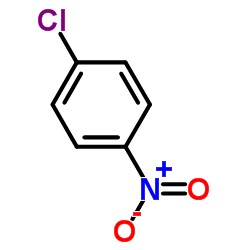 |
4-Chloronitrobenzene
CAS:100-00-5 |
C6H4ClNO2 |
|
Optimizations of packed sorbent and inlet temperature for la...
2014-08-22 [J. Chromatogr. A. 1356 , 221-9, (2014)] |
|
Precursor chemistry matters in boosting photoredox activity ...
2015-11-21 [Nanoscale 7 , 18062-70, (2015)] |
|
Degradation p-chloronitrobenzene in ozone-loaded system with...
2011-09-01 [Bull. Environ. Contam. Toxicol. 87(3) , 297-302, (2011)] |
|
Substituent effect on electronic structures of halonitrobenz...
2008-12-15 [Spectrochim. Acta. A. Mol. Biomol. Spectrosc. 71(4) , 1499-502, (2008)] |
|
Dechlorination/detoxification of aromatic chlorides using fl...
2009-12-01 [Waste Manag. 29(12) , 3004-8, (2009)] |