Formestane
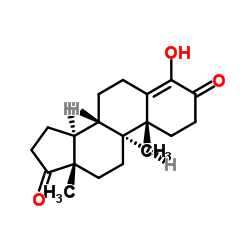
Formestane structure
|
Common Name | Formestane | ||
|---|---|---|---|---|
| CAS Number | 566-48-3 | Molecular Weight | 302.408 | |
| Density | 1.2±0.1 g/cm3 | Boiling Point | 475.4±45.0 °C at 760 mmHg | |
| Molecular Formula | C19H26O3 | Melting Point | 199-202°C | |
| MSDS | Chinese USA | Flash Point | 255.4±25.2 °C | |
| Symbol |

GHS08 |
Signal Word | Danger | |
|
Screening estrogenic activities of chemicals or mixtures in vivo using transgenic (cyp19a1b-GFP) zebrafish embryos.
PLoS ONE 7 , e36069, (2012) The tg(cyp19a1b-GFP) transgenic zebrafish expresses GFP (green fluorescent protein) under the control of the cyp19a1b gene, encoding brain aromatase. This gene has two major characteristics: (i) it is only expressed in radial glial progenitors in the brain of... |
|
|
Combined inhibitory effect of formestane and herceptin on a subpopulation of CD44+/CD24low breast cancer cells.
Cancer Sci. 101 , 1661-9, (2010) In breast cancer, stromal cells surrounding cancer epithelial cells can influence phenotype by producing paracrine factors. Among many mediators of epithelial-stromal interactions, aromatase activity is perhaps one of the best studied. Clinical data suggest t... |
|
|
The effects of aromatase inhibitors and selective estrogen receptor modulators on eye development in the zebrafish (Danio rerio).
Curr. Eye Res. 32(10) , 819-27, (2007) It has been shown that the steroid hormone estrogen plays an important role in the development of the central nervous system. The purpose of these studies was to determine the effect of estrogen on zebrafish eye maturation.In these experiments, the estrogen r... |
|
|
Coadministration of the aromatase inhibitor formestane and an isopropanolic extract of black cohosh in a rat model of chemically induced mammary carcinoma.
Planta Med. 73(4) , 318-22, (2007) Non-steroidal as well as steroidal aromatase inhibitors are currently being discussed as alternatives to tamoxifen in the first-line treatment of patients with hormone-dependent breast cancer. Many of these women are in a postmenopausal state and additionally... |
|
|
The role of estrogen in the developmental appearance of sensory-motor behaviors in the zebrafish (Danio rerio): The characterization of the “listless” model
Brain Res. 1222 , 118-28, (2008) The brain is a steroidogenic organ and is thus dependent on estrogen for many aspects of its development and maintenance in both males and females. The purpose of this study was to develop a model to investigate the effect of estrogen on zebrafish sensory-mot... |
|
|
Computer-aided structure analysis of an epimerized dehydroepiandrosterone derivative and its biological effect in a model of reactive gliosis.
Steroids 75(3) , 265-71, (2010) The naturally occurring steroid dehydroepiandrosterone (DHEA) is reported to reduce glial fibrillary acidic protein (GFAP) overexpression in a model of reactive gliosis due to its conversion to estradiol by the enzyme aromatase. In the present study we examin... |
|
|
Effect of 4-hydroxyandrost-4-ene-3,17-dione (formestane) on the bile secretion and metabolism of 4-(14)C-cholesterol to bile acids.
Pharmacol. Rep. 57(6) , 896-900, (2005) 4-Hydroxyandrost-4-ene-3,17-dione (formestane) is a selective aromatase inhibitor. It is indicated for postmenopausal patients with advanced breast cancer. The aim of the present study was to investigate the effect of 4-hydroxyandrost-4-ene-3,17-dione on the ... |
|
|
Investigations on carbon isotope ratios and concentrations of urinary formestane.
Drug Test. Anal. 4(12) , 942-50, (2012) The aromatase inhibitor formestane (4-hydroxy-androst-4-ene-3,17-dione, F) is prohibited in sports by the World Anti-Doping Agency (WADA). F possesses only weak androgenic properties and is presumed to be employed in order to suppress estrogen production duri... |
|
|
Aromatase destabilizer: novel action of exemestane, a food and drug administration-approved aromatase inhibitor.
Cancer Res. 66(21) , 10281-6, (2006) Using Western blot as the major technique, we studied the effects of the three Food and Drug Administration (FDA)-approved aromatase inhibitors (AI) on aromatase protein stability in the aromatase-overexpressing breast cancer cell line MCF-7aro. We have found... |
|
|
Synthesis and evaluation of novel 4-amino-4,6-androstadiene-3,17-dione: an analog of formestane.
Bioorg. Med. Chem. Lett. 18(20) , 5563-6, (2008) Synthesis of 4-amino-4,6-androstadiene-3,17-dione 7, an analog of formestane used in breast cancer therapy as an aromatase inhibitor, from 4-acetoxy-4-androstene-3,17-dione 2 is described. This is the first report of a 4-amino diene (4,6) system in this serie... |