Entecavir
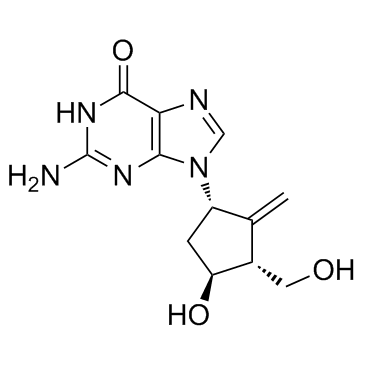
Entecavir structure
|
Common Name | Entecavir | ||
|---|---|---|---|---|
| CAS Number | 142217-69-4 | Molecular Weight | 277.279 | |
| Density | 1.8±0.1 g/cm3 | Boiling Point | 734.2ºC at 760 mmHg | |
| Molecular Formula | C12H15N5O3 | Melting Point | 249-252ºC | |
| MSDS | USA | Flash Point | 397.9ºC | |
|
Formation of covalently closed circular DNA in Hep38.7-Tet cells, a tetracycline inducible hepatitis B virus expression cell line.
Biochem. Biophys. Res. Commun. 452(3) , 315-21, (2014) Hepatitis B virus (HBV) covalently closed circular DNA (cccDNA) plays a central role in chronic HBV infection. However, analysis of the molecular mechanism of cccDNA formation is difficult because of the low efficiency in tissue cultured cells. In this study,... |
|
|
Influence of the basal core promoter and precore mutation on replication of hepatitis B virus and antiviral susceptibility of different genotypes.
J. Med. Virol. 87(4) , 601-8, (2015) Mutations in the basal core promoter (BCP) and precore (PC) regions of the hepatitis B virus (HBV) are more common in genotypes B and C than in genotype A, suggesting that these mutations might affect replication competency depending on genotype. The purpose ... |
|
|
Decreased liver distribution of entecavir is related to down-regulation of Oat2/Oct1 and up-regulation of Mrp1/2/3/5 in rat liver fibrosis.
Eur. J. Pharm. Sci. 71 , 73-9, (2015) We aimed to elucidate whether entecavir was taken-up into liver by transporters and clarify the possible molecular mechanisms of changes in the distribution of entecavir in rat liver fibrosis.Thioacetamide (TAA) was applied to induce rat liver fibrosis. Sampl... |
|
|
Cost-effectiveness analysis of antiviral therapies for hepatitis B e antigen-positive chronic hepatitis B patients in China.
Clin. Drug Investig. 35(3) , 197-209, (2015) Several antiviral therapies are now available for patients with chronic hepatitis B (CHB), but the most cost-effective strategy for Chinese patients is unclear. The aim of this study was to estimate the long-term cost effectiveness of the antiviral treatments... |
|
|
Hepatitis B Virus and DNA Stimulation Trigger a Rapid Innate Immune Response through NF-κB.
J. Immunol. 197 , 630-43, (2016) Cell-intrinsic innate immunity provides a rapid first line of defense to thwart invading viral pathogens through the production of antiviral and inflammatory genes. However, the presence of many of these signaling pathways in the liver and their role in hepat... |
|
|
The adherence impact of a program offering specialty pharmacy services to patients using retail pharmacies.
J. Am. Pharm. Assoc. (Wash.) 56 , 47-53, (2016) A new service model integrates the specialty pharmacy's comprehensive service with the retail pharmacy's patient contact, giving patients options for medication delivery to home, pharmacy, or doctor's office.Evaluate the impact of the new service model on med... |
|
|
Sodium selenite suppresses hepatitis B virus transcription and replication in human hepatoma cell lines.
J. Med. Virol. 88 , 653-63, (2016) Hepatitis B virus (HBV) infection is one of the most serious and prevalent health problems worldwide. Current anti-HBV medications have a number of drawbacks, such as adverse effects and drug resistance; thus, novel potential anti-HBV reagents are needed. Sel... |
|
|
Novel reporter system to monitor early stages of the hepatitis B virus life cycle.
Cancer Sci. 106 , 1616-24, (2016) A recombinant hepatitis B virus (HBV) expressing NanoLuc (NL) (HBV/NL) was produced by cotransfecting a plasmid containing a 1.2-fold HBV genome carrying the NL gene with a plasmid bearing a packaging-defective 1.2-fold HBV genome into a human hepatoma cell l... |
|
|
Baseline hepatitis B surface antigen quantitation can predict virologic response in entecavir-treated chronic hepatitis B patients.
J. Formos. Med. Assoc. 113(11) , 786-93, (2014) Several anti-viral drugs are approved for the treatment of hepatitis B virus (HBV) infection. However, whether quantitative hepatitis B surface antigen (qHBsAg) can predict the therapeutic response during long-term entecavir treatment remains unclear.Fifty-fi... |
|
|
Modeling host interactions with hepatitis B virus using primary and induced pluripotent stem cell-derived hepatocellular systems.
Proc. Natl. Acad. Sci. U. S. A. 111(33) , 12193-8, (2014) Hepatitis B virus (HBV) chronically infects 400 million people worldwide and is a leading driver of end-stage liver disease and liver cancer. Research into the biology and treatment of HBV requires an in vitro cell-culture system that supports the infection o... |