Modeling host interactions with hepatitis B virus using primary and induced pluripotent stem cell-derived hepatocellular systems.
Amir Shlomai, Robert E Schwartz, Vyas Ramanan, Ankit Bhatta, Ype P de Jong, Sangeeta N Bhatia, Charles M Rice
Index: Proc. Natl. Acad. Sci. U. S. A. 111(33) , 12193-8, (2014)
Full Text: HTML
Abstract
Hepatitis B virus (HBV) chronically infects 400 million people worldwide and is a leading driver of end-stage liver disease and liver cancer. Research into the biology and treatment of HBV requires an in vitro cell-culture system that supports the infection of human hepatocytes, and accurately recapitulates virus-host interactions. Here, we report that micropatterned cocultures of primary human hepatocytes with stromal cells (MPCCs) reliably support productive HBV infection, and infection can be enhanced by blocking elements of the hepatocyte innate immune response associated with the induction of IFN-stimulated genes. MPCCs maintain prolonged, productive infection and represent a facile platform for studying virus-host interactions and for developing antiviral interventions. Hepatocytes obtained from different human donors vary dramatically in their permissiveness to HBV infection, suggesting that factors--such as divergence in genetic susceptibility to infection--may influence infection in vitro. To establish a complementary, renewable system on an isogenic background in which candidate genetics can be interrogated, we show that inducible pluripotent stem cells differentiated into hepatocyte-like cells (iHeps) support HBV infection that can also be enhanced by blocking interferon-stimulated gene induction. Notably, the emergence of the capacity to support HBV transcriptional activity and initial permissiveness for infection are marked by distinct stages of iHep differentiation, suggesting that infection of iHeps can be used both to study HBV, and conversely to assess the degree of iHep differentiation. Our work demonstrates the utility of these infectious systems for studying HBV biology and the virus' interactions with host hepatocyte genetics and physiology.
Related Compounds
| Structure | Name/CAS No. | Molecular Formula | Articles |
|---|---|---|---|
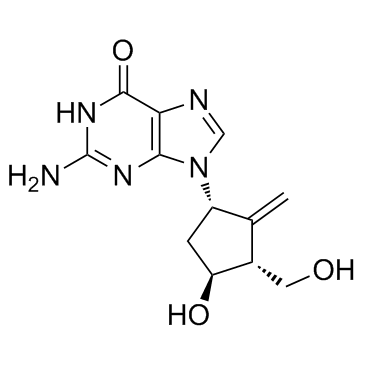 |
Entecavir
CAS:142217-69-4 |
C12H15N5O3 |
|
Formation of covalently closed circular DNA in Hep38.7-Tet c...
2014-09-26 [Biochem. Biophys. Res. Commun. 452(3) , 315-21, (2014)] |
|
Influence of the basal core promoter and precore mutation on...
2015-04-01 [J. Med. Virol. 87(4) , 601-8, (2015)] |
|
Decreased liver distribution of entecavir is related to down...
2015-04-25 [Eur. J. Pharm. Sci. 71 , 73-9, (2015)] |
|
Cost-effectiveness analysis of antiviral therapies for hepat...
2015-03-01 [Clin. Drug Investig. 35(3) , 197-209, (2015)] |
|
Hepatitis B Virus and DNA Stimulation Trigger a Rapid Innate...
2016-07-15 [J. Immunol. 197 , 630-43, (2016)] |