2,6-Dichlorobenzonitrile
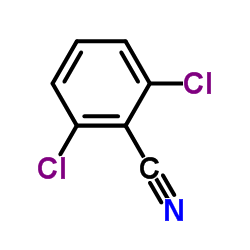
2,6-Dichlorobenzonitrile structure
|
Common Name | 2,6-Dichlorobenzonitrile | ||
|---|---|---|---|---|
| CAS Number | 1194-65-6 | Molecular Weight | 172.011 | |
| Density | 1.4±0.1 g/cm3 | Boiling Point | 279.2±20.0 °C at 760 mmHg | |
| Molecular Formula | C7H3Cl2N | Melting Point | 143-146 °C(lit.) | |
| MSDS | Chinese USA | Flash Point | 126.8±16.0 °C | |
| Symbol |


GHS07, GHS09 |
Signal Word | Warning | |
|
The fragile Fiber1 kinesin contributes to cortical microtubule-mediated trafficking of cell wall components.
Plant Physiol. 167 , 780-92, (2015) The cell wall consists of cellulose microfibrils embedded within a matrix of hemicellulose and pectin. Cellulose microfibrils are synthesized at the plasma membrane, whereas matrix polysaccharides are synthesized in the Golgi apparatus and secreted. The traff... |
|
|
Microbial degradation of the benzonitrile herbicides dichlobenil, bromoxynil and ioxynil in soil and subsurface environments--insights into degradation pathways, persistent metabolites and involved degrader organisms.
Environ. Pollut. 154(2) , 155-68, (2008) The benzonitriles dichlobenil, bromoxynil and ioxynil are important broad-spectrum or selective herbicides used in agriculture, orchards and public areas worldwide. The dichlobenil metabolite 2,6-dichlorobenzamide is the most frequently encountered groundwate... |
|
|
Study of Cytotoxic Effects of Benzonitrile Pesticides.
Biomed Res. Int. 2015 , 381264, (2015) The benzonitrile herbicides bromoxynil, chloroxynil, dichlobenil, and ioxynil have been used actively worldwide to control weeds in agriculture since 1970s. Even though dichlobenil is prohibited in EU since 2008, studies addressing the fate of benzonitrile he... |
|
|
Inherent mineralization of 2,6-dichlorobenzamide (BAM) in unsaturated zone and aquifers--effect of initial concentrations and adaptation.
Environ. Pollut. 159(10) , 2801-7, (2011) The dichlobenil metabolite BAM (2,6-dichlorobenzamide) is frequently detected in aquifers e.g. in Denmark despite the mother compound dichlobenil was banned here since 1997. BAM mineralization was investigated at environmentally relevant concentrations in sed... |
|
|
The most-probable-number enumeration of dichlobenil and 2,6-dichlorobenzamide (BAM) degrading microbes in Finnish aquifers.
Biodegradation 20(5) , 679-86, (2009) In groundwater subsurface deposits and a topsoil from five aquifers having 2,6-dichlorobenzamide (BAM) in water, we determined the most-probable-number (MPN) of 2,6-dichlorobenzonitrile (dichlobenil) and metabolite BAM degrading microorganisms. Dichlobenil an... |
|
|
Analysis and environmental concentrations of the herbicide dichlobenil and its main metabolite 2,6-dichlorobenzamide (BAM): a review.
Sci. Total Environ. 409(12) , 2343-56, (2011) Dichlobenil is an herbicide which has been applied in many countries for weed control in non-agricultural areas such as railroads, car parks and private gardens. In the aquatic environment it has been used for control of floating aquatic weeds. Dichlobenil is... |
|
|
Dichlobenil and 2,6-dichlorobenzamide (BAM) in the environment: what are the risks to humans and biota?
Sci. Total Environ. 409(19) , 3732-9, (2011) Dichlobenil is a herbicide widely used for weed control, mainly in non-agricultural areas and in the aquatic environment. When released into the environment, dichlobenil can undergo many processes such as vaporization to air, binding to soil and sediment, as ... |
|
|
Permeation of herbicidal dichlobenil from a Casoron formulation through nitrile gloves.
Arch. Environ. Contam. Toxicol. 58(2) , 249-54, (2010) The aim of this study was to measure permeation of the herbicide dichlobenil in Casoron 4G through disposable and chemically protective nitrile gloves using an American Society for Testing and Materials-type permeation cell and a closed-loop system employing ... |
|
|
Habituation to thaxtomin A in hybrid poplar cell suspensions provides enhanced and durable resistance to inhibitors of cellulose synthesis.
BMC Plant Biol. 10 , 272, (2010) Thaxtomin A (TA), a phytotoxin produced by the phytopathogen Streptomyces scabies, is essential for the development of potato common scab disease. TA inhibits cellulose synthesis but its actual mode of action is unknown. Addition of TA to hybrid poplar (Popul... |
|
|
Toxicological study of pesticides in air and precipitations of Paris by means of a bioluminescence method.
Anal. Bioanal. Chem 394(4) , 1099-106, (2009) A detailed toxicological study on several pesticides, including chlorothalonil, cyprodynil, dichlobénil, pendimethaline, trifluraline, and alpha-endosulfan, present at trace levels in air and total atmospheric precipitations of Paris is presented. The pestici... |