Lipoxin A4
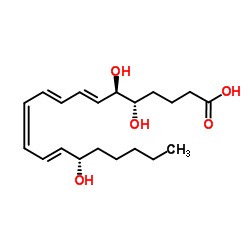
Lipoxin A4 structure
|
Common Name | Lipoxin A4 | ||
|---|---|---|---|---|
| CAS Number | 89663-86-5 | Molecular Weight | 352.47 | |
| Density | 1.1±0.1 g/cm3 | Boiling Point | 589.4±50.0 °C at 760 mmHg | |
| Molecular Formula | C20H32O5 | Melting Point | N/A | |
| MSDS | USA | Flash Point | 324.3±26.6 °C | |
| Symbol |


GHS02, GHS07 |
Signal Word | Danger | |
|
HMDB: a knowledgebase for the human metabolome.
Nucleic Acids Res. 37(Database issue) , D603-10, (2009) The Human Metabolome Database (HMDB, http://www.hmdb.ca) is a richly annotated resource that is designed to address the broad needs of biochemists, clinical chemists, physicians, medical geneticists, nutritionists and members of the metabolomics community. Si... |
|
|
The human serum metabolome.
PLoS ONE 6(2) , e16957, (2011) Continuing improvements in analytical technology along with an increased interest in performing comprehensive, quantitative metabolic profiling, is leading to increased interest pressures within the metabolomics community to develop centralized metabolite ref... |
|
|
Protective effects of n-6 fatty acids-enriched diet on intestinal ischaemia/reperfusion injury involve lipoxin A4 and its receptor.
Br. J. Pharmacol. 172(3) , 910-23, (2015) Long-term intake of dietary fatty acids is known to predispose to chronic inflammation, but their effects on acute intestinal ischaemia/reperfusion (I/R) injury is unknown. The aim of this study was to determine the consequences of a diet rich in n-3 or n-6 p... |
|
|
In Vivo Availability of Pro-Resolving Lipid Mediators in Oxazolone Induced Dermal Inflammation in the Mouse.
PLoS ONE 10 , e0143141, (2015) The activation and infiltration of polymorphonuclear neutrophils (PMN) are critical key steps in inflammation. PMN-mediated inflammation is limited by anti-inflammatory and pro-resolving mechanisms, including specialized pro-resolving lipid mediators (SPM). W... |
|
|
Lipidomics reveals a remarkable diversity of lipids in human plasma.
J. Lipid Res. 51(11) , 3299-305, (2010) The focus of the present study was to define the human plasma lipidome and to establish novel analytical methodologies to quantify the large spectrum of plasma lipids. Partial lipid analysis is now a regular part of every patient's blood test and physicians r... |
|
|
Chiral chromatography-tandem mass spectrometry applied to the determination of pro-resolving lipid mediators.
J. Chromatogr. A. 1360 , 150-63, (2014) Pro-resolving lipid mediators are a class of endogenously synthesized molecules derived from different fatty acids, such as arachidonic, docosahexaenoic or eicosapentaenoic acid, which are derived into four different product families: lipoxins, resolvins, mar... |
|
|
Lysosomal phospholipase A2: a novel player in host immunity to Mycobacterium tuberculosis.
Eur. J. Immunol. 44(8) , 2394-404, (2014) Phospholipases catalyze the cleavage of membrane phospholipids into smaller bioactive molecules. The lysosomal phospholipase A2 (LPLA2 ) is specifically expressed in macrophages. LPLA2 gene deletion in mice causes lysosomal phospholipid accumulation in tissue... |
|
|
Versatility of tandem mass spectrometry for focused analysis of oxylipids.
J. Mass Spectrom. 50 , 879-90, (2015) Liquid chromatography-tandem mass spectrometry (LC-MS/MS) in the multiple reaction monitoring (MRM) scan mode has been the primary MS method applied for the target identification of specific and minor oxylipids in complex matrices, such as eicosanoids and doc... |
|
|
Platelet microparticles are internalized in neutrophils via the concerted activity of 12-lipoxygenase and secreted phospholipase A2-IIA.
Proc. Natl. Acad. Sci. U. S. A. 112 , E3564-73, (2015) Platelets are anucleated blood elements highly potent at generating extracellular vesicles (EVs) called microparticles (MPs). Whereas EVs are accepted as an important means of intercellular communication, the mechanisms underlying platelet MP internalization ... |
|
|
Formation of a novel 20-hydroxylated metabolite of lipoxin A4 by human neutrophil microsomes.
FEBS Lett. 315(3) , 205-10, (1993) Lipoxin A4 (LXA4) is a biologically active compound produced from arachidonic acid via interactions of lipoxygenases. Incubation of LXA4 either with human neutrophils or with the neutrophil microsomes leads to formation of a polar compound on a reverse-phase ... |