NALOXONE METHIODIDE
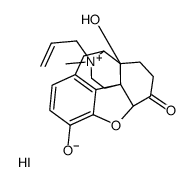
NALOXONE METHIODIDE structure
|
Common Name | NALOXONE METHIODIDE | ||
|---|---|---|---|---|
| CAS Number | 93302-47-7 | Molecular Weight | 469.31300 | |
| Density | N/A | Boiling Point | N/A | |
| Molecular Formula | C20H24INO4 | Melting Point | N/A | |
| MSDS | Chinese USA | Flash Point | N/A | |
| Symbol |

GHS07 |
Signal Word | Warning | |
|
Pronociceptive and Antinociceptive Effects of Buprenorphine in the Spinal Cord Dorsal Horn Cover a Dose Range of Four Orders of Magnitude.
J. Neurosci. 35 , 9580-94, (2015) Due to its distinct pharmacological profile and lower incidence of adverse events compared with other opioids, buprenorphine is considered a safe option for pain and substitution therapy. However, despite its wide clinical use, little is known about the synap... |
|
|
Mu opioid receptors on primary afferent nav1.8 neurons contribute to opiate-induced analgesia: insight from conditional knockout mice.
PLoS ONE 8 , e74706, (2013) Opiates are powerful drugs to treat severe pain, and act via mu opioid receptors distributed throughout the nervous system. Their clinical use is hampered by centrally-mediated adverse effects, including nausea or respiratory depression. Here we used a geneti... |
|
|
Involvement of central opioid systems in human interferon-alpha induced immobility in the mouse forced swimming test.
Br. J. Pharmacol. 130 , 1269-1274, (2000) 1. We investigated the mechanism by which human interferon-alpha (IFN-alpha) increases the immobility time in a forced swimming test, an animal model of depression. 2. Central administration of IFN-alpha (0.05 - 50 IU per mouse, i.cist.) increased the immobil... |
|
|
Quaternary naloxone blocks morphine analgesia in spinal but not intact rats.
Neurosci. Lett. 114 , 259-264, (1990) Quaternary derivatives of naloxone and other compounds are assumed not to enter the central nervous system following systemic administration. We report that i.p. naloxone methylbromide (5 mg/kg) completely reversed the antinociceptive effect of systemically a... |
|
|
Naloxone blockade of myocardial ischemic preconditioning does not require central nervous system participation.
Basic Res. Cardiol. 94 , 136-143, (1999) The hypothesis that naloxone blockade of ischemic preconditioning (IP)-induced infarct limitation does not require central nervous system participation was evaluated using quaternary naloxone in anesthetized rabbits (Study I) and naloxone hydrochloride in iso... |
|
|
An antihypertensive opioid: Biphalin, a synthetic non-addictive enkephalin analog decreases blood pressure in spontaneously hypertensive rats.
Pharmacol. Rep. 68 , 51-5, (2016) Endogenous opioid systems may be engaged in the control of arterial pressure (MAP), however, given the risk of addiction, opioid receptor agonists are not used in antihypertensive therapy. We examined cardiovascular effects of biphalin, a potentially non-addi... |
|
|
A Study on the Mechanism of Cinobufagin in the Treatment of Paw Cancer Pain by Modulating Local β -Endorphin Expression In Vivo.
Evid. Based. Complement. Alternat. Med. 2013 , 851256, (2013) Background. Cinobufagin has been widely used in the treatment of carcinoma and plays an important role in the relief of cancer pain. But the involved mechanism remains unknown. Aim. To investigate the changes in thermal and mechanical hyperalgesia in paw canc... |
|
|
Neonatal injury alters adult pain sensitivity by increasing opioid tone in the periaqueductal gray.
Front. Behav. Neurosci. 3 , 31, (2009) Studies in both rodents and humans have shown that acute inflammatory pain experienced during the perinatal period produces long-term decreases in pain sensitivity (hypoalgesia) (Grunau et al., 1994a, 2001; Ren et al., 2004; LaPrairie and Murphy, 2007). To da... |
|
|
Peripheral μ-opioid receptor mediated inhibition of calcium signaling and action potential-evoked calcium fluorescent transients in primary afferent CGRP nociceptive terminals.
Neuropharmacology 93 , 267-73, (2015) While μ-opioid receptor (MOR) agonists remain the most powerful analgesics for the treatment of severe pain, serious adverse side effects that are secondary to their central nervous system actions pose substantial barriers to therapeutic use. Preclinical and ... |
|
|
Early systemic granulocyte-colony stimulating factor treatment attenuates neuropathic pain after peripheral nerve injury.
PLoS ONE 7 , e43680, (2012) Recent studies have shown that opioid treatment can reduce pro-inflammatory cytokine production and counteract various neuropathic pain syndromes. Granulocyte colony-stimulating factor (G-CSF) can promote immune cell differentiation by increasing leukocytes (... |