2-Methoxyestradiol
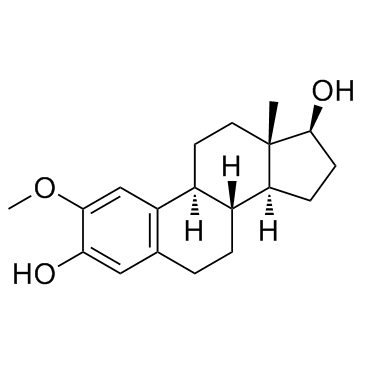
2-Methoxyestradiol structure
|
Common Name | 2-Methoxyestradiol | ||
|---|---|---|---|---|
| CAS Number | 362-07-2 | Molecular Weight | 302.408 | |
| Density | 1.2±0.1 g/cm3 | Boiling Point | 464.4±45.0 °C at 760 mmHg | |
| Molecular Formula | C19H26O3 | Melting Point | 188-190°C | |
| MSDS | Chinese USA | Flash Point | 234.7±28.7 °C | |
| Symbol |


GHS06, GHS08, GHS09 |
Signal Word | Danger | |
|
Cheminformatics analysis of assertions mined from literature that describe drug-induced liver injury in different species.
Chem. Res. Toxicol. 23 , 171-83, (2010) Drug-induced liver injury is one of the main causes of drug attrition. The ability to predict the liver effects of drug candidates from their chemical structures is critical to help guide experimental drug discovery projects toward safer medicines. In this st... |
|
|
Chemical genetics reveals a complex functional ground state of neural stem cells.
Nat. Chem. Biol. 3(5) , 268-273, (2007) The identification of self-renewing and multipotent neural stem cells (NSCs) in the mammalian brain holds promise for the treatment of neurological diseases and has yielded new insight into brain cancer. However, the complete repertoire of signaling pathways ... |
|
|
An updated steroid benchmark set and its application in the discovery of novel nanomolar ligands of sex hormone-binding globulin.
J. Med. Chem. 51 , 2047-56, (2008) A benchmark data set of steroids with known affinity for sex hormone-binding globulin (SHBG) has been widely used to validate popular molecular field-based QSAR techniques. We have expanded the data set by adding a number of nonsteroidal SHBG ligands identifi... |
|
|
Structural requirements for drug inhibition of the liver specific human organic cation transport protein 1.
J. Med. Chem. 51 , 5932-42, (2008) The liver-specific organic cation transport protein (OCT1; SLC22A1) transports several cationic drugs including the antidiabetic drug metformin and the anticancer agents oxaliplatin and imatinib. In this study, we explored the chemical space of registered ora... |
|
|
Genetic mapping of targets mediating differential chemical phenotypes in Plasmodium falciparum.
Nat. Chem. Biol. 5 , 765-71, (2009) Studies of gene function and molecular mechanisms in Plasmodium falciparum are hampered by difficulties in characterizing and measuring phenotypic differences between individual parasites. We screened seven parasite lines for differences in responses to 1,279... |
|
|
Cellular redox status determines sensitivity to BNIP3-mediated cell death in cardiac myocytes.
Am. J. Physiol. Cell Physiol. 308 , C983-92, (2015) The atypical BH3-only protein Bcl-2/adenovirus E1B 19-kDa interacting protein 3 (BNIP3) is an important regulator of hypoxia-mediated cell death. Interestingly, the susceptibility to BNIP3-mediated cell death differs between cells. In this study we examined w... |
|
|
Phytochemical screening of Artemisia arborescens L. by means of advanced chromatographic techniques for identification of health-promoting compounds.
J. Pharm. Biomed. Anal. 117 , 499-509, (2015) Artemisia arborescens, also known as tree wormwood, is a typical species of the Mediterranean flora. It has been used in folk medicine for its antispasmodic, anti-pyretic, anti-inflammatory, and abortifacient properties. In the current study, the application ... |
|
|
Inhibition of autophagy promotes metastasis and glycolysis by inducing ROS in gastric cancer cells.
Oncotarget 6 , 39839-54, (2015) Autophagy defect has been shown to be correlated with malignant phenotype and poor prognosis of human cancers, however, the detailed mechanisms remain obscure. In this study, we investigated the biological changes induced by autophagy inhibition in gastric ca... |
|
|
2-methoxyestradiol synergizes with sorafenib to suppress hepatocellular carcinoma by simultaneously dysregulating hypoxia-inducible factor-1 and -2
Cancer Lett. 355(1) , 96-105, (2014) Sorafenib is the approved systemic drug of choice for advanced hepatocellular carcinoma (HCC), but has demonstrated limited benefits because of drug resistance. 2-Methoxyestradiol (2ME2) has been shown to be a promising anticancer drug against various types o... |
|
|
Improved profiling of estrogen metabolites by orbitrap LC/MS.
Steroids 99 , 84-90, (2015) Estrogen metabolites are important biomarkers to evaluate cancer risks and metabolic diseases. Due to their low physiological levels, a sensitive and accurate method is required, especially for the quantitation of unconjugated forms of endogenous steroids and... |