RGX-202
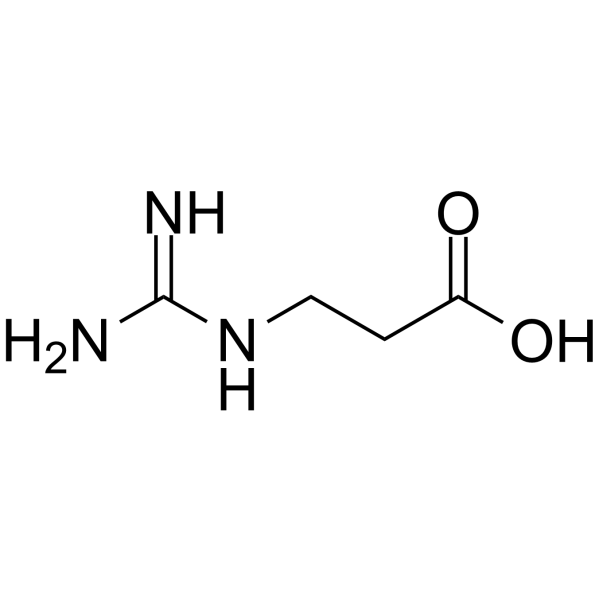
RGX-202 structure
|
Common Name | RGX-202 | ||
|---|---|---|---|---|
| CAS Number | 353-09-3 | Molecular Weight | 131.133 | |
| Density | 1.5±0.1 g/cm3 | Boiling Point | 299.1±42.0 °C at 760 mmHg | |
| Molecular Formula | C4H9N3O2 | Melting Point | 222 °C (dec.)(lit.) | |
| MSDS | Chinese USA | Flash Point | 134.7±27.9 °C | |
| Symbol |

GHS07 |
Signal Word | Warning | |
|
Novel parent structures for inhibitors of the murine GABA transporters mGAT3 and mGAT4.
Eur. J. Pharmacol. 519(1-2) , 43-7, (2005) Searching for potent and subtype selective parent structures of the murine gamma-aminobutyric acid (GABA) transporter subtypes mGAT3 and mGAT4 a series of amino acids was characterised in a uniform [3H]GABA uptake test system based on transiently expressed mG... |
|
|
Three-dimensional quantitative structure-activity relationship analyses of substrates of the human proton-coupled amino acid transporter 1 (hPAT1).
Bioorg. Med. Chem. 19 , 6409-18, (2011) The proton-coupled amino acid transporter hPAT1 has recently gained much interest due to its ability to transport small drugs thereby allowing their oral administration. A three-dimensional quantitative structure-activity relationship (3D QSAR) study has been... |
|
|
Accumulation of methylguanidine and changes in guanidino compound levels in plasma, urine, and kidneys of furosemide-treated rats.
Metab. Clin. Exp. 57(6) , 802-10, (2008) Antidiuresis and renal diseases alter the levels of guanidino compounds (GCs) in various tissues. Therefore, we hypothesized that diuresis could also disturb GC metabolism, storage, and elimination. In this study, rats were made diuretic to analyze GC levels ... |
|
|
Anisoin: a useful pre-chromatographic derivatization fluorogenic reagent for LC analysis of guanidino compounds.
J. Pharm. Biomed. Anal. 42(1) , 11-6, (2006) The use of anisoin as pre-chromatographic reagent for LC analysis of guanidino compounds is proposed. The reagent reacts (5 min at 100 degrees C) with guanidino function and the resulting adducts can be chromatographed under reversed-phase conditions. A fluor... |
|
|
Combinatorial approaches towards the discovery of new tryptase inhibitors.
Bioorg. Med. Chem. Lett. 15 , 1659-64, (2005) The synthesis and evaluation as tryptase inhibitors of a library of 2,5-diketopiperazine derivatives containing guanidine or amidine functional groups is reported. Among the compounds evaluated, derivatives 6{CG4-CG8} and 6{CG4-CG9} are the most active compou... |
|
|
Pharmacological identification of a guanidine-containing β-alanine analogue with low micromolar potency and selectivity for the betaine/GABA transporter 1 (BGT1).
Neurochem. Res. 39(10) , 1988-96, (2014) The γ-aminobutyric acid (GABA) transporters (GATs) are key membrane transporter proteins involved in the termination of GABAergic signaling at synapses in the mammalian brain and proposed drug targets in neurological disorders such as epilepsy. To date, four ... |
|
|
Overexpression of wild-type creatine transporter (SLC6A8) restores creatine uptake in primary SLC6A8-deficient fibroblasts.
J. Inherit. Metab. Dis. 29(2-3) , 345-6, (2006) In the study reported, we prove that mutations in the SLC6A8 gene are responsible for SLC6A8 deficiency, a cerebral creatine deficiency syndrome (CCDS), since overexpression of the wild-type SLC6A8 open reading frame (ORF) restores the creatine uptake profile... |
|
|
BVT.3531 reduces body weight and activates K(ATP) channels in isolated arcuate neurons in rats.
Regul. Pept. 141(1-3) , 19-24, (2007) A number of hormones, including leptin, have been shown to inhibit food intake in humans and animals. Analogues of 3-guanidinopropionic acid have also been found to reduce total food intake, but their mechanisms of action have not been well studied. The prese... |
|
|
The creatine transporter mediates the uptake of creatine by brain tissue, but not the uptake of two creatine-derived compounds.
Neuroscience 142(4) , 991-7, (2006) Hereditary creatine transporter deficiency causes brain damage, despite the brain having the enzymes to synthesize creatine. Such damage occurring despite an endogenous synthesis is not easily explained. This condition is incurable, because creatine may not b... |
|
|
Effects of creatine and its analog, β-guanidinopropionic acid, on the differentiation of and nucleoli in myoblasts.
Biosci. Biotechnol. Biochem. 75(6) , 1085-9, (2011) The effects of supplementation with creatine (Cr) and its analog, β-guanidinopropionic acid (β-GPA), on the differentiation of myoblasts and the numbers of nucleoli were studied in C2C12 cells. The cells were cultured in differentiation medium for 4 d. Then C... |