The creatine transporter mediates the uptake of creatine by brain tissue, but not the uptake of two creatine-derived compounds.
G Lunardi, A Parodi, L Perasso, A V Pohvozcheva, S Scarrone, E Adriano, T Florio, C Gandolfo, A Cupello, S V Burov, M Balestrino
Index: Neuroscience 142(4) , 991-7, (2006)
Full Text: HTML
Abstract
Hereditary creatine transporter deficiency causes brain damage, despite the brain having the enzymes to synthesize creatine. Such damage occurring despite an endogenous synthesis is not easily explained. This condition is incurable, because creatine may not be delivered to the brain without its transporter. Creatine-derived compounds that crossed the blood-brain barrier in a transporter-independent fashion would be useful in the therapy of hereditary creatine transporter deficiency, and possibly also in neuroprotection against brain anoxia or ischemia. We tested the double hypothesis that: (1) the creatine carrier is needed to make creatine cross the plasma membrane of brain cells and (2) creatine-derived molecules may cross this plasma membrane independently of the creatine carrier. In in vitro mouse hippocampal slices, incubation with creatine increased creatine and phosphocreatine content of the tissue. Inhibition of the creatine transporter with 3-guanidinopropionic acid (GPA) dose-dependently prevented this increase. Incubation with creatine benzyl ester (CrOBzl) or phosphocreatine-Mg-complex acetate (PCr-Mg-CPLX) increased tissue creatine content, not phosphocreatine. This increase was not prevented by GPA. Thus, the creatine transporter is required for creatine uptake through the plasma membrane. Since there is a strong indication that creatine in the brain is mainly synthesized by glial cells and transferred to neurons, this might explain why hereditary transporter deficiency is attended by severe brain damage despite the possibility of an endogenous synthesis. CrOBzl and PCr-Mg-CPLX cross the plasma membrane in a transporter-independent way, and might be useful in the therapy of hereditary creatine transporter deficiency. They may also prove useful in the therapy of brain anoxia or ischemia.
Related Compounds
| Structure | Name/CAS No. | Molecular Formula | Articles |
|---|---|---|---|
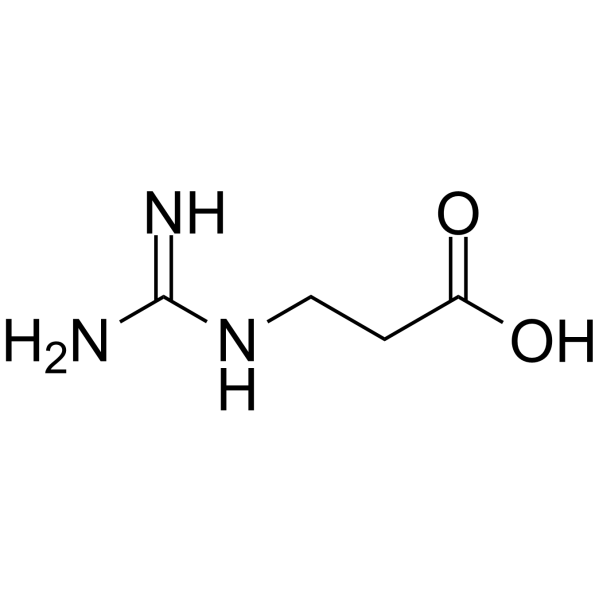 |
RGX-202
CAS:353-09-3 |
C4H9N3O2 |
|
Novel parent structures for inhibitors of the murine GABA tr...
2005-09-05 [Eur. J. Pharmacol. 519(1-2) , 43-7, (2005)] |
|
Three-dimensional quantitative structure-activity relationsh...
2011-11-01 [Bioorg. Med. Chem. 19 , 6409-18, (2011)] |
|
Accumulation of methylguanidine and changes in guanidino com...
2008-06-01 [Metab. Clin. Exp. 57(6) , 802-10, (2008)] |
|
Anisoin: a useful pre-chromatographic derivatization fluorog...
2006-09-11 [J. Pharm. Biomed. Anal. 42(1) , 11-6, (2006)] |
|
Combinatorial approaches towards the discovery of new trypta...
2005-03-15 [Bioorg. Med. Chem. Lett. 15 , 1659-64, (2005)] |