GW4064
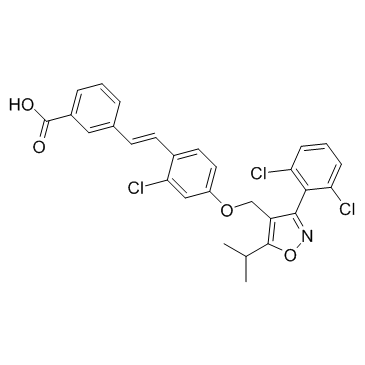
GW4064 structure
|
Common Name | GW4064 | ||
|---|---|---|---|---|
| CAS Number | 278779-30-9 | Molecular Weight | 542.838 | |
| Density | 1.4±0.1 g/cm3 | Boiling Point | 702.1±60.0 °C at 760 mmHg | |
| Molecular Formula | C28H22Cl3NO4 | Melting Point | N/A | |
| MSDS | Chinese USA | Flash Point | 378.4±32.9 °C | |
| Symbol |

GHS07 |
Signal Word | Warning | |
|
Transcriptional Regulation of Cytosolic Sulfotransferase 1C2 by Intermediates of the Cholesterol Biosynthetic Pathway in Primary Cultured Rat Hepatocytes.
J. Pharmacol. Exp. Ther. 355 , 429-41, (2015) Cytosolic sulfotransferase 1C2 (SULT1C2) is expressed in the kidney, stomach, and liver of rats; however, the mechanisms regulating expression of this enzyme are not known. We evaluated transcriptional regulation of SULT1C2 by mevalonate (MVA)-derived interme... |
|
|
Circadian control of bile acid synthesis by a KLF15-Fgf15 axis.
Nat. Commun. 6 , 7231, (2015) Circadian control of nutrient availability is critical to efficiently meet the energetic demands of an organism. Production of bile acids (BAs), which facilitate digestion and absorption of nutrients, is a major regulator of this process. Here we identify a K... |
|
|
The commonly used antimicrobial additive triclosan is a liver tumor promoter.
Proc. Natl. Acad. Sci. U. S. A. 111(48) , 17200-5, (2014) Triclosan [5-chloro-2-(2,4-dichlorophenoxy)phenol; TCS] is a synthetic, broad-spectrum antibacterial chemical used in a wide range of consumer products including soaps, cosmetics, therapeutics, and plastics. The general population is exposed to TCS because of... |
|
|
Conformational dynamics of human FXR-LBD ligand interactions studied by hydrogen/deuterium exchange mass spectrometry: insights into the antagonism of the hypolipidemic agent Z-guggulsterone.
Biochim. Biophys. Acta 1844(9) , 1684-93, (2014) Farnesoid X receptor (FXR) is a member of the nuclear receptor superfamily of transcription factors that plays a key role in the regulation of bile acids, lipid and glucose metabolisms. The regulative function of FXR is governed by conformational changes of t... |
|
|
Curcumin attenuates ethanol-induced hepatic steatosis through modulating Nrf2/FXR signaling in hepatocytes.
IUBMB Life 67 , 645-58, (2015) Alcoholic liver disease (ALD) is a common health problem worldwide, characterized by aberrant accumulation of lipid in hepatocytes. Inhibition of lipid accumulation has been well recognized as a promising strategy for ALD. Previous studies showed that curcumi... |
|
|
FXR induces SOCS3 and suppresses hepatocellular carcinoma.
Oncotarget 6 , 34606-16, (2015) Suppressor of cytokine signaling 3 (SOCS3) is regarded as a vital repressor in the liver carcinogenesis mainly by inhibiting signal transducer and activator of transcription 3 (STAT3) activity. Farnesoid X Receptor (FXR), highly expressed in liver, has an imp... |
|
|
The crucial role of bile acids in the entry of porcine enteric calicivirus.
Virology 456-457 , 268-78, (2014) Replication of porcine enteric calicivirus (PEC) in LLC-PK cells is dependent on the presence of bile acids in the medium. However, the mechanism of bile acid-dependent PEC replication is unknown. Understanding of bile acid-mediated PEC replication may provid... |
|
|
A dysregulated acetyl/SUMO switch of FXR promotes hepatic inflammation in obesity.
EMBO J. 34(2) , 184-99, (2015) Acetylation of transcriptional regulators is normally dynamically regulated by nutrient status but is often persistently elevated in nutrient-excessive obesity conditions. We investigated the functional consequences of such aberrantly elevated acetylation of ... |
|
|
Cysteine sulfinic acid decarboxylase regulation: A role for farnesoid X receptor and small heterodimer partner in murine hepatic taurine metabolism.
Hepatol. Res. 44(10) , E218-28, (2014) Bile acid synthesis is regulated by nuclear receptors including farnesoid X receptor (FXR) and small heterodimer partner (SHP), and by fibroblast growth factor 15/19 (FGF15/19). We hypothesized that hepatic cysteine sulfinic acid decarboxylase (CSAD) (a key e... |
|
|
Dose-dependent induction of signaling pathways by the flavonoid quercetin in human primary hepatocytes: A transcriptomic study.
Mol. Nutr. Food. Res. 59 , 1117-29, (2015) Quercetin is widespread in plant kingdom and consumed regularly with human diet (16 mg/day). Due to reported positive effects on health, quercetin supplements with recommended doses up to 2 g/day are offered. However, molecular effects of such high doses on h... |