Benzenesulfonic acid
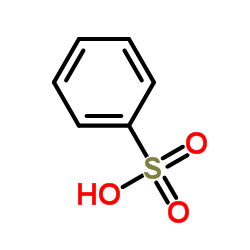
Benzenesulfonic acid structure
|
Common Name | Benzenesulfonic acid | ||
|---|---|---|---|---|
| CAS Number | 98-11-3 | Molecular Weight | 158.175 | |
| Density | 1.4±0.1 g/cm3 | Boiling Point | 137℃ | |
| Molecular Formula | C6H6O3S | Melting Point | 30-60 °C | |
| MSDS | Chinese USA | Flash Point | >230 °F | |
| Symbol |

GHS05 |
Signal Word | Danger | |
|
Role of Counterions in Controlling the Properties of Ultrasonically Generated Chitosan-Stabilized Oil-in-Water Emulsions.
ACS Appl. Mater. Interfaces 7 , 12972-80, (2015) An oil-in-water emulsion was ultrasonically prepared in aqueous chitosan solutions containing different counterions. Tetradecane was used as the oil phase in order to mimic nonpolar substances used in food processes. Various acids were used to dissolve chitos... |
|
|
Nanocarriers for photodynamic therapy-rational formulation design and medium-scale manufacture.
Int. J. Pharm. 491 , 250-60, (2015) The development and manufacture of novel nanocarriers for drug delivery has proved challenging with regards to scale-up and pharmaceutical quality. Polymeric nanocarriers composed of poly(lactic-co-glycolic acid)-b-poly(ethylene glycol) (PLGA-PEG) were prepar... |
|
|
Kinetic and computational evidence for an intermediate in the hydrolysis of sulfonate esters.
Org. Biomol. Chem. 10(40) , 8095-101, (2012) The hydrolytic reactions of sulfonate esters have previously been considered to occur by concerted mechanisms. We now report the observation of a break in a Brønsted correlation for the alkaline hydrolysis of aryl benzenesulfonates. On either side of a break-... |
|
|
CE-ESI-MS analysis of singly charged inorganic and organic anions using a dicationic reagent as a complexing agent.
Electrophoresis 30(22) , 3918-25, (2009) A dicationic ion-pairing reagent, N,N'-dibutyl 1,1'-pentylenedipyrrolidinium, was used to form complexes with singly charged anions for their subsequent analysis by CE-ESI-MS in positive ion mode. This methodology offers the advantages of greater versatility ... |
|
|
Improved oral absorption of cilostazol via sulfonate salt formation with mesylate and besylate.
Drug Des. Devel. Ther. 9 , 3961-8, (2015) Cilostazol is a Biopharmaceutical Classification System class II drug with low solubility and high permeability, so its oral absorption is variable and incomplete. The aim of this study was to prepare two sulfonate salts of cilostazol to increase the dissolut... |
|
|
The sodium-bicarbonate cotransporter NBCe2 (slc4a5) expressed in human renal proximal tubules shows increased apical expression under high-salt conditions.
Am. J. Physiol. Regul. Integr. Comp. Physiol. 309 , R1447-59, (2015) The electrogenic sodium bicarbonate cotransporter (NBCe2) is encoded by SLC4A5, variants of which have been associated with salt sensitivity of blood pressure, which affects 25% of the adult population. NBCe2 is thought to mediate sodium bicarbonate cotranspo... |
|
|
Synthesis, structure and in vitro antibacterial activities of new hybrid disinfectants quaternary ammonium compounds: pyridinium and quinolinium stilbene benzenesulfonates.
Eur. J. Med. Chem. 45 , 4199-208, (2010) The series of pyridinium (1-10) and quinolinium (11-20) stilbene benzenesulfonates have been synthesized and their structures were investigated by UV-vis, FT-IR and (1)H NMR spectroscopy. In addition, compound 5 was also determined by single crystal X-ray dif... |
|
|
4-Pregnen-21-ol-3,20-dione-21-(4-bromobenzenesulfonate) (NSC 88915) and related novel steroid derivatives as tyrosyl-DNA phosphodiesterase (Tdp1) inhibitors.
J. Med. Chem. 52 , 7122-31, (2009) Tyrosyl-DNA phosphodiesterase 1 (Tdp1) is an enzyme that catalyzes the hydrolysis of 3'-phosphotyrosyl bonds. Such linkages form in vivo when topoisomerase I (Top1) processes DNA. For this reason, Tdp1 has been implicated in the repair of irreversible Top1-DN... |
|
|
Pseudomonas aeruginosa strain RW41 mineralizes 4-chlorobenzenesulfonate, the major polar by-product from DDT manufacturing.
Environ. Microbiol. 10(6) , 1591-600, (2008) Pseudomonas aeruginosa RW41 is the first bacterial strain, which could be isolated by virtue of its capability to mineralize 4-chlorobenzenesulfonic acid (4CBSA), the major polar by-product of the chemical synthesis of 1,1,1-trichloro-2,2-bis-(4-chlorophenyl)... |
|
|
Molecular template approach for evolution of conducting polymer nanostructures: tracing the role of morphology on conductivity and solid state ordering.
J. Phys. Chem. B 114(3) , 1314-24, (2010) Here, we report a unique molecular template approach, for the first time, to study the evolution of the different types of nanomaterial morphologies such as nanofiber, nanorod, nanosphere, and nanotube in a single system without changing their chemical compos... |