艾塞那肽
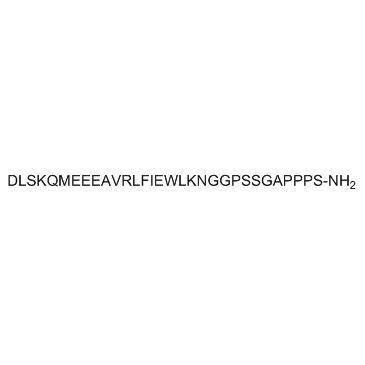
艾塞那肽结构式

|
常用名 | 艾塞那肽 | 英文名 | Exendin Fragment 9-39 |
|---|---|---|---|---|
| CAS号 | 133514-43-9 | 分子量 | 3369.757 | |
| 密度 | 1.5±0.1 g/cm3 | 沸点 | N/A | |
| 分子式 | C149H234N40O47S | 熔点 | N/A | |
| MSDS | 中文版 美版 | 闪点 | N/A |
艾塞那肽用途Exendin (9-39) 是特异竞争性的 glucagon-like peptide-1 受体拮抗剂。 |

| 中文名 | 艾塞那肽 |
|---|---|
| 英文名 | Exendin (9-39) |
| 英文别名 | 更多 |
| 描述 | Exendin (9-39) 是特异竞争性的 glucagon-like peptide-1 受体拮抗剂。 |
|---|---|
| 相关类别 | |
| 体外研究 | GLP-1在控制空腹血糖中起作用。 Exendin-(9-39)是GLP-1激动剂exendin-4的截短形式,是小鼠和人的特异性GLP-1受体拮抗剂。 Exendin(9-39)显着抑制从KATPHI新生儿分离的胰岛中氨基酸刺激的胰岛素分泌[1]。 |
| 体内研究 | 与载体相比,Exendin(9-39)输注期间胰岛素与葡萄糖的比率显着降低[1]。连续皮下输注exendin-(9-39)可显着提高SUR-1 -/-小鼠的空腹血糖水平,而不影响葡萄糖耐量或胰岛素敏感性[2]。 |
| 动物实验 | 小鼠:将Alzet miniosmotic泵皮下植入以150pmol / kg / min的速率递送exendin(9-39)或载体(0.9%NaCl,1%牛血清白蛋白)2周[2]。 |
| 参考文献 |
| 密度 | 1.5±0.1 g/cm3 |
|---|---|
| 分子式 | C149H234N40O47S |
| 分子量 | 3369.757 |
| 精确质量 | 3367.687012 |
| PSA | 1415.58000 |
| LogP | -5.88 |
| InChIKey | WSEVKKHALHSUMB-MVNVRWBSSA-N |
| SMILES | CCC(C)C(NC(=O)C(Cc1ccccc1)NC(=O)C(CC(C)C)NC(=O)C(CCCNC(=N)N)NC(=O)C(NC(=O)C(C)NC(=O)C(CCC(=O)O)NC(=O)C(CCC(=O)O)NC(=O)C(CCC(=O)O)NC(=O)C(CCSC)NC(=O)C(CCC(N)=O)NC(=O)C(CCCCN)NC(=O)C(CO)NC(=O)C(CC(C)C)NC(=O)C(N)CC(=O)O)C(C)C)C(=O)NC(CCC(=O)O)C(=O)NC(Cc1c[nH]c2ccccc12)C(=O)NC(CC(C)C)C(=O)NC(CCCCN)C(=O)NC(CC(N)=O)C(=O)NCC(=O)NCC(=O)N1CCCC1C(=O)NC(CO)C(=O)NC(CO)C(=O)NCC(=O)NC(C)C(=O)N1CCCC1C(=O)N1CCCC1C(=O)N1CCCC1C(=O)NC(CO)C(N)=O |
| 折射率 | 1.671 |
| 储存条件 | 密封、在 -20ºC下保存 |
| 稳定性 | 如果遵照规格使用和储存则不会分解,未有已知危险反应 |
| 分子结构 | 1、摩尔折射率:833.56 2、摩尔体积(cm3/mol):2229.8 3、等张比容(90.2K):6389.1 4、表面张力(dyne/cm):67.3 5、介电常数:无可用的 6、极化率(10-24cm3):330.45 7、单一同位素质量:3367.687075 Da 8、标称质量:3366 Da 9、平均质量:3369.7571 Da |
| 计算化学 | 1.疏水参数计算参考值(XlogP):-16.7 2.氢键供体数量:45 3.氢键受体数量:52 4.可旋转化学键数量:109 5.互变异构体数量:1000 6.拓扑分子极性表面积1420 7.重原子数量:237 8.表面电荷:0 9.复杂度:8000 10.同位素原子数量:0 11.确定原子立构中心数量:29 12.不确定原子立构中心数量:0 13.确定化学键立构中心数量:0 14.不确定化学键立构中心数量:0 15.共价键单元数量:1 |
| 更多 | 1. 性状:固体 2. 密度(g/mL,20℃):未确定 3. 相对蒸汽密度(g/mL,空气=1):未确定 4. 熔点(ºC):未确定 5. 沸点(ºC,常压):未确定 6. 沸点(ºC,KPa):未确定 7. 折射率:未确定 8. 闪点(ºC):未确定 9. 比旋光度(º):未确定 10. 自燃点或引燃温度(ºC):未确定 11. 蒸气压(Pa,20ºC):未确定 12. 饱和蒸气压(KPa,20ºC):未确定 13. 燃烧热(KJ/mol):未确定 14. 临界温度(ºC):未确定 15. 临界压力(KPa):未确定 16. 油水(辛醇/水)分配系数的对数值:未确定 17. 爆炸上限(%,V/V):未确定 18. 爆炸下限(%,V/V):未确定 19. 溶解性:未确定 |
| 个人防护装备 | Eyeshields;Gloves;type N95 (US);type P1 (EN143) respirator filter |
|---|---|
| 危害码 (欧洲) | F+ |
| 危险品运输编码 | NONH for all modes of transport |
| WGK德国 | 3 |
|
Hindbrain oxytocin receptors contribute to the effects of circulating oxytocin on food intake in male rats.
Endocrinology 155(8) , 2845-57, (2014) Oxytocin (OT)-elicited hypophagia has been linked to neural activity in the nucleus of the solitary tract (NTS). Because plasma OT levels increase after a meal, we hypothesized that circulating OT act... |
|
|
Endogenous glucagon-like peptide-1 reduces drinking behavior and is differentially engaged by water and food intakes in rats.
J. Neurosci. 34(49) , 16417-23, (2014) Glucagon-like peptide-1 (GLP-1) is produced in the ileum and the nucleus of the solitary tract. It is well known that GLP-1 controls food intake, but there is a growing literature indicating that GLP-... |
|
|
GLP-1 receptor activation modulates appetite- and reward-related brain areas in humans.
Diabetes 63(12) , 4186-96, (2014) Gut-derived hormones, such as GLP-1, have been proposed to relay information to the brain to regulate appetite. GLP-1 receptor agonists, currently used for the treatment of type 2 diabetes (T2DM), imp... |
| Exendin 9-39 |
| Exendin(9-39)amide |
| L-Serinamide, L-α-aspartyl-L-leucyl-L-seryl-L-lysyl-L-glutaminyl-L-methionyl-L-α-glutamyl-L-α-glutamyl-L-α-glutamyl-L-alanyl-L-valyl-L-arginyl-L-leucyl-L-phenylalanyl-L-isoleucyl-L-alp 
ha-glutamyl-L-tryptophyl-L-leucyl-L-lysyl-L-asparaginylglycylglycyl-L-prolyl-L-seryl-L-serylglycyl-L-alanyl-L-prolyl-L-prolyl-L-prolyl- |
| UNII-5313W10MYT |
| Exendin-3 (9-39) amide |
| L-α-Aspartyl-L-leucyl-L-seryl-L-lysyl-L-glutaminyl-L-methionyl-L-α-glutamyl-L-α-glutamyl-L-α-glutamyl-L-alanyl-L-valyl-L-arginyl-L-leucyl-L-phenylalanyl-L-isoleucyl-L-α-glutamyl-L- tryptophyl-L-leucyl-L-lysyl-L-asparaginylglycylglycyl-L-prolyl-L-seryl-L-serylglycyl-L-alanyl-L-prolyl-L-prolyl-L-prolyl-L-serinamide |
| Exendin 3 (heloderma horridum),1-de-L-histidine-2-de-L-serine-3-de-L-aspartic acid-4-deglycine-5-de-L-threonine-6-de-L-phenylalanine-7-de-L-threonine-8-de-L-serine |
| MFCD00283195 |
本网页内容来自不同专业数据源,如对内容有疑义,欢迎联系service1@chemsrc.com。

- 上海化源生化科技有限公司
- 上海市 上海市 普陀区
- 产品名:艾塞那肽
- 纯度:98.0%
- 价格:
- 联系人:徐经理

- 联系电话:133 1186 9306
- 上海阿拉丁生化科技股份有限公司
- 上海市 上海市 浦东新区
- 产品名:Exendin Fragment 9-39
- 产品网址:http://www.aladdin-e.com/zh_cn/E101622.html
- 纯度:95.0%
- 价格: ¥1226.9/1mg ¥1998.9/1mg ¥4960.9/5mg ¥需询单/1g
- 联系人:阿拉丁
- 联系电话:400-620-6333
查看所有供应商和价格请点击: