Exendin Fragment 9-39
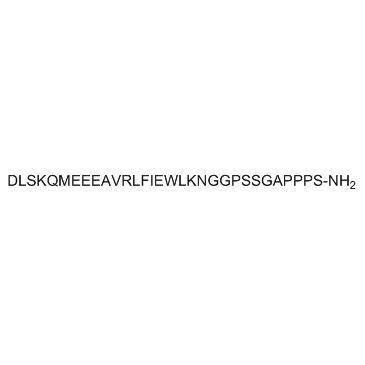
Exendin Fragment 9-39 structure
|
Common Name | Exendin Fragment 9-39 | ||
|---|---|---|---|---|
| CAS Number | 133514-43-9 | Molecular Weight | 3369.757 | |
| Density | 1.5±0.1 g/cm3 | Boiling Point | N/A | |
| Molecular Formula | C149H234N40O47S | Melting Point | N/A | |
| MSDS | Chinese USA | Flash Point | N/A | |
Use of Exendin Fragment 9-39Exendin (9-39) is a specific and competitive glucagon-like peptide-1 receptor antagonist. |
| Name | Exendin (9-39) |
|---|---|
| Synonym | More Synonyms |
| Description | Exendin (9-39) is a specific and competitive glucagon-like peptide-1 receptor antagonist. |
|---|---|
| Related Catalog | |
| In Vitro | GLP-1 plays a role in the control of fasting glucose. Exendin-(9-39), a truncated form of the GLP-1 agonist exendin-4, is a specific GLP-1 receptor antagonist in mice and humans. Exendin (9-39) significantly inhibits amino acid-stimulated insulin secretion in pancreatic islets isolated from neonates with KATPHI[1]. |
| In Vivo | Insulin-to-glucose ratios are significantly lower during Exendin (9-39) infusion compared with vehicle[1]. Continuous subcutaneous infusion of exendin-(9-39) significantly raises fasting blood glucose levels in SUR-1 −/− mice without affecting glucose tolerance or insulin sensitivity[2]. |
| Animal Admin | Mice: Alzet miniosmotic pumps are implanted subcutaneously to deliver exendin (9-39) at a rate of 150 pmol/kg/min or vehicle (0.9% NaCl, 1% bovine serum albumin) for 2 weeks[2]. |
| References |
| Density | 1.5±0.1 g/cm3 |
|---|---|
| Molecular Formula | C149H234N40O47S |
| Molecular Weight | 3369.757 |
| Exact Mass | 3367.687012 |
| PSA | 1415.58000 |
| LogP | -5.88 |
| Index of Refraction | 1.671 |
| InChIKey | WSEVKKHALHSUMB-MVNVRWBSSA-N |
| SMILES | CCC(C)C(NC(=O)C(Cc1ccccc1)NC(=O)C(CC(C)C)NC(=O)C(CCCNC(=N)N)NC(=O)C(NC(=O)C(C)NC(=O)C(CCC(=O)O)NC(=O)C(CCC(=O)O)NC(=O)C(CCC(=O)O)NC(=O)C(CCSC)NC(=O)C(CCC(N)=O)NC(=O)C(CCCCN)NC(=O)C(CO)NC(=O)C(CC(C)C)NC(=O)C(N)CC(=O)O)C(C)C)C(=O)NC(CCC(=O)O)C(=O)NC(Cc1c[nH]c2ccccc12)C(=O)NC(CC(C)C)C(=O)NC(CCCCN)C(=O)NC(CC(N)=O)C(=O)NCC(=O)NCC(=O)N1CCCC1C(=O)NC(CO)C(=O)NC(CO)C(=O)NCC(=O)NC(C)C(=O)N1CCCC1C(=O)N1CCCC1C(=O)N1CCCC1C(=O)NC(CO)C(N)=O |
| Storage condition | -20°C |
| Personal Protective Equipment | Eyeshields;Gloves;type N95 (US);type P1 (EN143) respirator filter |
|---|---|
| Hazard Codes | F+ |
| RIDADR | NONH for all modes of transport |
| WGK Germany | 3 |
|
Hindbrain oxytocin receptors contribute to the effects of circulating oxytocin on food intake in male rats.
Endocrinology 155(8) , 2845-57, (2014) Oxytocin (OT)-elicited hypophagia has been linked to neural activity in the nucleus of the solitary tract (NTS). Because plasma OT levels increase after a meal, we hypothesized that circulating OT act... |
|
|
Endogenous glucagon-like peptide-1 reduces drinking behavior and is differentially engaged by water and food intakes in rats.
J. Neurosci. 34(49) , 16417-23, (2014) Glucagon-like peptide-1 (GLP-1) is produced in the ileum and the nucleus of the solitary tract. It is well known that GLP-1 controls food intake, but there is a growing literature indicating that GLP-... |
|
|
GLP-1 receptor activation modulates appetite- and reward-related brain areas in humans.
Diabetes 63(12) , 4186-96, (2014) Gut-derived hormones, such as GLP-1, have been proposed to relay information to the brain to regulate appetite. GLP-1 receptor agonists, currently used for the treatment of type 2 diabetes (T2DM), imp... |
| Exendin 9-39 |
| Exendin(9-39)amide |
| L-Serinamide, L-α-aspartyl-L-leucyl-L-seryl-L-lysyl-L-glutaminyl-L-methionyl-L-α-glutamyl-L-α-glutamyl-L-α-glutamyl-L-alanyl-L-valyl-L-arginyl-L-leucyl-L-phenylalanyl-L-isoleucyl-L-alp 
ha-glutamyl-L-tryptophyl-L-leucyl-L-lysyl-L-asparaginylglycylglycyl-L-prolyl-L-seryl-L-serylglycyl-L-alanyl-L-prolyl-L-prolyl-L-prolyl- |
| UNII-5313W10MYT |
| Exendin-3 (9-39) amide |
| L-α-Aspartyl-L-leucyl-L-seryl-L-lysyl-L-glutaminyl-L-methionyl-L-α-glutamyl-L-α-glutamyl-L-α-glutamyl-L-alanyl-L-valyl-L-arginyl-L-leucyl-L-phenylalanyl-L-isoleucyl-L-α-glutamyl-L- tryptophyl-L-leucyl-L-lysyl-L-asparaginylglycylglycyl-L-prolyl-L-seryl-L-serylglycyl-L-alanyl-L-prolyl-L-prolyl-L-prolyl-L-serinamide |
| Exendin 3 (heloderma horridum),1-de-L-histidine-2-de-L-serine-3-de-L-aspartic acid-4-deglycine-5-de-L-threonine-6-de-L-phenylalanine-7-de-L-threonine-8-de-L-serine |
| MFCD00283195 |