ACRIFLAVINE
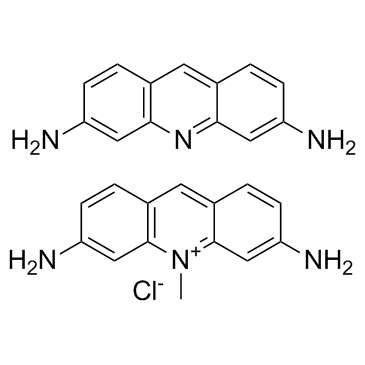
ACRIFLAVINE structure
|
Common Name | ACRIFLAVINE | ||
|---|---|---|---|---|
| CAS Number | 8048-52-0 | Molecular Weight | 259.73 | |
| Density | N/A | Boiling Point | N/A | |
| Molecular Formula | C14H14ClN3 | Melting Point | 179-181 °C | |
| MSDS | Chinese USA | Flash Point | N/A | |
| Symbol |

GHS07 |
Signal Word | Warning | |
Use of ACRIFLAVINEAcriflavine is a fluorescent dye for labeling high molecular weight RNA. It is also a topical antiseptic. |
| Name | acriflavine |
|---|---|
| Synonym | More Synonyms |
| Description | Acriflavine is a fluorescent dye for labeling high molecular weight RNA. It is also a topical antiseptic. |
|---|---|
| Related Catalog | |
| In Vitro | Acriflavine is identified as a potent inhibitor of the MCT4 that can inhibit the binding between Basigin and MCT4. Acriflavine significantly inhibits growth and self-renewal potential of several glioblastoma neurosphere lines[1]. The HIF-1 inhibitor acriflavine decreases survival and growth of CML cells. It targets stem cell potential of CML cells[2]. |
| In Vivo | Acriflavine treatment inhibits intratumoral expression of VEGF and tumor vascularization[1]. In a murine CML model, acriflavine decreases leukemia development and reduces LSC maintenance[2]. Acriflavine retards tumor growth in a murine model of breast cancer. The combination of sunitinib with acriflavine significantly decreases vascular endothelial growth factor and TGF-β expression and reduces tumor vasculature followed by increased intratumor necrosis and apoptosis[3]. |
| Animal Admin | Mice: CML mice are treated daily with acriflavine (8 mg/kg) or PBS via intraperitoneal injection, for 10 days starting from day 7 after bone marrow transplantation[2]. |
| References |
| Melting Point | 179-181 °C |
|---|---|
| Molecular Formula | C14H14ClN3 |
| Molecular Weight | 259.73 |
| PSA | 120.85000 |
| LogP | 3.86310 |
CHEMICAL IDENTIFICATION
HEALTH HAZARD DATAACUTE TOXICITY DATA
MUTATION DATA
|
| Symbol |
GHS07 |
|---|---|
| Signal Word | Warning |
| Hazard Statements | H302-H315-H319-H335 |
| Precautionary Statements | P261-P305 + P351 + P338 |
| Personal Protective Equipment | dust mask type N95 (US);Eyeshields;Gloves |
| Hazard Codes | Xn:Harmful;N:Dangerousfortheenvironment; |
| Risk Phrases | R22;R37/38;R41;R50/53 |
| Safety Phrases | S26-S39-S60-S61 |
| RIDADR | UN 3077 9/PG 3 |
| WGK Germany | 3 |
| RTECS | AR9660000 |
| HS Code | 38249064 |
| HS Code | 38249064 |
|---|
|
Bilobalide attenuates hypoxia induced oxidative stress, inflammation, and mitochondrial dysfunctions in 3T3-L1 adipocytes via its antioxidant potential.
Free Radic. Res. 48(10) , 1206-17, (2014) Excessive expansion of white adipose tissue leads to hypoxia which is considered as a key factor responsible for adipose tissue dysfunction in obesity. Hypoxia induces inflammation, insulin resistance... |
|
|
Vacuolar ATPase depletion affects mitochondrial ATPase function, kinetoplast dependency, and drug sensitivity in trypanosomes.
Proc. Natl. Acad. Sci. U. S. A. 112 , 9112-7, (2015) Kinetoplastid parasites cause lethal diseases in humans and animals. The kinetoplast itself contains the mitochondrial genome, comprising a huge, complex DNA network that is also an important drug tar... |
|
|
The efflux pump inhibitor timcodar improves the potency of antimycobacterial agents.
Antimicrob. Agents Chemother. 59(3) , 1534-41, (2015) Previous studies indicated that inhibition of efflux pumps augments tuberculosis therapy. In this study, we used timcodar (formerly VX-853) to determine if this efflux pump inhibitor could increase th... |
| ACRIFLAVINE |
| EUFLAVINE |
| 3,6-Diamino-10-methylacridinium chloride - 3,6-acridinediamine (1:1:1) |
| 3,6-Diamino-10-methylacridinium Chloride mixt with 3,6-Acridine Diamine |
| 3,6-Diamino-10-methylacridinium chloride 3,6-acridinediamine (1:1:1) |
| diacrid |
| 3,6-Diamino-10-methylacridinium chloride 3,6-acridinediamine (1:1) |
| flavipin |
| Trypaflavine |
| Acridinium, 3,6-diamino-10-methyl-, chloride, mixt. with 3,6-acridinediamine |
| gonacin |
| 3,6-Diamino-10-methylacridinium chloride - acridine-3,6-diamine (1:1:1) |
| flavine |
| Neutroflavine |
| EUFLAVIN |
| angiflan |
| Neutral Acriflavine |
| flavisept |
| isravin |
| MFCD00064307 |
The content on this webpage is sourced from various professional data sources. If you have any questions or concerns regarding the content, please feel free to contact service1@chemsrc.com.
- Shanghai Nianxing Industrial Co., Ltd
- China
- Product Name: ACRIFLAVINE
- Price: Check
- Purity: 98.0%
- Delivery: 10 Day
- Contact: Yang
- Email: sales@echemcloud.com
- Shanghai Jizhi Biochemical Technology Co., Ltd
- China
- Product Name: ACRIFLAVINE
- Price: ¥108.0/5g ¥348.0/25g
- Purity: 98.0%
- Delivery: 3 Day
- Contact: Liu jia


- Email: 2130147988@qq.com
- DC Chemicals Limited
- China
- Product Name: Acriflavine
- Price: ¥Inquiry/100mg ¥Inquiry/250mg ¥Inquiry/1g ¥220.0/10ml
- Purity: 98.0%
- Delivery: 10 Day
- Contact: Tony Cao
- Email: sales@dcchemicals.com
- Dayang Chem (Hangzhou) Co., Ltd.
- China
- Product Name: Acriflavine
- Price: $Inquiry/100g $Inquiry/1kg $Inquiry/100kg $Inquiry/1000kg
- Purity: 98.0%
- Delivery: Inquiry
- Contact: Ms Wang
- Email: enquiry@dycnchem.com
Get all suppliers and price by the below link:
Reference only. check more ACRIFLAVINE price