20(S)-Ginsenoside Rh2
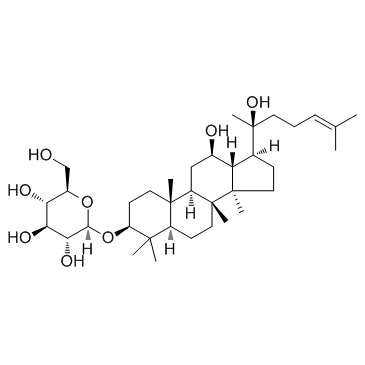
20(S)-Ginsenoside Rh2 structure
|
Common Name | 20(S)-Ginsenoside Rh2 | ||
|---|---|---|---|---|
| CAS Number | 78214-33-2 | Molecular Weight | 622.873 | |
| Density | 1.2±0.1 g/cm3 | Boiling Point | 726.4±60.0 °C at 760 mmHg | |
| Molecular Formula | C36H62O8 | Melting Point | N/A | |
| MSDS | Chinese USA | Flash Point | 393.1±32.9 °C | |
| Symbol |

GHS07 |
Signal Word | Warning | |
Use of 20(S)-Ginsenoside Rh2Ginsenoside Rh2 is isolated from the root of Ginseng. Ginsenoside Rh2 induces the activation of caspase-8 and caspase-9. Ginsenoside Rh2 induces cancer cell apoptosis in a multi-path manner. |
| Name | (20S)-ginsenoside Rh2 |
|---|---|
| Synonym | More Synonyms |
| Description | Ginsenoside Rh2 is isolated from the root of Ginseng. Ginsenoside Rh2 induces the activation of caspase-8 and caspase-9. Ginsenoside Rh2 induces cancer cell apoptosis in a multi-path manner. |
|---|---|
| Related Catalog | |
| Target |
Caspase-8 Caspase-9 Apoptosis |
| In Vitro | Ginsenoside Rh2 induces the activation of two initiator caspases, caspase-8 and caspase-9 in human cancer cells. Ginsenoside Rh2 induces cancer cell apoptosis in a multi-path manner and is therefore a promising candidate for anti-tumor drug development. Ginsenoside Rh2 triggers p53-dependent Fas expression and consequent activation of caspase-8 and p53-independent caspase-9-mediated intrinsic pathway to cause cancer cell death.The cytotoxic activity of Ginsenoside Rh2 in the human tumor cell lines HeLa, SK-HEP-1, SW480, and PC-3 is assessed by MTT. The cell viability of HeLa cells is remarkably inhibited by Ginsenoside Rh2, with an IC50 value of 2.52 μg/mL, whereas SK-HEP-1 and SW480 cells are less sensitive to Ginsenoside Rh2, with IC50 values of 3.15 μg/mL and 4.06 μg/mL, respectively. PC-3 cells are the least vulnerable to Ginsenoside Rh2, with an IC50 value of 7.85 μg/mL, 3-fold higher than HeLa cells[1]. |
| In Vivo | A total of 15 days following B16-F10 cell injection, tumor sizes from the 3 tumor bearing groups are measured. The tumor sizes in the G-L group and G-H group (G-L and G-H refer to a low or high dose of ginsenoside Rh2 injection) are reduced compared with the tumor group (P<0.05). The survival analysis reveals that the Ginsenoside Rh2 treated groups survive longer than the untreated tumor group and the effect is dose-dependent (P<0.05)[2]. |
| Kinase Assay | HeLa, SK-HEP-1, SW480, and PC-3 cells are treated with Ginsenoside Rh2 (7.5 μg/mL) in serum free media for indicated time periods and then are harvested. Fifty micrograms of cell lysates are incubated with 200 nM Ac-DEVD-AFC (for caspase-3), Ac-IETD-AFC (for caspase-8), and Ac-LEHD-AFC (for caspase-9) in a reaction buffer containing 20 mM HEPES, pH 7.4, 100 mM NaCl, 10 mM DTT, 0.1% CHAPS, and 10% sucrose at 37°C for 1 h. The reaction is monitored by fluorescence emission at 535 nm and excitation at 405 nm[1]. |
| Cell Assay | Determination of cell viability is performed by using MTT assay, which is used to calculate the growth inhibition induced by increasing concentrations of drug. Briefly, exponentially growing HeLa, SK-HEP-1, SW480, and PC-3 cells are seeded into a 96-well plate at 1×10⁴ cells/well in triplicate. After incubation for 24 h, cells are treated with increasing concentration of Ginsenoside Rh2 (1, 2.5, 5, 7.5 and 10 μg/mL) in serum free media for 48 h. At the end of treatment, 20 μL of MTT (5 mg/mL) is added to each well and incubated for an additional 4 h. The formazan grains formed by viable cells are solubilized with DMSO, and the color intensity is measured at 550 nm with an ELISA reader[1]. |
| Animal Admin | Mice[2] Male C57BL6 mice (3-4 weeks old) are randomly arranged into 4 groups of 80 mice: Tumor group, G-L group, G-H group and Control group. G-L and G-H refer to a low or high dose of ginsenoside Rh2 injection. For the tumor group, G-L group and G-H group, the B16-F10 cell line is injected into the mice. These 3 groups become tumor bearing groups. For the control group, the same volume of PBS is injected instead. Ginsenoside Rh2 is injected into the left back of mice in the G-L and G-H groups. The dose for the G-H group is 0.5 mg/kg or 0.2 mg/kg for G-L group, every 2 days after day 5. PBS is injected in the tumor and control groups at the same time points. |
| References |
| Density | 1.2±0.1 g/cm3 |
|---|---|
| Boiling Point | 726.4±60.0 °C at 760 mmHg |
| Molecular Formula | C36H62O8 |
| Molecular Weight | 622.873 |
| Flash Point | 393.1±32.9 °C |
| Exact Mass | 622.444458 |
| PSA | 139.84000 |
| LogP | 5.62 |
| Vapour Pressure | 0.0±5.4 mmHg at 25°C |
| Index of Refraction | 1.572 |
| InChIKey | CKUVNOCSBYYHIS-UHFFFAOYSA-N |
| SMILES | CC(C)=CCCC(C)(O)C1CCC2(C)C1C(O)CC1C3(C)CCC(OC4OC(CO)C(O)C(O)C4O)C(C)(C)C3CCC12C |
| Storage condition | 2-8°C |
| Symbol |
GHS07 |
|---|---|
| Signal Word | Warning |
| Hazard Statements | H302 |
| Hazard Codes | Xi |
| Risk Phrases | R36/37/38:Irritating to eyes, respiratory system and skin . |
| Safety Phrases | S26-S36/37/39 |
| RIDADR | NONH for all modes of transport |
| WGK Germany | 3 |
| RTECS | LZ5776539 |
|
Ginsenoside Rh2 mediates changes in the microRNA expression profile of human non-small cell lung cancer A549 cells.
Oncol. Rep. 29(2) , 523-8, (2013) Non-small cell lung cancer (NSCLC) is the most common type of lung cancer insensitive to chemotherapy. Efforts are, therefore, directed toward understanding the molecular mechanisms of chemotherapy in... |
|
|
Structural modification of ginsenoside Rh(2) by fatty acid esterification and its detoxification property in antitumor.
Bioorg. Med. Chem. Lett. 22(2) , 1082-5, (2012) Ginsenoside Rh(2), one of the most important ginsenosides with anticancer properties in red ginseng, has been developed as principal antitumor ingredient for clinical use. However, the cytotoxicity te... |
|
|
A dynamic study on reversal of multidrug resistance by ginsenoside Rh₂ in adriamycin-resistant human breast cancer MCF-7 cells.
Talanta 88 , 345-51, (2012) The quartz crystal microbalance (QCM) dynamic measurements indicate that ginsenoside Rh(2) (G-Rh(2)) could inhibit the proliferation of adriamycin-resistant human breast cancer MCF-7 cells (MCF-7/ADR)... |
| (3β,12β)-12,20-Dihydroxydammar-24-en-3-yl β-D-glucopyranoside |
| β-D-Glucopyranoside, (3β,12β)-12,20-dihydroxydammar-24-en-3-yl |
| ginenoside Rh2 |
| MFCD00800712 |
| (3β,12β)-12,20-Dihydroxydammar-24-en-3-yl-β-D-glucopyranoside |
| dihydroxydammar-24-en-3-yl |
| β-D-Glucopyranoside, (3α,5ξ,9ξ,12α,13α,14β)-12,20-dihydroxydammar-24-en-3-yl |
| (2R,3R,4S,5S,6R)-2-[[(3R,8R,10R,12S,13S,14S,17S)-12-hydroxy-17-[(2S)-2-hydroxy-6-methylhept-5-en-2-yl]-4,4,8,10,14-pentamethyl-2,3,5,6,7,9,11,12,13,15,16,17-dodecahydro-1H-cyclopenta[a]phenanthren-3-yl]oxy]-6-(hydroxymethyl)oxane-3,4,5-triol |
| Ginsenoside Rh2 |
| GinsenosideRh2 |
| (3α,5ξ,9ξ,12α,13α,14β)-12,20-Dihydroxydammar-24-en-3-yl β-D-glucopyranoside |
| Ginsenoside Rh2, 20(S)- |
The content on this webpage is sourced from various professional data sources. If you have any questions or concerns regarding the content, please feel free to contact service1@chemsrc.com.
- Shanghai Nianxing Industrial Co., Ltd
- China
- Product Name: 20(S)-Ginsenoside Rh2
- Price: Check
- Purity: 93.1%
- Delivery: 10 Day
- Contact: Yang
- Email: sales@echemcloud.com
- Shanghai Jizhi Biochemical Technology Co., Ltd
- China
- Product Name: 20(S)-Ginsenoside Rh2
- Price: ¥960.0/5mg
- Purity: 98.0%
- Delivery: Inquiry
- Contact: Liu jia


- Email: 2130147988@qq.com
- DC Chemicals Limited
- China
- Product Name: Ginsenoside Rh2
- Price: $280.0/20mg
- Purity: 98.0%
- Delivery: 3 Day
- Contact: Tony Cao
- Email: sales@dcchemicals.com
- Dayang Chem (Hangzhou) Co., Ltd.
- China
- Product Name: Ginsenoside rh2
- Price: $Inquiry/100g $Inquiry/1kg $Inquiry/100kg $Inquiry/1000kg
- Purity: 98.0%
- Delivery: Inquiry
- Contact: Ms Wang
- Email: enquiry@dycnchem.com
- Shanghai Amole Biotechnology Co., Ltd.
- China
- Product Name: 20(S)-Ginsenoside Rh2
- Price: ¥Inquiry/100mg ¥Inquiry/10mg ¥Inquiry/1g ¥Inquiry/250mg
- Purity: 98.0%
- Delivery: Inquiry
- Contact: Xiyao Wang
- Email: 3623107365@qq.com
Get all suppliers and price by the below link:
20(S)-Ginsenoside Rh2 suppliers
Reference only. check more 20(S)-Ginsenoside Rh2 price