Poly(ethylene glycol)
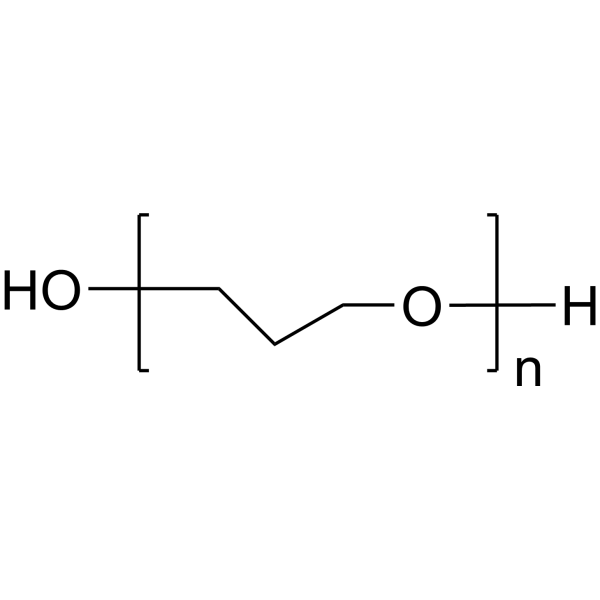
Poly(ethylene glycol) structure
|
Common Name | Poly(ethylene glycol) | ||
|---|---|---|---|---|
| CAS Number | 25322-68-3 | Molecular Weight | 104.15 | |
| Density | 1.125 | Boiling Point | 250ºC | |
| Molecular Formula | C5H12O2 | Melting Point | -65ºC | |
| MSDS | Chinese USA | Flash Point | 171ºC | |
| Symbol |


GHS06, GHS08, GHS09 |
Signal Word | Danger | |
Use of Poly(ethylene glycol)PEG300 is a neutral and biocompatible hydrophilic polymer. |
| Name | poly(ethylene glycol) |
|---|---|
| Synonym | More Synonyms |
| Description | PEG300 is a neutral and biocompatible hydrophilic polymer. |
|---|---|
| Related Catalog | |
| References |
| Density | 1.125 |
|---|---|
| Boiling Point | 250ºC |
| Melting Point | -65ºC |
| Molecular Formula | C5H12O2 |
| Molecular Weight | 104.15 |
| Flash Point | 171ºC |
| Vapour density | >1 (vs air) |
| Vapour Pressure | <0.01 mm Hg ( 20 °C) |
| Index of Refraction | 1.458-1.461 |
| Storage condition | 2-8°C |
| Stability | Stable. Incompatible with strong oxidizing agents. |
| Water Solubility | H2O: 50 mg/mL, clear, colorless |
CHEMICAL IDENTIFICATION
HEALTH HAZARD DATAACUTE TOXICITY DATA
|
| Symbol |
GHS06, GHS08, GHS09 |
|---|---|
| Signal Word | Danger |
| Hazard Statements | H302-H311-H373-H411 |
| Precautionary Statements | P273-P280-P301 + P312 + P330-P302 + P352 + P312-P391-P501 |
| Personal Protective Equipment | Eyeshields;Gloves;type N95 (US);type P1 (EN143) respirator filter |
| Hazard Codes | Xi |
| Risk Phrases | R36/38 |
| Safety Phrases | S24/25 |
| RIDADR | NONH for all modes of transport |
| WGK Germany | 3 |
| RTECS | TQ4110000 |
| HS Code | 3404900000 |
| HS Code | 3404900000 |
|---|
|
A Comparison of the α2/3/5 Selective Positive Allosteric Modulators L-838,417 and TPA023 in Preclinical Models of Inflammatory and Neuropathic Pain.
Adv. Pharmacol. Sci. 2011 , 608912, (2011) GABA(A) receptors containing α2/3 subunits are current targets in the battle to develop new pain medications, as they are expressed in the spinal cord where increasing inhibitory drive should result i... |
|
|
PDADMAC flocculation of Chinese hamster ovary cells: enabling a centrifuge-less harvest process for monoclonal antibodies.
MAbs 7(2) , 413-28, (2015) High titer (>10 g/L) monoclonal antibody (mAb) cell culture processes are typically achieved by maintaining high viable cell densities over longer culture durations. A corresponding increase in the so... |
|
|
Localized experimental bone metastasis drives osteolysis and sensory hypersensitivity at distant non-tumor-bearing sites.
Breast Cancer Res. Treat. 153 , 9-20, (2015) Patients with breast cancer metastasis to bone suffer from inadequate pain relief. Animal models provide increased understanding of cancer-induced bone and sensory alterations. The objective of this s... |
| EINECS 203-473-3 |
| Polyethylene glycol 10000 |
| Poly(ethylene oxide),approx. M.W. 900,000 |
| Polyethylene glycol 1000 |
| Poly(ethylene glycol),average M.W. 200 |
| Polyethylene glycol 12000 |
| Polyethylene glycol (PEG) |
| Poly(ethylene glycol) |
| Poly(ethylene g |
| Macrogol 300,PEG |
| MFCD00081839 |
| Polyethylene Glycol |
| Poly(ethylene oxide) |
| PEG (Poly(ethylene glycol) |
| Polyethylene oxide |
| PEG300 |
The content on this webpage is sourced from various professional data sources. If you have any questions or concerns regarding the content, please feel free to contact service1@chemsrc.com.
- Shanghai Nianxing Industrial Co., Ltd
- China
- Product Name: Poly(ethylene glycol)
- Price: Check
- Purity: 98.0%
- Delivery: 10 Day
- Contact: Yang
- Email: sales@echemcloud.com
- Shanghai Jizhi Biochemical Technology Co., Ltd
- China
- Product Name: Poly(ethylene glycol)
- Price: ¥98.0/1kg ¥98.0/1kg ¥98.0/500g ¥98.0/1kg
- Purity: 98.0%
- Delivery: 1 Day
- Contact: Liu jia


- Email: 2130147988@qq.com
- Dayang Chem (Hangzhou) Co., Ltd.
- China
- Product Name: Poly(ethylene oxide)
- Price: $Inquiry/100g $Inquiry/1kg $Inquiry/100kg $Inquiry/1000kg
- Purity: 98.0%
- Delivery: Inquiry
- Contact: Ms Wang
- Email: enquiry@dycnchem.com
Get all suppliers and price by the below link:
Poly(ethylene glycol) suppliers
Reference only. check more Poly(ethylene glycol) price