Apamin
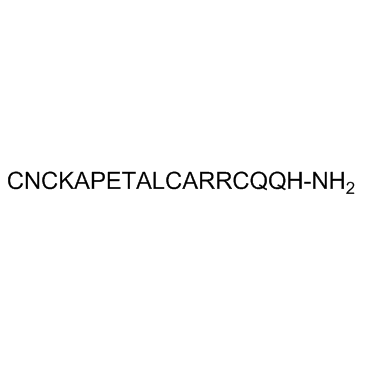
Apamin structure
|
Common Name | Apamin | ||
|---|---|---|---|---|
| CAS Number | 24345-16-2 | Molecular Weight | 2027.339 | |
| Density | 1.6±0.1 g/cm3 | Boiling Point | N/A | |
| Molecular Formula | C79H131N31O24S4 | Melting Point | N/A | |
| MSDS | Chinese USA | Flash Point | N/A | |
| Symbol |

GHS08 |
Signal Word | Danger | |
Use of ApaminApamin, an 18 amino acid peptide neurotoxin found in apitoxin (bee venom), is known to block Ca2+-activated K+ channels and prevent carbon tetrachloride-induced liver fibrosis. |
| Name | Apamin |
|---|---|
| Synonym | More Synonyms |
| Description | Apamin, an 18 amino acid peptide neurotoxin found in apitoxin (bee venom), is known to block Ca2+-activated K+ channels and prevent carbon tetrachloride-induced liver fibrosis. |
|---|---|
| Related Catalog | |
| Target |
K+ channel[1] |
| In Vitro | Apamin is an 18 amino acid peptide neurotoxin found in apitoxin (bee venom). It has long been known as a specifically selective blocker of Ca2+-activated K+ (SK) channels. Apamin inhibits liver fibrosis in a 3,5-diethoxycarbonyl-1,4-dihydrocollidine (DDC)-induced mouse model as determined by hematoxylin and eosin staining. Apamin treatment attenuates inflammatory cytokine expression, including IL-6, IFN-γ, TNF-α and IL-1β compared with expression levels in the DDC-fed group[1]. Apamin is an 18 amino acid peptide neurotoxin found in apitoxin (bee venom). Apamin, a neurotoxin extracted from bee venom, specifically binds to a particular class of Ca2+-activated K+ channels which are involved in the slow afterhyperpolarization (S-AHP) that follows action potentials in many excitable cell[2]. |
| In Vivo | To investigate the anti-fibrotic effect of Apamin on ECM deposition in the DDC-fed mice, Liver fibrosis induced by DDC is confirmed by induction of fibrogenic genes, FSP-1, α-smooth muscle actin (α-SMA) and collagen I expression. Expression of α-SMA is strongly expressed in the myofibroblasts and HSCs around the proliferated bile duct in the DDC-fed group and clearly with the Apamin treatment. Moreover, expression of collagen I in the DDC-fed group is significantly increased, especially in the portal tracts[1]. |
| Cell Assay | HSC-T6 cells, an immortalized rat hepatic stellate cell line, which has a stable phenotype and biochemical characteristics. Cells are cultured at 37°C in a humidified incubator under a 5% CO2 atmosphere. HSC-T6 cells are seeded in complete medium for 24 h. The cells are changed to fresh serum-free media containing the indicated concentrations of Apamin (0.5, 1 and 2 µg/mL). After 24 h, the cells are replaced with fresh serum-free media containing 2 ng/mL of TGF-β1 for 24 h[1]. |
| Animal Admin | Mice[1] For induction of liver injury, 8-week-old C57BL/6 male mice (20-25 g) are selected. Male C57BL/6 mice are fed a control diet or a DDC supplemented diet (0.1%) for 4 weeks to induce advanced biliary fibrosis. The mice receive an intraperitoneal injection of Apamin (0.1 mg/kg) dissolved in saline twice a week. Mice are sacrificed after 4 weeks from the first DDC diet administration. |
| References |
| Density | 1.6±0.1 g/cm3 |
|---|---|
| Molecular Formula | C79H131N31O24S4 |
| Molecular Weight | 2027.339 |
| Exact Mass | 2025.886597 |
| PSA | 1021.52000 |
| LogP | -14.24 |
| Index of Refraction | 1.724 |
| InChIKey | YVIIHEKJCKCXOB-UHFFFAOYSA-N |
| SMILES | CC(C)CC1NC(=O)C(C)NC(=O)C(C(C)O)NC(=O)C(CCC(=O)O)NC(=O)C2CCCN2C(=O)C(C)NC(=O)C(CCCCN)NC(=O)C2CSSCC(C(=O)NC(CCC(N)=O)C(=O)NC(CCC(N)=O)C(=O)NC(Cc3c[nH]cn3)C(N)=O)NC(=O)C(CCCNC(=N)N)NC(=O)C(CCCNC(=N)N)NC(=O)C(C)NC(=O)C(CSSCC(N)C(=O)NC(CC(N)=O)C(=O)N2)NC1=O |
CHEMICAL IDENTIFICATION
HEALTH HAZARD DATAACUTE TOXICITY DATA
|
| Symbol |
GHS08 |
|---|---|
| Signal Word | Danger |
| Hazard Statements | H334 |
| Precautionary Statements | P261-P342 + P311 |
| Hazard Codes | Xn |
| Safety Phrases | S22-S24/25 |
| RIDADR | UN 2811 |
| WGK Germany | 3 |
| RTECS | CD6899900 |
| Packaging Group | III |
| Hazard Class | 6.1(b) |
|
Type 2 diabetes: increased expression and contribution of IKCa channels to vasodilation in small mesenteric arteries of ZDF rats.
Am. J. Physiol. Heart Circ. Physiol. 307(8) , H1093-102, (2014) Impaired endothelial function, which is dysregulated in diabetes, also precedes hypertension. We hypothesized that in Type 2 diabetes, the impaired endothelium-dependent relaxation is due to a loss of... |
|
|
The effect of hyperpolarization-activated cyclic nucleotide-gated ion channel inhibitors on the vagal control of guinea pig airway smooth muscle tone.
Br. J. Pharmacol. 171(15) , 3633-50, (2014) Subtypes of the hyperpolarization-activated cyclic nucleotide-gated (HCN) family of cation channels are widely expressed on nerves and smooth muscle cells in many organ systems, where they serve to re... |
|
|
The GPR55 agonist lysophosphatidylinositol relaxes rat mesenteric resistance artery and induces Ca(2+) release in rat mesenteric artery endothelial cells.
Br. J. Pharmacol. 172 , 3043-57, (2015) Lysophosphatidylinositol (LPI), a lipid signalling molecule, activates GPR55 and elevates intracellular Ca(2+). Here, we examine the actions of LPI in the rat resistance mesenteric artery and Ca(2+) r... |
| apamine |
| MFCD00167944 |
| N-{[(1R,4S,7S,13S,16S,19S,22S,25S,28R,31S,34S,37S,40R,47S,50R)-50-Amino-4-(4-aminobutyl)-47-(2-amino-2-oxoethyl)-34,37-bis(3-carbamimidamidopropyl)-16-(2-carboxyethyl)-19-(1-hydroxyethyl)-25-isobut yl-7,22,31-trimethyl-2,5,8,14,17,20,23,26,29,32,35,38,46,49-tetradecaoxo-42,43,52,53-tetrathia-3,6,9,15,18,21,24,27,30,33,36,39,45,48-tetradecaazatricyclo[26.16.10.0]tetrapentacont-40-yl]carbony ;l}-L-glutaminyl-L-glutaminyl-L-histidinamide |
| Apamin |
| APAMIN,BEE VENOM |
| APAMIN FROM BEE VENOM |
| CNCKAPETALCARRCQQH-NH2 |
| M.W. 2027.34 C79H131N31O24S4 |
| APAMIN FROM HONEY BEE VENOM |
| EINECS 246-182-7 |
The content on this webpage is sourced from various professional data sources. If you have any questions or concerns regarding the content, please feel free to contact service1@chemsrc.com.
- Shanghai Nianxing Industrial Co., Ltd
- China
- Product Name: Apamin
- Price: Check
- Purity: 98.0%
- Delivery: 10 Day
- Contact: Yang
- Email: sales@echemcloud.com
- GL Biochem (Shanghai) Ltd.
- China
- Product Name: CNCKAPETALCARRCQQH-NH2
- Price: $Inquiry/1kg
- Purity: 98.0%
- Delivery: Inquiry
- Contact: Jackie Yang
- Email: ymbetter@glbiochem.com
- Shanghai Jizhi Biochemical Technology Co., Ltd
- China
- Product Name: Apamin
- Price: ¥Inquiry/1mg ¥648.0/1mg ¥3748.0/5mg
- Purity: 97.0%
- Delivery: Inquiry
- Contact: Liu jia


- Email: 2130147988@qq.com
- Nanjing Peptide Biotech Ltd
- China
- Product Name: Apamin
- Price: ¥Inquiry/10g ¥Inquiry/100g ¥Inquiry/1kg ¥Inquiry/10kg
- Purity: 98.0%
- Delivery: 7 Day
- Contact: jom
- Email: chenglong.fan@njpeptide.com
- Taiwan Oyi peptide Co. Ltd
- China
- Product Name: Apamin
- Price: $Inquiry/1mg $Inquiry/100kg
- Purity: 98.0%
- Delivery: 1 Day
- Contact: Vinnie
- Email: Jamie@api-made.com
Get all suppliers and price by the below link:
Reference only. check more Apamin price