AP C5
Modify Date: 2025-08-27 13:37:47
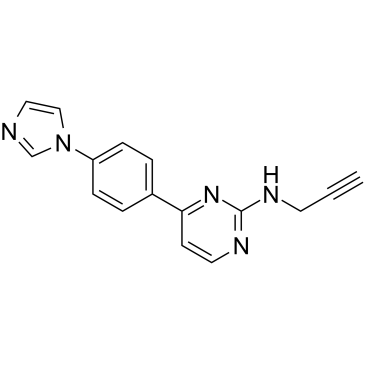
AP C5 structure
|
Common Name | AP C5 | ||
|---|---|---|---|---|
| CAS Number | 2234272-10-5 | Molecular Weight | 275.31 | |
| Density | N/A | Boiling Point | N/A | |
| Molecular Formula | C16H13N5 | Melting Point | N/A | |
| MSDS | N/A | Flash Point | N/A | |
Use of AP C5AP-C5 displays selective inhibition of guanosine 3′,5′-cyclic monophosphate (cGMP)-dependent protein kinase II (cGKII) with a pIC50 of 7.2, which can be used for the research of diarrheal disease[1]. |
| Name | AP-C5 |
|---|
| Description | AP-C5 displays selective inhibition of guanosine 3′,5′-cyclic monophosphate (cGMP)-dependent protein kinase II (cGKII) with a pIC50 of 7.2, which can be used for the research of diarrheal disease[1]. |
|---|---|
| Related Catalog | |
| Target |
pIC50: 7.2 (cGKII)[1] |
| In Vitro | AP-C5 shows potent inhibition of cGMP-dependent cGKII-mediated protein phosphorylation and effective inhibition of cGMP-dependent, CFTR-mediated anion secretion in intestinal tissue[1]. AP-C5 potentiates cAMP signaling by PDE inhibition[1]. AP-C5 (20 μM) partially blocks the heat-stable toxin (STa)-mediated short-circuit current (Isc) response in mouse ileum[1]. |
| References |
| Molecular Formula | C16H13N5 |
|---|---|
| Molecular Weight | 275.31 |
| InChIKey | QKHQFSQJQKGFAA-UHFFFAOYSA-N |
| SMILES | C#CCNc1nccc(-c2ccc(-n3ccnc3)cc2)n1 |