Danofloxacine
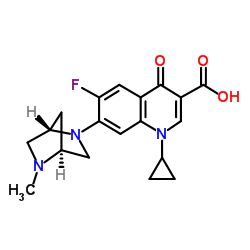
Danofloxacine structure
|
Common Name | Danofloxacine | ||
|---|---|---|---|---|
| CAS Number | 112398-08-0 | Molecular Weight | 357.379 | |
| Density | 1.5±0.1 g/cm3 | Boiling Point | 569.3±50.0 °C at 760 mmHg | |
| Molecular Formula | C19H20FN3O3 | Melting Point | 268-272ºC | |
| MSDS | Chinese USA | Flash Point | 298.1±30.1 °C | |
Use of DanofloxacineDanofloxacin is a third generation fluoroquinolone and orally active antimicrobial agent. Danofloxacin shows a broad spectrum of activity against most Gram-negative and Gram-positive bacteria, mycoplasma and chlamydia species, and plays an antimicrobial role by inhibition of bacterial DNA-gyrase. Danofloxacinh has the potential for respiratory diseases in cattle, swine, and chickens treatment[1][2]. |
This table lists Chinese names, IUPAC names and various aliases of this chemical substance.
| Name | Danofloxacin |
|---|---|
| Synonym | More Synonyms |
This table contains bioactivity, target information and biological‑assay experimental data of this compound.
| Description | Danofloxacin is a third generation fluoroquinolone and orally active antimicrobial agent. Danofloxacin shows a broad spectrum of activity against most Gram-negative and Gram-positive bacteria, mycoplasma and chlamydia species, and plays an antimicrobial role by inhibition of bacterial DNA-gyrase. Danofloxacinh has the potential for respiratory diseases in cattle, swine, and chickens treatment[1][2]. |
|---|---|
| Related Catalog | |
| References |
This table shows physicochemical parameters including melting point, boiling point, density, solubility and optical rotation. Missing data is marked as N/A.
| Density | 1.5±0.1 g/cm3 |
|---|---|
| Boiling Point | 569.3±50.0 °C at 760 mmHg |
| Melting Point | 268-272ºC |
| Molecular Formula | C19H20FN3O3 |
| Molecular Weight | 357.379 |
| Flash Point | 298.1±30.1 °C |
| Exact Mass | 357.148865 |
| PSA | 65.78000 |
| LogP | 1.20 |
| Vapour Pressure | 0.0±1.6 mmHg at 25°C |
| Index of Refraction | 1.679 |
| InChIKey | QMLVECGLEOSESV-RYUDHWBXSA-N |
| SMILES | C[NH+]1CC2CC1CN2c1cc2c(cc1F)c(=O)c(C(=O)[O-])cn2C1CC1 |
| Water Solubility | Soluble in water, acetic acid and DMSO |
This table covers safety warnings, protective measures, incompatible substances and disposal guidelines for this compound.
| Personal Protective Equipment | Eyeshields;Gloves;type N95 (US);type P1 (EN143) respirator filter |
|---|---|
| Hazard Codes | Xn,Xi |
| Risk Phrases | 20/21/22-36/37/38 |
| Safety Phrases | 22-24/25 |
| RIDADR | NONH for all modes of transport |
This table presents publicly reported synthetic routes, reaction conditions, reactants and product information of the compound.
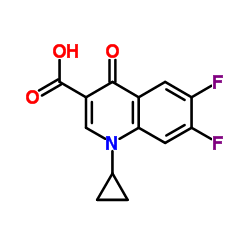
![2-Methyl-2,5-diaza-bicyclo[2.2.1]heptanedihydrochloride structure](https://image.chemsrc.com/caspic/086/52321-26-3.png)
This table lists upstream starting materials and downstream derivative products related to this chemical.
| Precursor 1 | |
|---|---|
| DownStream 0 | |
This table lists relevant public references with title, journal and publication metadata for this compound.
|
Multiresidue determination of fluoroquinolones in poultry muscle and kidney according to the regulation 2002/657/EC. A systematic comparison of two different approaches: Liquid chromatography coupled to high-resolution mass spectrometry or tandem mass spectrometry.
J. Chromatogr. A. 1379 , 83-91, (2015) This work involved the optimization and validation of two methods according to the Commission Decision 2002/657/EC directives for determining fluoroquinolones residues in samples of poultry muscle and... |
|
|
Simultaneous determination of 38 veterinary antibiotic residues in raw milk by UPLC-MS/MS.
Food Chem. 181 , 119-26, (2015) A selective and rapid method has been developed to determine, simultaneously, 38 veterinary antibiotic residues in raw milk by ultra-high-performance liquid chromatography-tandem mass spectrometry (UP... |
|
|
Decay mechanisms of protonated 4-quinolone antibiotics after electrospray ionization and ion activation.
J. Am. Soc. Mass Spectrom. 25(11) , 1974-86, (2014) This study presents a detailed experimental investigation of charge isomers of protonated 4-quinolone antibiotics molecules formed during electrospray ionization (ESI) with proposed dissociation mecha... |
This table contains target information, in‑vitro & in‑vivo assay data for this compound.
This table collects all English aliases, systematic names and CAS‑related synonyms of the compound.
| 1-Cyclopropyl-6-fluoro-7-[(1S,4S)-5-methyl-2,5-diazabicyclo[2.2.1]hept-2-yl]-4-oxo-1,4-dihydro-3-quinolinecarboxylic acid |
| danofloxacin |
| 1-Cyclopropyl-6-fluoro-7-[(1S,4S)-5-methyl-2,5-diazabicyclo[2.2.1]hept-2-yl]-4-oxo-1,4-dihydroquinoline-3-carboxylic acid |
| (1S)-1-Cyclopropyl-6-fluoro-1,4-dihydro-7-(5-methyl-2,5-diazabicyclo[2.2.1]hept-2-yl)-4-oxo-3-quinolinecarboxylic acid |
This section contains frequently‑asked‑questions about this compound, including basic parameters, properties, storage conditions and corresponding answers.
| Q: What is the InChIKey of Danofloxacin? |
| A: InChIKey of Danofloxacin is QMLVECGLEOSESV-RYUDHWBXSA-N. |
| Q: What is the polar surface area (PSA) of Danofloxacin? |
| A: Polar surface area (PSA) of Danofloxacin is 65.78000. |
| Q: What is the CAS number of Danofloxacin? |
| A: CAS number of Danofloxacin is 112398-08-0. |
| Q: What is the safety information for Danofloxacin? |
| A: Safety information for Danofloxacin: 22-24/25. |
| Q: What is the molecular weight of Danofloxacin? |
| A: Molecular weight of Danofloxacin is 357.379. |
| Q: What are the upstream materials of Danofloxacin? |
| A: Related upstream materials(CAS) of Danofloxacin: 93107-30-3. |
| Q: How is the water solubility of Danofloxacin? |
| A: Water solubility of Danofloxacin: Soluble in water, acetic acid and DMSO. |
| Q: What are the uses of Danofloxacin? |
| A: Main uses of Danofloxacin: Danofloxacin is a third generation fluoroquinolone and orally active antimicrobial agent. Danofloxacin shows a broad spectrum of activity against most Gram-negative and Gram-positive bacteria, mycoplasma and chlamydia species, and plays an antimicrobial role by inhibition of bacterial DNA-gyrase. Danofloxacinh has the potential for respiratory diseases in cattle, swine, and chickens treatment[1][2]. |
| Q: What is the SMILES notation of Danofloxacin? |
| A: SMILES notation of Danofloxacin is C[NH+]1CC2CC1CN2c1cc2c(cc1F)c(=O)c(C(=O)[O-])cn2C1CC1. |
| Q: What English synonyms does Danofloxacin have? |
| A: English synonyms of Danofloxacin: 1-Cyclopropyl-6-fluoro-7-[(1S,4S)-5-methyl-2,5-diazabicyclo[2.2.1]hept-2-yl]-4-oxo-1,4-dihydro-3-quinolinecarboxylic acid, danofloxacin, 1-Cyclopropyl-6-fluoro-7-[(1S,4S)-5-methyl-2,5-diazabicyclo[2.2.1]hept-2-yl]-4-oxo-1,4-dihydroquinoline-3-carboxylic acid, (1S)-1-Cyclopropyl-6-fluoro-1,4-dihydro-7-(5-methyl-2,5-diazabicyclo[2.2.1]hept-2-yl)-4-oxo-3-quinolinecarboxylic acid. |
This table lists manufacturers and suppliers of this compound, including vendor names and product supply reference information.
| Shanghai Nianxing Industrial Co., Ltd |
| Dayang Chem (Hangzhou) Co., Ltd. |