5-Chloro-2'-deoxyuridine
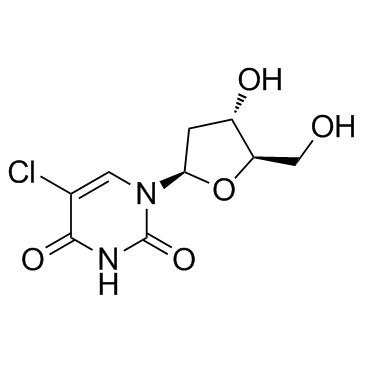
5-Chloro-2'-deoxyuridine structure
|
Common Name | 5-Chloro-2'-deoxyuridine | ||
|---|---|---|---|---|
| CAS Number | 50-90-8 | Molecular Weight | 262.64700 | |
| Density | 1.67 g/cm3 | Boiling Point | N/A | |
| Molecular Formula | C9H11ClN2O5 | Melting Point | 176-179ºC | |
| MSDS | Chinese USA | Flash Point | N/A | |
| Symbol |


GHS07, GHS08 |
Signal Word | Warning | |
Use of 5-Chloro-2'-deoxyuridine5-Chloro-2'-deoxyuridine, a thymine analog, is to study the potential of hypochlorous acid damage to DNA and DNA precursors. |
This table lists Chinese names, IUPAC names and various aliases of this chemical substance.
| Name | 5-chloro-2'-deoxyuridine |
|---|---|
| Synonym | More Synonyms |
This table contains bioactivity, target information and biological‑assay experimental data of this compound.
| Description | 5-Chloro-2'-deoxyuridine, a thymine analog, is to study the potential of hypochlorous acid damage to DNA and DNA precursors. |
|---|---|
| Related Catalog | |
| In Vitro | When 5-Chloro-2’-deoxyuridine (ClDU) is placed into tissue culture medium, mammalian cells incorporate the analog into DNA. It is observed that 10 μM concentration of 5-Chloro-2’-deoxyuridine in the media does not alter cell division kinetics. Previously it has been shown that 5-Chloro-2’-deoxyuridine is metabolized and incorporated into DNA using antibodies that bind selectively to DNA containing halogenated bases. In the studies reported here, 5-Chloro-2’-deoxyuridine is more similar to BrdU in acting as a T analog. The toxicity of 5-Chloro-2’-deoxyuridine could in part be attributed to inhibition of thymidylate synthase[1]. |
| Cell Assay | Human erythroleukemia K-562 cells are used throughout the study. Cells are initially seeded at 1.0×10⁵ cells/mL and treated with either 10 μM 5-Chloro-2’-deoxyuridine or 10 μM thymidine (negative control) for 63 h, or two cell doublings. Cells are counted by trypan blue exclusion, pelleted by centrifugation (500×g) and washed with 10 mL sterile PBS[1]. |
| Animal Admin | Rats[2] Adult, male Wistar rats, weighing 200-250 g are used. Firstly, the animals are allowed to self-administer methamphetamine at a dose of 0.05 mg/kg/injection under a fixed-ratio 1 (FR1) schedule for baseline sessions. After that, the rats are divided into four groups. Two groups of rats (long-access; LgA-4 days (d), LgA-13 d; n=7 per group) are allowed to self-administer 0.05 mg/kg/injection of methamphetamine for 6 h per day, whereas the other groups (short-access; ShA-4 d, ShA-13 d; n=7 per group) are allowed to do so for 1 h per day. All procedures are performed during the dark cycle. On day 5, ShA-4 d and LgA-4 d rats receive one injection of 50 mg/kg 5-chloro-2’-deoxyuridine and survive for 30 min. On day 14, ShA-13 d and LgA-13 d receive one injection of 50 mg/kg 5-Iodo-2’-deoxyuridine followed by 50 mg/kg 5-chloro-2’-deoxyuridine 2 h later. These rats also survive for 30 min after the 5-Chloro-2'-deoxyuridine injection. A parallel group of drug-naive rats (n=6) receive one injection of 50 mg/kg IdU followed by 50 mg/kg 5-Chloro-2'-deoxyuridine 2 h later. These rats also survive for 30 min after the 5-Chloro-2'-deoxyuridine injection[2]. |
| References |
This table shows physicochemical parameters including melting point, boiling point, density, solubility and optical rotation. Missing data is marked as N/A.
| Density | 1.67 g/cm3 |
|---|---|
| Melting Point | 176-179ºC |
| Molecular Formula | C9H11ClN2O5 |
| Molecular Weight | 262.64700 |
| Exact Mass | 262.03600 |
| PSA | 104.55000 |
| Index of Refraction | 1.644 |
| InChIKey | NJCXGFKPQSFZIB-XVMARJQXSA-N |
| SMILES | O=c1[nH]c(=O)n(C2CC(O)C(CO)O2)cc1Cl |
This table provides MSDS information including hazard classification, first‑aid, fire‑fighting, spill handling, operation and storage instructions.
This table summarizes toxicological test data, acute & chronic toxicity and ecological hazard parameters for this chemical.
CHEMICAL IDENTIFICATION
HEALTH HAZARD DATAACUTE TOXICITY DATA
MUTATION DATA
|
This table covers safety warnings, protective measures, incompatible substances and disposal guidelines for this compound.
| Symbol |
GHS07, GHS08 |
|---|---|
| Signal Word | Warning |
| Hazard Statements | H302-H312-H332-H351 |
| Precautionary Statements | P280 |
| Personal Protective Equipment | dust mask type N95 (US);Eyeshields;Gloves |
| Hazard Codes | Xn: Harmful; |
| Risk Phrases | R20/21/22 |
| Safety Phrases | 36/37/39-45 |
| RIDADR | NONH for all modes of transport |
| WGK Germany | 3 |
| RTECS | YU7400000 |
| HS Code | 2942000000 |
This table presents publicly reported synthetic routes, reaction conditions, reactants and product information of the compound.
|
~94%
5-Chloro-2'-deo... CAS#:50-90-8 |
| Literature: Asakura, Jun-ichi; Robins, Morris J. Journal of Organic Chemistry, 1990 , vol. 55, # 16 p. 4928 - 4933 |
|
~%
5-Chloro-2'-deo... CAS#:50-90-8 |
| Literature: Yueh, Han; Yu, Hongchuan; Theile, Christopher S.; Pal, Ayan; Horhota, Allen; Greco, Nicholas; Christianson, Carl V.; McLaughlin, Larry W. Nucleosides, Nucleotides and Nucleic Acids, 2012 , vol. 31, # 9 p. 661 - 679 |
|
~84%
5-Chloro-2'-deo... CAS#:50-90-8
Learn More
|
| Literature: Hatano, Akihiko; Harano, Aiko; Kirihara, Masayuki Chemistry Letters, 2006 , vol. 35, # 2 p. 232 - 233 |
|
~89%
5-Chloro-2'-deo... CAS#:50-90-8 |
| Literature: Kumar, Vineet; Yap, Jeremy; Muroyama, Andrew; Malhotra, Sanjay V. Synthesis, 2009 , # 23 art. no. M01709SS, p. 3957 - 3962 |
|
~19%
5-Chloro-2'-deo... CAS#:50-90-8 |
| Literature: Kawai, Kiyohiko; Saito, Isao; Sugiyama, Hiroshi Tetrahedron Letters, 1999 , vol. 40, # 31 p. 5721 - 5724 |
![[(2R,3S,5R)-3-acetyloxy-5-(5-chloro-2,4-dioxopyrimidin-1-yl)oxolan-2-yl]methyl acetate structure](https://image.chemsrc.com/caspic/394/6046-63-5.png)
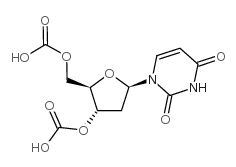
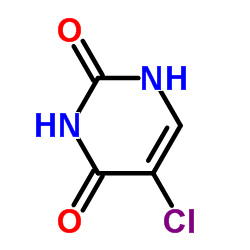
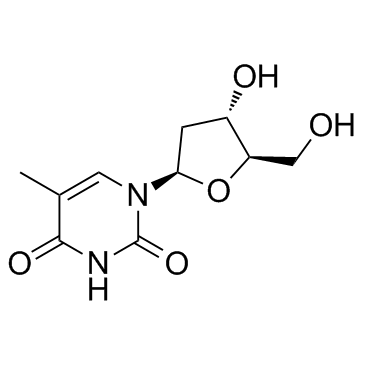
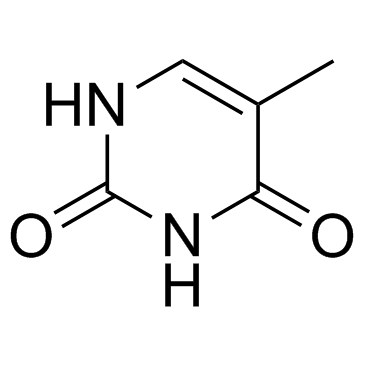
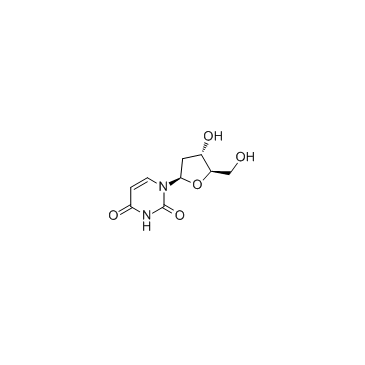
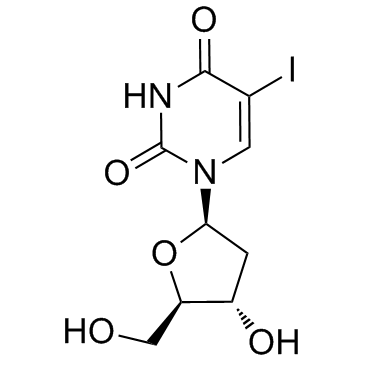
This table lists upstream starting materials and downstream derivative products related to this chemical.
| Precursor 6 | |
|---|---|
| DownStream 1 | |
This table shows customs‑related data including HS‑code, tariff and regulatory conditions for import and export.
| HS Code | 2942000000 |
|---|
This table lists relevant public references with title, journal and publication metadata for this compound.
|
RAD50 phosphorylation promotes ATR downstream signaling and DNA restart following replication stress.
Hum. Mol. Genet. 23(16) , 4232-48, (2014) The MRE11/RAD50/NBN (MRN) complex plays a key role in detecting DNA double-strand breaks, recruiting and activating ataxia-telangiectasia mutated and in processing the breaks. Members of this complex ... |
|
|
Both high-fidelity replicative and low-fidelity Y-family polymerases are involved in DNA rereplication.
Mol. Cell. Biol. 35(4) , 699-715, (2015) DNA rereplication is a major form of aberrant replication that causes genomic instabilities, such as gene amplification. However, little is known about which DNA polymerases are involved in the proces... |
|
|
Role of the Exocyst Complex Component Sec6/8 in Genomic Stability.
Mol. Cell. Biol. 35 , 3633-45, (2015) The exocyst is a heterooctomeric complex well appreciated for its role in the dynamic assembly of specialized membrane domains. Accumulating evidence indicates that this macromolecular machine also se... |
This table contains target information, in‑vitro & in‑vivo assay data for this compound.
This table collects all English aliases, systematic names and CAS‑related synonyms of the compound.
| 5-CHLORODEOXYURIDINE |
| MFCD00006531 |
| 5-CHLORODESOXYURIDINE |
| 5-Chloro-2'-deoxy-D-uridine |
| CLUDR |
| 5-Chlorodeoxyuridin |
| CldU |
| 2'-DEOXY-5-CHLOROURIDINE |
| Chlorodeoxyuridine |
This section contains frequently‑asked‑questions about this compound, including basic parameters, properties, storage conditions and corresponding answers.
| Q: What is the English name of 5-chloro-2'-deoxyuridine? |
| A: The English name of 5-chloro-2'-deoxyuridine is 5-chloro-2'-deoxyuridine. |
| Q: What is the molecular formula of 5-chloro-2'-deoxyuridine? |
| A: Molecular formula of 5-chloro-2'-deoxyuridine is C9H11ClN2O5. |
| Q: What are the uses of 5-chloro-2'-deoxyuridine? |
| A: Main uses of 5-chloro-2'-deoxyuridine: 5-Chloro-2'-deoxyuridine, a thymine analog, is to study the potential of hypochlorous acid damage to DNA and DNA precursors. |
| Q: What is the safety information for 5-chloro-2'-deoxyuridine? |
| A: Safety information for 5-chloro-2'-deoxyuridine: 36/37/39-45. |
| Q: What is the polar surface area (PSA) of 5-chloro-2'-deoxyuridine? |
| A: Polar surface area (PSA) of 5-chloro-2'-deoxyuridine is 104.55000. |
| Q: What are the downstream products of 5-chloro-2'-deoxyuridine? |
| A: Related downstream products(CAS) of 5-chloro-2'-deoxyuridine: 1820-81-1. |
| Q: What is the melting point of 5-chloro-2'-deoxyuridine? |
| A: Melting point of 5-chloro-2'-deoxyuridine is 176-179ºC. |
| Q: What are the upstream materials of 5-chloro-2'-deoxyuridine? |
| A: Related upstream materials(CAS) of 5-chloro-2'-deoxyuridine: 6046-63-5;951-78-0;13030-62-1;54-42-2;1820-81-1;50-89-5. |
| Q: What is the SMILES notation of 5-chloro-2'-deoxyuridine? |
| A: SMILES notation of 5-chloro-2'-deoxyuridine is O=c1[nH]c(=O)n(C2CC(O)C(CO)O2)cc1Cl. |
| Q: What is the molecular weight of 5-chloro-2'-deoxyuridine? |
| A: Molecular weight of 5-chloro-2'-deoxyuridine is 262.64700. |
This table lists manufacturers and suppliers of this compound, including vendor names and product supply reference information.
| Shanghai Nianxing Industrial Co., Ltd |
| Dayang Chem (Hangzhou) Co., Ltd. |