Ropinirole hydrochloride
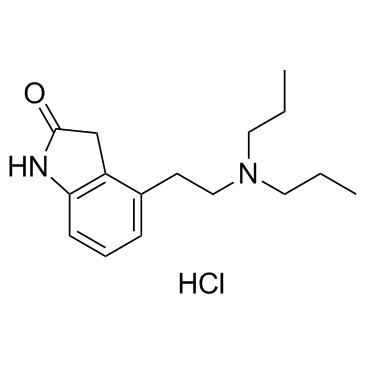
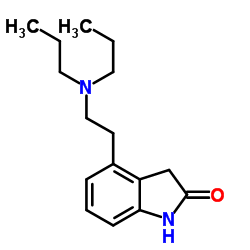
Ropinirole hydrochloride structure
|
Common Name | Ropinirole hydrochloride | ||
|---|---|---|---|---|
| CAS Number | 91374-20-8 | Molecular Weight | 296.836 | |
| Density | N/A | Boiling Point | 410.5ºC at 760mmHg | |
| Molecular Formula | C16H25ClN2O | Melting Point | 241-243ºC | |
| MSDS | Chinese USA | Flash Point | N/A | |
| Symbol |


GHS07, GHS09 |
Signal Word | Warning | |
Use of Ropinirole hydrochlorideRopinirole hydrochloride(SKF101468 hydrochloride) a selective dopamine D2 receptor inhibitor with IC50 of 29 nM.Target: Dopamine D2 ReceptorRopinirole (50 mg/kg, i.p.) causes biphasic spontaneous locomotor activity in mice. Ropinirole (0.05-1.0 mg/kg SC) dose-dependently inhibits the dyskinesias induced by 2-di-n-propylamino-5,6-di-hydroxytetralin in mice. Ropirtirole, at doses of 1 and 10 μg, injected unilaterally directly into the striatum of the rat causes marked, contralateral (away from the side of injection) asymmetry and circling in mice. Ropinirole (0.05-1.0 mg/kg SC or 0.1 mg/kg PO) reverses all motor and behavioural deficits induced by MPTP in marmosets [1]. Ropinirole (2 mg/kg, i.p.) for 7 days increases GSH, catalase and SOD activities in the striatum and protected striatal dopaminergic neurons against 6-hydroxydopamine (6-OHDA) in mice [2]. Ropinirole (0.2 mg/kg, i.p.) improves the use of previously akinetic forelimb and produced robust circling behavior in lesioned rats with striatal over-expression of both D2R and D3R compared to lesioned animals that received blank vector. The subtherapeutic dose of ropinirole generates only modest motor effects in lesioned rats with sole over-expression of D2R or D3R [3]. Ropinirole (1-8 mg t.i.d.) is rapidly and completely absorbed with oral bioavailability of 55%, clearance of 780 mL/min, elimination half-life of 6 hours in healthy volunteer. Since the major route of elimination for Ropinirole is by the CYP enzyme system, mainly by CYP1A2 and also by CYP3A4, inhibition of the former and possibly the latter may reduce the agent's clearance and lead to drug accumulation [4]. |
This table lists Chinese names, IUPAC names and various aliases of this chemical substance.
| Name | 4-(2-(Dipropylamino)ethyl)indolin-2-one hydrochloride |
|---|---|
| Synonym | More Synonyms |
This table contains bioactivity, target information and biological‑assay experimental data of this compound.
| Description | Ropinirole hydrochloride(SKF101468 hydrochloride) a selective dopamine D2 receptor inhibitor with IC50 of 29 nM.Target: Dopamine D2 ReceptorRopinirole (50 mg/kg, i.p.) causes biphasic spontaneous locomotor activity in mice. Ropinirole (0.05-1.0 mg/kg SC) dose-dependently inhibits the dyskinesias induced by 2-di-n-propylamino-5,6-di-hydroxytetralin in mice. Ropirtirole, at doses of 1 and 10 μg, injected unilaterally directly into the striatum of the rat causes marked, contralateral (away from the side of injection) asymmetry and circling in mice. Ropinirole (0.05-1.0 mg/kg SC or 0.1 mg/kg PO) reverses all motor and behavioural deficits induced by MPTP in marmosets [1]. Ropinirole (2 mg/kg, i.p.) for 7 days increases GSH, catalase and SOD activities in the striatum and protected striatal dopaminergic neurons against 6-hydroxydopamine (6-OHDA) in mice [2]. Ropinirole (0.2 mg/kg, i.p.) improves the use of previously akinetic forelimb and produced robust circling behavior in lesioned rats with striatal over-expression of both D2R and D3R compared to lesioned animals that received blank vector. The subtherapeutic dose of ropinirole generates only modest motor effects in lesioned rats with sole over-expression of D2R or D3R [3]. Ropinirole (1-8 mg t.i.d.) is rapidly and completely absorbed with oral bioavailability of 55%, clearance of 780 mL/min, elimination half-life of 6 hours in healthy volunteer. Since the major route of elimination for Ropinirole is by the CYP enzyme system, mainly by CYP1A2 and also by CYP3A4, inhibition of the former and possibly the latter may reduce the agent's clearance and lead to drug accumulation [4]. |
|---|---|
| Related Catalog | |
| References |
This table shows physicochemical parameters including melting point, boiling point, density, solubility and optical rotation. Missing data is marked as N/A.
| Boiling Point | 410.5ºC at 760mmHg |
|---|---|
| Melting Point | 241-243ºC |
| Molecular Formula | C16H25ClN2O |
| Molecular Weight | 296.836 |
| Exact Mass | 296.165527 |
| PSA | 32.34000 |
| LogP | 3.78570 |
| InChIKey | XDXHAEQXIBQUEZ-UHFFFAOYSA-N |
| SMILES | CCCN(CCC)CCc1cccc2c1CC(=O)N2.Cl |
| Storage condition | Room temp |
This table summarizes toxicological test data, acute & chronic toxicity and ecological hazard parameters for this chemical.
CHEMICAL IDENTIFICATION
HEALTH HAZARD DATAACUTE TOXICITY DATA
|
This table covers safety warnings, protective measures, incompatible substances and disposal guidelines for this compound.
| Symbol |
GHS07, GHS09 |
|---|---|
| Signal Word | Warning |
| Hazard Statements | H302-H400 |
| Precautionary Statements | P301 + P312 + P330 |
| Personal Protective Equipment | dust mask type N95 (US);Eyeshields;Faceshields;Gloves |
| Hazard Codes | Xn,N |
| Risk Phrases | R22 |
| Safety Phrases | 36-60-61-37/39-26 |
| RIDADR | UN 3077 9/PG 3 |
| RTECS | NM3288250 |
| Hazard Class | 9.0 |
| HS Code | 2933790090 |
This table presents publicly reported synthetic routes, reaction conditions, reactants and product information of the compound.
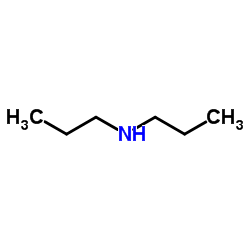
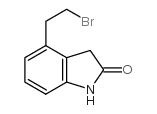
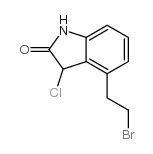
|
~89%
Ropinirole hydr... CAS#:91374-20-8 |
| Literature: IND-SWIFT LABORATORIES LIMITED Patent: WO2008/84499 A1, 2008 ; Location in patent: Page/Page column 8 ; |
|
~50%
Ropinirole hydr... CAS#:91374-20-8 |
| Literature: TORRENT PHARMACEUTICALS LTD Patent: WO2005/80333 A1, 2005 ; Location in patent: Page/Page column 23 ; |
|
~%
Ropinirole hydr... CAS#:91374-20-8 |
| Literature: WO2011/30330 A2, ; Page/Page column 9 ; |
|
~%
Ropinirole hydr... CAS#:91374-20-8 |
| Literature: WO2005/40115 A1, ; Page/Page column 6 ; |
|
~40%
Ropinirole hydr... CAS#:91374-20-8 |
| Literature: Helm AG; CF Pharma Gyogyszergyarto Kft. Patent: EP1568689 A1, 2005 ; Location in patent: Page/Page column 7 ; |
|
~85%
Ropinirole hydr... CAS#:91374-20-8 |
| Literature: Hayler, John D.; Howie, Simon L. B.; Giles, Robert G.; Negus, Alan; Oxley, Paul W.; Walsgrove, Timothy C.; Whiter Organic Process Research and Development, 1998 , vol. 2, # 1 p. 3 - 9 |
|
~%
Ropinirole hydr... CAS#:91374-20-8 |
| Literature: WO2011/72704 A1, ; |
|
~%
Ropinirole hydr... CAS#:91374-20-8 |
| Literature: Organic Process Research and Development, , vol. 2, # 1 p. 3 - 9 |
|
~%
Ropinirole hydr... CAS#:91374-20-8 |
| Literature: Organic Process Research and Development, , vol. 2, # 1 p. 3 - 9 |

![2-{2-[2-(dipropylamino)ethyl]phenyl}-N-hydroxyacetamide structure](https://image.chemsrc.com/caspic/470/863436-07-1.png)
![4-[2'-[[(4-Methylphenyl)sulfonyl]oxy]ethyl]-1,3-dihydro-2H-indole-2-one structure](https://image.chemsrc.com/caspic/086/139122-20-6.png)
![[2-(2-methyl-3-nitro-phenyl)-ethyl]-dipropyl-amine hydrochloride structure](https://image.chemsrc.com/caspic/123/920986-68-1.png)
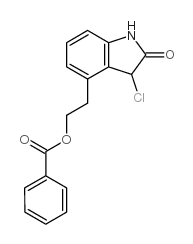
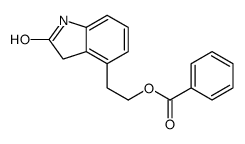
This table lists upstream starting materials and downstream derivative products related to this chemical.
| Precursor 10 | |
|---|---|
| DownStream 1 | |
This table shows customs‑related data including HS‑code, tariff and regulatory conditions for import and export.
| HS Code | 2933790090 |
|---|---|
| Summary | 2933790090. other lactams. VAT:17.0%. Tax rebate rate:9.0%. . MFN tariff:9.0%. General tariff:20.0% |
This table lists relevant public references with title, journal and publication metadata for this compound.
|
Sustained release microspheres of ropinirole hydrochloride: effect of process parameters.
Acta. Pharm. 61 , 363-376, (2011) An emulsion solvent evaporation method was employed to prepare microspheres of ropinirole hydrochloride, a highly water soluble drug, by using ethylcellulose and PEG with the help of 32 full factorial... |
|
|
Serotonergic and dopaminergic mechanisms in graft-induced dyskinesia in a rat model of Parkinson's disease
Neurobiol. Dis. 47(3) , 393-406, (2012) Dyskinesia seen in the off-state, referred as graft-induced dyskinesia (GID), has emerged as a serious complication induced by dopamine (DA) cell transplantation in parkinsonian patients. Although the... |
|
|
Structure-activity relationship study of N⁶-(2-(4-(1H-Indol-5-yl)piperazin-1-yl)ethyl)-N⁶-propyl-4,5,6,7-tetrahydrobenzo[d]thiazole-2,6-diamine analogues: development of highly selective D3 dopamine receptor agonists along with a highly potent D2/D3 agonist and their pharmacological characterization.
J. Med. Chem. 55(12) , 5826-40, (2012) In our effort to develop multifunctional drugs against Parkinson's disease, a structure-activity-relationship study was carried out based on our hybrid molecular template targeting D2/D3 receptors. Co... |
This table contains target information, in‑vitro & in‑vivo assay data for this compound.
|
Name: QFRET-based biochemical primary high throughput screening assay to identify exosite i...
Source: The Scripps Research Institute Molecular Screening Center
Target: disintegrin and metalloproteinase domain-containing protein 17 preproprotein [Homo sapiens]
External Id: ADAM17_INH_QFRET_1536_1X%INH PRUN
|
|
Name: Thermal Shift Assay. Domain: start/stop: M1-L298
Source: ChEMBL
Target: Cyclin-dependent kinase 2
External Id: CHEMBL5062802
|
|
Name: Inhibition of neurosphere proliferation of mouse neural precursor cells by MTT assay
Source: ChEMBL
Target: N/A
External Id: CHEMBL1266185
|
|
Name: Identifying Sarm1 Tir Hydrolase inhibitors through NAD-Glo assay
Source: 24386
Target: N/A
External Id: Sarm1 Tir NADase inhibitors screen
|
|
Name: GPR151 activator identification: cell-based high-throughput counter-screen assay
Source: The Scripps Research Institute Molecular Screening Center
Target: RecName: Full=Glucose-dependent insulinotropic receptor; AltName: Full=G-protein coupled receptor 119
External Id: GPR119_PHUNTER_AG_LUMI_1536_3X%ACT CSRUN1
|
|
Name: Thermal Shift Assay. Domain: start/stop: M26-R383
Source: ChEMBL
Target: Glycogen synthase kinase-3 beta
External Id: CHEMBL5066364
|
|
Name: GPR151 activator identification: cell-based high-throughput confirmation assay
Source: The Scripps Research Institute Molecular Screening Center
Target: RecName: Full=G-protein coupled receptor 151; AltName: Full=G-protein coupled receptor PGR7; AltName: Full=GPCR-2037; AltName: Full=Galanin receptor 4; AltName: Full=Galanin-receptor-like protein; Short=GalRL
External Id: GPR151_PHUNTER_AG_LUMI_1536_3X%ACT CRUN1
|
|
Name: Dicer-mediated maturation of pre-microRNA
Source: Center for Chemical Genomics, University of Michigan
Target: N/A
External Id: TargetID_659_CEMA
|
|
Name: Fluorescence polarization-based biochemical high throughput primary assay to identify...
Source: The Scripps Research Institute Molecular Screening Center
Target: RecName: Full=Sialate O-acetylesterase; AltName: Full=H-Lse; AltName: Full=Sialic acid-specific 9-O-acetylesterase; Flags: Precursor [Homo sapiens]
External Id: SIAE_INH_FP_1536_1X%INH PRUN
|
|
Name: Thermal Shift Assay. Domain: start/stop: M26-R383
Source: ChEMBL
Target: Glycogen synthase kinase-3 beta
External Id: CHEMBL5065589
|
This table collects all English aliases, systematic names and CAS‑related synonyms of the compound.
| 2H-Indol-2-one, 4-[2-(dipropylamino)ethyl]-1,3-dihydro-, hydrochloride (1:1) |
| 4-[2-(Dipropylamino)ethyl]-1,3-dihydro-2H-indol-2-one hydrochloride |
| 4-[2-(Dipropylamino)ethyl]-1,3-dihydro-2H-indol-2-one hydrochloride (1:1) |
| 4-[2-(Dipropylamino)ethyl]-1,3-dihydro-2H-indol-2-onhydrochlorid |
| UNII-D7ZD41RZI9 |
| ropinirole hcl |
| 4-[2-(dipropylamino)éthyl]-1,3-dihydro-2H-indol-2-one chlorhydrate |
| Adartrel |
| MFCD01754173 |
| Ropinirole hydrochloride |
| 2H-indol-2-one, 4-[2-(dipropylamino)ethyl]-1,3-dihydro-, monohydrochloride |
| Requip |
| Ropinirole (hydrochloride) |
This section contains frequently‑asked‑questions about this compound, including basic parameters, properties, storage conditions and corresponding answers.
| Q: What is the SMILES notation of 4-(2-(Dipropylamino)ethyl)indolin-2-one hydrochloride? |
| A: SMILES notation of 4-(2-(Dipropylamino)ethyl)indolin-2-one hydrochloride is CCCN(CCC)CCc1cccc2c1CC(=O)N2.Cl. |
| Q: What are the storage conditions for 4-(2-(Dipropylamino)ethyl)indolin-2-one hydrochloride? |
| A: Storage conditions for 4-(2-(Dipropylamino)ethyl)indolin-2-one hydrochloride: Room temp. |
| Q: What is the LogP of 4-(2-(Dipropylamino)ethyl)indolin-2-one hydrochloride? |
| A: LogP of 4-(2-(Dipropylamino)ethyl)indolin-2-one hydrochloride is 3.78570. |
| Q: What is the polar surface area (PSA) of 4-(2-(Dipropylamino)ethyl)indolin-2-one hydrochloride? |
| A: Polar surface area (PSA) of 4-(2-(Dipropylamino)ethyl)indolin-2-one hydrochloride is 32.34000. |
| Q: What are the upstream materials of 4-(2-(Dipropylamino)ethyl)indolin-2-one hydrochloride? |
| A: Related upstream materials(CAS) of 4-(2-(Dipropylamino)ethyl)indolin-2-one hydrochloride: 91374-25-3;142-84-7;120427-96-5;120427-95-4;91374-21-9;863436-07-1;139122-20-6;920986-68-1;139122-17-1;139122-18-2. |
| Q: What is the English name of 4-(2-(Dipropylamino)ethyl)indolin-2-one hydrochloride? |
| A: The English name of 4-(2-(Dipropylamino)ethyl)indolin-2-one hydrochloride is 4-(2-(Dipropylamino)ethyl)indolin-2-one hydrochloride. |
| Q: What is the melting point of 4-(2-(Dipropylamino)ethyl)indolin-2-one hydrochloride? |
| A: Melting point of 4-(2-(Dipropylamino)ethyl)indolin-2-one hydrochloride is 241-243ºC. |
| Q: What is the boiling point of 4-(2-(Dipropylamino)ethyl)indolin-2-one hydrochloride? |
| A: Boiling point of 4-(2-(Dipropylamino)ethyl)indolin-2-one hydrochloride is 410.5ºC at 760mmHg. |
| Q: What is the InChIKey of 4-(2-(Dipropylamino)ethyl)indolin-2-one hydrochloride? |
| A: InChIKey of 4-(2-(Dipropylamino)ethyl)indolin-2-one hydrochloride is XDXHAEQXIBQUEZ-UHFFFAOYSA-N. |
| Q: What is the safety information for 4-(2-(Dipropylamino)ethyl)indolin-2-one hydrochloride? |
| A: Safety information for 4-(2-(Dipropylamino)ethyl)indolin-2-one hydrochloride: 36-60-61-37/39-26. |
This table lists manufacturers and suppliers of this compound, including vendor names and product supply reference information.
| Shanghai Nianxing Industrial Co., Ltd |
| Dayang Chem (Hangzhou) Co., Ltd. |