isatin
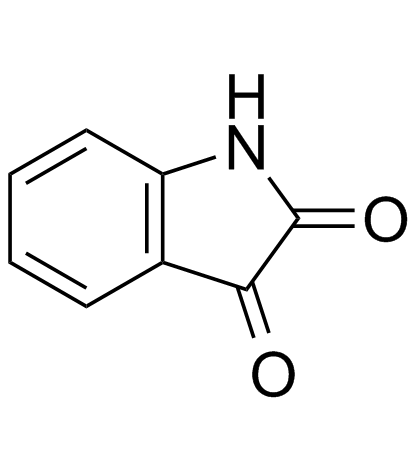
isatin structure
|
Common Name | isatin | ||
|---|---|---|---|---|
| CAS Number | 91-56-5 | Molecular Weight | 147.131 | |
| Density | 1.4±0.1 g/cm3 | Boiling Point | 360.3±52.0 °C at 760 mmHg | |
| Molecular Formula | C8H5NO2 | Melting Point | 193-195 °C (dec.)(lit.) | |
| MSDS | Chinese USA | Flash Point | 171.7±30.7 °C | |
|
Unprecedented one-pot, domino tertiary alcohol protection-Michael type addition of halides to Morita-Baylis-Hillman adduct of isatin with RCOX/K2CO3: diastereoselective synthesis of oxindole appended β-halo esters.
Org. Lett. 15(6) , 1186-9, (2013) A facile method utilizing RCOX/K2CO3 as a novel reagent for conjugate addition of hydrogen halide, in addition to tertiary (3°)-hydroxyl protection that leads to the synthesis of functionalized β-halo Morita-Baylis-Hillman ester appended oxindoles, has been d... |
|
|
Tryptophan 2,3-dioxygenase (TDO) inhibitors. 3-(2-(pyridyl)ethenyl)indoles as potential anticancer immunomodulators.
J. Med. Chem. 54 , 5320, (2011) Tryptophan catabolism mediated by indoleamine 2,3-dioxygenase (IDO) is an important mechanism of peripheral immune tolerance contributing to tumoral immune resistance. IDO inhibition is thus an active area of research in drug development. Recently, our group ... |
|
|
Reactivity of dinuclear copper(II) complexes towards melanoma cells: Correlation with its stability, tyrosinase mimicking and nuclease activity.
J. Inorg. Biochem. 149 , 49-58, (2015) In this work, the influence of two new dinuclear copper(II) complexes in the viability of melanoma cells (B16F10 and TM1MNG3) was investigated, with the aim of verifying possible correlations between their cytotoxicity and their structure. One of the complexe... |
|
|
Enzymatic detection and quantification assay of isatin, a putative stress biomarker in blood.
ACS Chem. Neurosci. 6 , 1353-60, (2015) Isatin is an endogenous inhibitor of monoamine oxidase B and is found in human blood and tissue. Increased levels of isatin have been linked to stress and anxiety in rodents and humans; however, the metabolism of isatin in humans is largely unknown. We have d... |
|
|
Cloning of Toluene 4-Monooxygenase Genes and Application of Two-Phase System to the Production of the Anticancer Agent, Indirubin.
Mol. Biotechnol. 57 , 720-6, (2015) Indirubin is a strong inhibitor of several eukaryotic cell signaling pathways and shows promise as a treatment for myelocytic leukemia and Alzheimer's disease. The tmoABCDEF operon, encoding the components of a novel toluene 4-monooxygenase from the paint fac... |
|
|
The endogenous oxindole isatin induces apoptosis of MCF‑7 breast cancer cells through a mitochondrial pathway.
Oncol. Rep. 32(5) , 2111-7, (2014) Isatin is an endogenous indole in mammalian tissues and fluids that is expected to have antitumor effects in human breast cancer cells. Human breast cancer cells (MCF-7) were exposed to isatin at various concentrations (0, 50, 100, 200 µmol/l) for 48 h. Apopt... |
|
|
Rabbit 3-hydroxyhexobarbital dehydrogenase is a NADPH-preferring reductase with broad substrate specificity for ketosteroids, prostaglandin D₂, and other endogenous and xenobiotic carbonyl compounds.
Biochem. Pharmacol. 86(9) , 1366-75, (2013) 3-Hydroxyhexobarbital dehydrogenase (3HBD) catalyzes NAD(P)⁺-linked oxidation of 3-hydroxyhexobarbital into 3-oxohexobarbital. The enzyme has been thought to act as a dehydrogenase for xenobiotic alcohols and some hydroxysteroids, but its physiological functi... |
|
|
PAC-1 and isatin derivatives are weak matrix metalloproteinase inhibitors.
Biochim. Biophys. Acta 1840(10) , 3162-9, (2014) Dysregulation of apoptotic cell death is observed in a large number of pathological conditions. As caspases are central enzymes in the regulation of apoptosis, a large number of procaspase-activating compounds (PAC-1 derivatives) and inhibitors (isatin deriva... |
|
|
Pseudomonas aeruginosa Expresses a Functional Human Natriuretic Peptide Receptor Ortholog: Involvement in Biofilm Formation.
MBio 6 , (2015) Considerable evidence exists that bacteria detect eukaryotic communication molecules and modify their virulence accordingly. In previous studies, it has been demonstrated that the increasingly antibiotic-resistant pathogen Pseudomonas aeruginosa can detect th... |
|
|
Selective inhibition of carboxylesterases by isatins, indole-2,3-diones.
J. Med. Chem. 50 , 1876-85, (2007) Carboxylesterases (CE) are ubiquitous enzymes thought to be responsible for the metabolism and detoxification of xenobiotics. Numerous clinically used drugs including Demerol, lidocaine, capecitabine, and CPT-11 are hydrolyzed by these enzymes. Hence, the ide... |