Etazolate hydrochloride
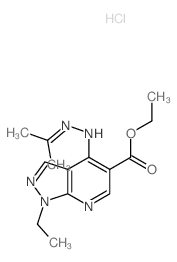
Etazolate hydrochloride structure
|
Common Name | Etazolate hydrochloride | ||
|---|---|---|---|---|
| CAS Number | 35838-58-5 | Molecular Weight | 325.79400 | |
| Density | 1.25g/cm3 | Boiling Point | 427.6ºC at 760mmHg | |
| Molecular Formula | C14H20ClN5O2 | Melting Point | N/A | |
| MSDS | USA | Flash Point | 212.4ºC | |
| Symbol |

GHS07 |
Signal Word | Warning | |
|
Etazolate improves performance in a foraging and homing task in aged rats.
Eur. J. Pharmacol. 634(1-3) , 95-100, (2010) Etazolate is a phosphodiesterase 4 (PDE4) inhibitor and GABAA receptor modulator that also stimulates alpha-secretase activity and neurotrophic soluble amyloid precursor protein (sAPPalpha) production, currently developed as a possible Alzheimer's disease the... |
|
|
Physostigmine inhibition of 3',5'-cyclic AMP phosphodiesterase from cat sciatic nerve.
J. Pharmacol. Exp. Ther. 228(3) , 656-61, (1984) This study was designed to determine whether cholinergic drug interaction with cyclic (c) AMP phosphodiesterase (PDE) might account for part of the effects of this class of drugs at the neuromuscular junction. The activity levels of both high- and low-affinit... |
|
|
[Pharmacologic value of cyclic nucleotide phosphodiesterase inhibitors].
Ann. Pharm. Fr. 42(2) , 99-112, (1984)
|
|
|
TcPDE4, a novel membrane-associated cAMP-specific phosphodiesterase from Trypanosoma cruzi.
Mol. Biochem. Parasitol. 145(1) , 40-9, (2006) Cyclic nucleotide phosphodiesterases constitute the only known mechanism to inactivate regulatory signals involving cAMP or cGMP. In our laboratory a cAMP-specific phosphodiesterase associated to the flagellar apparatus, named TcPDE1, was identified in Trypan... |
|
|
Characteristics of flunitrazepam binding to intact primary cultured spinal cord neurons and its modulation by GABAergic drugs.
J. Neurochem. 49(5) , 1491-7, (1987) The interaction of [3H]flunitrazepam and its modulation by various drugs was studied in intact primary cultured spinal cord neurons. In the intact cells, the [3H]-flunitrazepam binding was rapid and saturable. The benzodiazepine binding sites exhibited high a... |
|
|
In vitro characterization of agonist, antagonist, inverse agonist and agonist/antagonist benzodiazepines.
Prog. Neuropsychopharmacol. Biol. Psychiatry 8(4-6) , 785-8, (1984) The efficacy of coupling between the benzodiazepine receptor and chloride channel as well as the coupling to the GABA receptor is differentially affected by different benzodiazepine ligands. In general, the order of efficacy with regard to allosteric effects ... |
|
|
Hamster sperm Na+, K+-adenosine triphosphatase: increased activity during capacitation in vitro and its relationship to cyclic nucleotides.
Biol. Reprod. 30(3) , 573-84, (1984) These in vitro studies of golden hamster sperm were undertaken to determine whether: Na+, K+-adenosine triphosphatase (ATPase) activity is required for capacitation; Na+, K+-ATPase activity is altered during capacitation; and cyclic nucleotides can control th... |
|
|
Isobutylmethylxanthine and other classical cyclic nucleotide phosphodiesterase inhibitors affect cAMP-dependent protein kinase activity.
Cell. Signal. 5(5) , 615-21, (1993) The effect of 17 inhibitors of cyclic nucleotide phosphodiesterases (PDEs) was assayed on cAMP binding activity of Mucor rouxii protein kinase A (PKA), on PKA activity in the absence of cAMP and on free catalytic subunit (C) activity. Isobutylmethylxanthine (... |
|
|
Differential modulation of etazolate or pentobarbital enhanced [3H] muscimol binding by benzodiazepine agonists and inverse agonists.
Brain Res. 280(2) , 383-6, (1983) Flunitrazepam, a benzodiazepine agonist increases, and DMCM, an inverse agonist decreases the stimulation by etazolate or pentobarbital of [3H] muscimol binding to membranes of rat cerebral cortex. Ro 15-1788 has no marked effects but antagonizes the action o... |
|
|
Anxiolytic-like effect of etazolate, a type 4 phosphodiesterase inhibitor in experimental models of anxiety.
Indian J. Exp. Biol. 51(6) , 444-9, (2013) Etazolate is a selective inhibitor of type 4 phosphodiesterase (PDE4) class enzyme. Antidepressant-like effect of etazolate has been previously demonstrated in the rodent models of depression. The present study was designed to investigate the anxiolytic-like ... |