6,2',4'-TRIMETHOXYFLAVONE
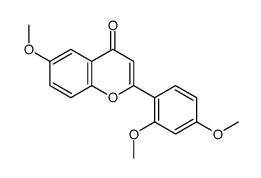
6,2',4'-TRIMETHOXYFLAVONE structure
|
Common Name | 6,2',4'-TRIMETHOXYFLAVONE | ||
|---|---|---|---|---|
| CAS Number | 720675-90-1 | Molecular Weight | 312.31700 | |
| Density | N/A | Boiling Point | N/A | |
| Molecular Formula | C18H16O5 | Melting Point | N/A | |
| MSDS | Chinese USA | Flash Point | N/A | |
| Symbol |

GHS06 |
Signal Word | Danger | |
|
Quantification of 5,7-dimethoxyflavone in mouse plasma using liquid chromatography-tandem mass spectrometry (LC-MS/MS) and its application to a pharmacokinetic study.
J. Chromatogr. B. Analyt. Technol. Biomed. Life Sci. 978-979 , 11-7, (2015) 5,7-Dimethoxyflavone (5,7-DMF), a natural flavonoid abundant in many plants, has been reported to have many beneficial pharmacological effects, including strong chemopreventive and chemosensitizing properties, anti-oxidant, cardiovascular protectant, and anti... |
|
|
A monolithic drug-in-adhesive patch of methoxyflavones from Kaempferia parviflora: in vitro and in vivo evaluation.
Int. J. Pharm. 478(2) , 486-95, (2015) The aim of this study was to design and develop a suitable monolithic drug-in-adhesive type patch of methoxyflavones from Kaempferia parviflora (K. parviflora) using acrylic polymer Durotak(®) 87-2852. The absence of interaction between components in K. parvi... |
|
|
Cytokine responses induced by diesel exhaust particles are suppressed by PAR-2 silencing and antioxidant treatment, and driven by polar and non-polar soluble constituents.
Toxicol. Lett. 238 , 72-82, (2015) Adsorbed soluble organics seem to be the main drivers of inflammatory responses induced by diesel exhaust particles (DEP). The specific compounds contributing to this process and the cellular mechanisms behind DEP-induced inflammation are not well known. We h... |
|
|
L-kynurenine/aryl hydrocarbon receptor pathway mediates brain damage after experimental stroke.
Circulation 130(23) , 2040-51, (2014) Aryl hydrocarbon receptor (AhR) is a transcription factor that belongs to the basic helix-loop-helix PAS (Per-Arnt-Sim homology domain) family known to mediate the toxic and carcinogenic effects of xenobiotics. Interestingly, AhR is widely expressed in the ce... |