2-Methyl-3,5-dinitroaniline
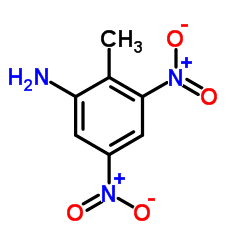
2-Methyl-3,5-dinitroaniline structure
|
Common Name | 2-Methyl-3,5-dinitroaniline | ||
|---|---|---|---|---|
| CAS Number | 35572-78-2 | Molecular Weight | 197.148 | |
| Density | 1.5±0.1 g/cm3 | Boiling Point | 405.7±40.0 °C at 760 mmHg | |
| Molecular Formula | C7H7N3O4 | Melting Point | N/A | |
| MSDS | N/A | Flash Point | 199.2±27.3 °C | |
| Symbol |


GHS02, GHS07 |
Signal Word | Danger | |
|
Fe(III) mineral reduction followed by partial dissolution and reactive oxygen species generation during 2,4,6-trinitrotoluene transformation by the aerobic yeast Yarrowia lipolytica.
AMB Express 5 , 8, (2015) Understanding the factors that influence pollutant transformation in the presence of ferric (oxyhydr)oxides is crucial to the efficient application of different remediation strategies. In this study we determined the effect of goethite, hematite, magnetite an... |
|
|
A novel method for the identification of inorganic and organic gunshot residue particles of lead-free ammunitions from the hands of shooters using scanning laser ablation-ICPMS and Raman micro-spectroscopy.
Analyst 139(23) , 6232-41, (2014) A method based on scanning laser ablation and inductively coupled plasma-mass spectrometry (SLA-ICPMS) and Raman micro-spectroscopy for the detection and identification of compounds consistent with gunshot residue particles (GSR) has been developed. The metho... |
|
|
Analysis of nitroaromatic compounds in urine by gas chromatography-mass spectrometry for the biological monitoring of explosives.
J. Chromatogr. B. Biomed. Sci. Appl. 710(1-2) , 91-9, (1998) Organic nitrocompounds are the most frequently used constituents of explosives and some of them have been evaluated to be highly toxic or even carcinogenic. Human contact with explosives may originate from a variety of sources, including occupational exposure... |
|
|
Electrochemical destruction of dinitrotoluene isomers and 2,4,6-trinitrotoluene in spent acid from toluene nitration process.
J. Hazard. Mater. 161(2-3) , 1017-23, (2009) Mineralization of dinitrotoluene (DNT) isomers and 2,4,6-trinitrotoluene (TNT) in spent acid was conducted by in situ electrogenerated hydrogen peroxide. The electrolytic experiments were carried out to elucidate the influence of various operating parameters ... |
|
|
Anaerobic in situ biodegradation of TNT using whey as an electron donor: a case study.
New Biotechnology 32 , 701-9, (2015) Contamination by 2,4,6-trinitrotoluene (TNT), an explosive extensively used by the military, represents a serious environmental problem. In this study, whey has been selected as the most technologically and economically suitable primary substrate for anaerobi... |
|
|
Denitration of 2,4,6-trinitrotoluene by Pseudomonas savastanoi.
Can. J. Microbiol. 43(5) , 447-55, (1997) Past disposal of wastewaters containing 2,4,6-trinitrotoluene (TNT) at the former Nebraska Ordnance Plant has resulted in numerous acres of TNT-contaminated soil. Examining the microbial population of these soils revealed several TNT-tolerant Pseudomonas spp.... |
|
|
Disappearance of 2,4-dinitrotoluene and 2-Amino,4,6-dinitrotoluene by Phanerochaete chrysosporium under non-ligninolytic conditions.
Bull. Environ. Contam. Toxicol. 62(4) , 390-6, (1999)
|
|
|
Pseudomonas aeruginosa strain MA01 aerobically metabolizes the aminodinitrotoluenes produced by 2,4,6-trinitrotoluene nitro group reduction.
Can. J. Microbiol. 41(11) , 984-91, (1995) Many microbes reduce the nitro substituents of 2,4,6-trinitrotoluene (TNT), producing aminodinitrotoluenes (ADNTs). These compounds are recalcitrant to further breakdown and are acutely toxic. In a search for organisms capable of metabolizing ADNTs, a bacteri... |
|
|
Biotransformation of 2,4,6-trinitrotoluene (TNT) by the fungus Fusarium oxysporum.
Int. J. Phytoremediation 8(2) , 95-105, (2006) The fungus Fusarium oxysporum was isolated and identified from the aquatic plant M. aquaticum. The capability of this fungus to transform 2,4,6-trinitrotoluene (TNT) in liquid cultures was investigated TNT was added to shake flask cultures and transformed int... |
|
|
Conversion of aminonitrotoluenes by fungal manganese peroxidase.
J. Basic Microbiol. 38(1) , 51-9, (1998) Preparations of extracellular manganese peroxidase from the white-rot fungus Nematoloma frowardii and the litter decaying fungus Stropharia rugosoannulata converted rapidly the main intermediates of the explosive 2,4,-trinitrotoluene--the aminonitrotoluenes. ... |