Pindolol
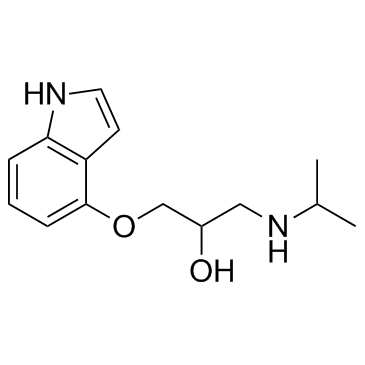
Pindolol structure
|
Common Name | Pindolol | ||
|---|---|---|---|---|
| CAS Number | 13523-86-9 | Molecular Weight | 248.321 | |
| Density | 1.2±0.1 g/cm3 | Boiling Point | 457.1±35.0 °C at 760 mmHg | |
| Molecular Formula | C14H20N2O2 | Melting Point | 167-171 °C(lit.) | |
| MSDS | Chinese USA | Flash Point | 230.3±25.9 °C | |
| Symbol |

GHS07 |
Signal Word | Warning | |
|
Translating clinical findings into knowledge in drug safety evaluation--drug induced liver injury prediction system (DILIps).
J. Sci. Ind. Res. 65(10) , 808, (2006) Drug-induced liver injury (DILI) is a significant concern in drug development due to the poor concordance between preclinical and clinical findings of liver toxicity. We hypothesized that the DILI types (hepatotoxic side effects) seen in the clinic can be tra... |
|
|
Calculating virtual log P in the alkane/water system (log P(N)(alk)) and its derived parameters deltalog P(N)(oct-alk) and log D(pH)(alk).
J. Med. Chem. 48 , 3269-79, (2005) Growing interest in the use of both the logarithm of the partition coefficient of the neutral species in the alkane/water system (log P(N)(alk)) and the difference between log P(N)(oct) (the logarithm of the partition coefficient of the neutral species in the... |
|
|
Developing structure-activity relationships for the prediction of hepatotoxicity.
Chem. Res. Toxicol. 23 , 1215-22, (2010) Drug-induced liver injury is a major issue of concern and has led to the withdrawal of a significant number of marketed drugs. An understanding of structure-activity relationships (SARs) of chemicals can make a significant contribution to the identification o... |
|
|
A predictive ligand-based Bayesian model for human drug-induced liver injury.
Drug Metab. Dispos. 38 , 2302-8, (2010) Drug-induced liver injury (DILI) is one of the most important reasons for drug development failure at both preapproval and postapproval stages. There has been increased interest in developing predictive in vivo, in vitro, and in silico models to identify comp... |
|
|
Chemical genetics reveals a complex functional ground state of neural stem cells.
Nat. Chem. Biol. 3(5) , 268-273, (2007) The identification of self-renewing and multipotent neural stem cells (NSCs) in the mammalian brain holds promise for the treatment of neurological diseases and has yielded new insight into brain cancer. However, the complete repertoire of signaling pathways ... |
|
|
Air to lung partition coefficients for volatile organic compounds and blood to lung partition coefficients for volatile organic compounds and drugs.
Eur. J. Med. Chem. 43 , 478-85, (2008) Values of in vitro gas to lung partition coefficients, K(lung), of VOCs have been collected from the literature. For 44 VOCs, application of the Abraham solvation equation to log K(lung) yielded a correlation with R(2)=0.968 and S.D.=0.25 log units. Combinati... |
|
|
Direct doping analysis of beta-blocker drugs from urinary samples by on-line molecularly imprinted solid-phase extraction coupled to liquid chromatography/mass spectrometry.
Analyst 140(8) , 2696-703, (2015) The use of beta-blockers to enhance performance in some sports is forbidden. Based on this regulation, there is a demand for dynamic analytical procedures for analyzing these compounds quickly and without manual sample preparation. Therefore, the use of a mol... |
|
|
Enantiomers separation by nano-liquid chromatography: use of a novel sub-2 μm vancomycin silica hydride stationary phase.
J. Chromatogr. A. 1381 , 149-59, (2015) A novel sub-2 μm chiral stationary phase (CSP) was prepared immobilizing vancomycin onto 1.8 μm diol hydride-based silica particles. The CSP was packed into fused silica capillaries of 75 μm i.d. with a length of 11 cm and evaluated by means of nano-liquid ch... |
|
|
Single-step approach for fabrication of vancomycin-bonded silica monolith as chiral stationary phase.
J. Chromatogr. A. 1358 , 208-16, (2014) A vancomycin-bonded silica monolithic column for capillary electrochromatography (CEC) was prepared by a single-step in situ sol-gel approach. This sol-gel process incorporates a synthetic sol-gel precursor which contains a macrocyclic antibiotic, vancomycin,... |
|
|
Neural computational prediction of oral drug absorption based on CODES 2D descriptors.
Eur. J. Med. Chem. 45 , 930-40, (2010) A neural model based on a numerical molecular representation using CODES program to predict oral absorption of any structure is described. This model predicts both high and low-absorbed compounds with a global accuracy level of 74%. CODES/ANN methodology show... |