Tricosanoic acid
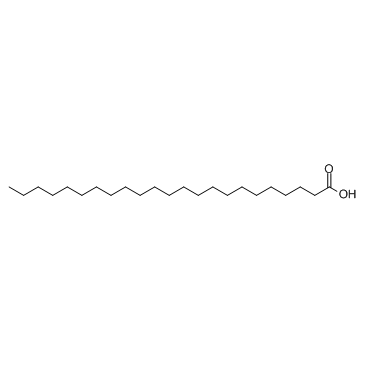
Tricosanoic acid structure
|
Common Name | Tricosanoic acid | ||
|---|---|---|---|---|
| CAS Number | 2433-96-7 | Molecular Weight | 354.610 | |
| Density | 0.9±0.1 g/cm3 | Boiling Point | 399.0±5.0 °C at 760 mmHg | |
| Molecular Formula | C23H46O2 | Melting Point | 77-79 °C(lit.) | |
| MSDS | Chinese USA | Flash Point | 179.3±12.5 °C | |
| Symbol |

GHS07 |
Signal Word | Warning | |
|
Chemical Compositions of Egg Yolks and Egg Quality of Laying Hens Fed Prebiotic, Probiotic, and Synbiotic Diets.
J. Food Sci. 80 , C1686-95, (2015) A 16-wk feeding experiment was conducted to investigate the effects of a prebiotic, isomaltooligosaccharide (IMO), a probiotic, PrimaLac®, and their combination as a synbiotic on the chemical compositions of egg yolks and the egg quality of laying hens. One h... |
|
|
Commercial sheep flocks--fatty acid and fat-soluble antioxidant composition of milk and cheese related to changes in feeding management throughout lactation.
J. Dairy Res. 82 , 334-43, (2015) Fatty acids (FAs), tocopherols and retinoids were analysed in raw milk and cheese from six commercial sheep flocks monitored from early lactation in winter to late lactation in summer. In winter, animals received concentrate and forage indoors; in early sprin... |
|
|
Development and application of a comparative fatty acid analysis method to investigate voriconazole-induced hepatotoxicity.
Clin. Chim. Acta 438 , 126-34, (2014) As fatty acids play an important role in biological regulation, the profiling of fatty acid expression has been used to discover various disease markers and to understand disease mechanisms. This study developed an effective and accurate comparative fatty aci... |
|
|
An efficient and economical MTT assay for determining the antioxidant activity of plant natural product extracts and pure compounds.
J. Nat. Prod. 73 , 1193-5, (2010) Antioxidants scavenge free radicals, singlet oxygen, and electrons in cellular redox reactions. The yellow MTT [3-(4,5-dimethylthiazole-2-yl)-2,5-diphenyltetrazolium bromide] is reduced to a purple formazan by mitochondrial enzymes. NADPH is the basis of esta... |
|
|
Effects of protein intake on rate of growth, protein deposition, and carcass traits of heavy Iberian pigs.
J. Anim. Sci. 93 , 3471-82, (2015) A feeding, digestibility, and balance trial was performed to determine the effect of the incorporation of increasing amounts of soybean protein concentrate (SPC) to a basal acorn diet at a fixed energy intake on the rate of growth, protein deposition (PD), an... |
|
|
Lipidomics reveals a remarkable diversity of lipids in human plasma.
J. Lipid Res. 51(11) , 3299-305, (2010) The focus of the present study was to define the human plasma lipidome and to establish novel analytical methodologies to quantify the large spectrum of plasma lipids. Partial lipid analysis is now a regular part of every patient's blood test and physicians r... |
|
|
Characterization of Shrimp Oil from Pandalus borealis by High Performance Liquid Chromatography and High Resolution Mass Spectrometry.
Mar. Drugs 13 , 3849-76, (2015) Northern shrimp (Pandalus borealis) oil, which is rich in omega-3 fatty acids, was recovered from the cooking water of shrimp processing facilities. The oil contains significant amounts of omega-3 fatty acids in triglyceride form, along with substantial long-... |
|
|
Microwave Energy Increases Fatty Acid Methyl Ester Yield in Human Whole Blood Due to Increased Sphingomyelin Transesterification.
Lipids 50 , 895-905, (2015) Dried blood spots (DBS) by fingertip prick collection for fatty acid profiling are becoming increasingly popular due to ease of collection, minimal invasiveness and its amenability to high-throughput analyses. Herein, we assess a microwave-assisted direct tra... |
|
|
Analysis of Long-Chain Unsaturated Fatty Acids by Ionic Liquid Gas Chromatography.
J. Agric. Food Chem. 64 , 1422-32, (2016) Four ionic liquid (IL) columns, SLB-IL59, SLB-IL60, SLB-IL65, and SLB-IL111, were evaluated for more rapid analysis or improved resolution of long-chain methyl and ethyl esters of omega-3, omega-6, and additional positional isomeric and stereoisomeric blends ... |
|
|
Surfactants have multi-fold effects on skin barrier function.
Eur. J. Dermatol. 25 , 424-35, (2015) The stratum corneum (SC) is responsible for the barrier properties of the skin and the role of intercorneocyte skin lipids, particularly their structural organization, in controlling SC permeability is acknowledged. Upon contacting the skin, surfactants inter... |