Benserazide hydrochloride
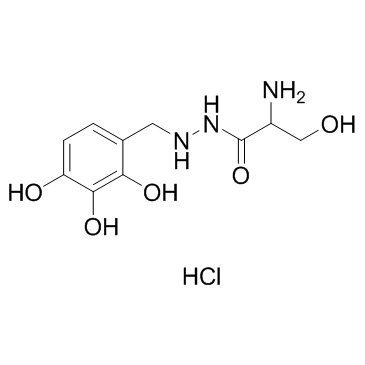
Benserazide hydrochloride structure
|
Common Name | Benserazide hydrochloride | ||
|---|---|---|---|---|
| CAS Number | 14919-77-8 | Molecular Weight | 293.704 | |
| Density | N/A | Boiling Point | 574.2ºC at 760 mmHg | |
| Molecular Formula | C10H16ClN3O5 | Melting Point | 146°C | |
| MSDS | Chinese USA | Flash Point | N/A | |
| Symbol |

GHS07 |
Signal Word | Warning | |
|
Adenosine A1 receptor stimulation reduces D1 receptor-mediated GABAergic transmission from striato-nigral terminals and attenuates l-DOPA-induced dyskinesia in dopamine-denervated mice
Exp. Neurol. 261 , 733-43, (2014) γ-Aminobutyric acid A receptor (GABAAR)-mediated postsynaptic currents were recorded in brain slices from substantia nigra pars reticulate neurons. The selective adenosine A1 receptor (A1R) antagonist, 8-cyclopentyl-1,3-dipropylxanthine (DPCPX), increased the... |
|
|
Cav1.3 channels control D2-autoreceptor responses via NCS-1 in substantia nigra dopamine neurons.
Brain 137(Pt 8) , 2287-302, (2014) Dopamine midbrain neurons within the substantia nigra are particularly prone to degeneration in Parkinson's disease. Their selective loss causes the major motor symptoms of Parkinson's disease, but the causes for the high vulnerability of SN DA neurons, compa... |
|
|
L-DOPA-induced dyskinesia in a rat model of Parkinson's disease is associated with the fluctuational release of norepinephrine in the sensorimotor striatum.
J. Neurosci. Res. 92(12) , 1733-45, (2014) L-3,4-dihydroxyphenylalanine (L-DOPA)-induced dyskinesia (LID) is the most common complication of standard L-DOPA therapy for Parkinson's disease experienced by most parkinsonian patients. LID is associated with disruption of dopaminergic homeostasis in basal... |
|
|
Side effect profile of 5-HT treatments for Parkinson's disease and L-DOPA-induced dyskinesia in rats.
Br. J. Pharmacol. 172(1) , 119-30, (2014) Treatment of Parkinson's disease (PD) with L-DOPA eventually causes abnormal involuntary movements known as dyskinesias in most patients. Dyskinesia can be reduced using compounds that act as direct or indirect agonists of the 5-HT1 A receptor, but these drug... |
|
|
Genome-wide microarray analysis identifies a potential role for striatal retrograde endocannabinoid signaling in the pathogenesis of experimental L-DOPA-induced dyskinesia.
Synapse 68(8) , 332-43, (2014) l-3,4-Dihydroxyphenylalanine (L-DOPA) is the most widely used drug for the treatment of Parkinson's disease. Unfortunately, chronic administration of this dopamine precursor causes L-DOPA-induced dyskinesia (LID), which is a debilitating complication whose pa... |
|
|
Spinal cord injury enables aromatic L-amino acid decarboxylase cells to synthesize monoamines.
J. Neurosci. 34(36) , 11984-2000, (2014) Serotonin (5-HT), an important modulator of both sensory and motor functions in the mammalian spinal cord, originates mainly in the raphe nuclei of the brainstem. However, following complete transection of the spinal cord, small amounts of 5-HT remain detecta... |
|
|
Neuroprotective effects of 5-(4-hydroxy-3-dimethoxybenzylidene)-thiazolidinone in MPTP induced Parkinsonism model in mice.
Neuropharmacology 93 , 209-18, (2015) Parkinson's disease (PD) is a neurological disorder characterized by degeneration of nigrostriatal dopaminergic (DAergic) system. Present treatment targeting to DAergic system solely ameliorated the symptoms but failed to retard the DAergic neuron degeneratio... |
|
|
Noradrenergic terminals regulate L-DOPA-derived dopamine extracellular levels in a region-dependent manner in Parkinsonian rats.
CNS Neurosci. Ther. 20(7) , 671-8, (2014) Serotonin (5-HT) neurons mediate the ectopic release of dopamine (DA) induced by L-DOPA in the Parkinsonian brain. We hypothesized that the participation of noradrenalin transporters (NET) in the clearance of DA may account for the lower effect of L-DOPA in e... |
|
|
RGS4 is involved in the generation of abnormal involuntary movements in the unilateral 6-OHDA-lesioned rat model of Parkinson's disease.
Neurobiol. Dis. 70 , 138-48, (2014) Regulators of G-protein signalling (RGS) proteins are implicated in striatal G-protein coupled receptor (GPCR) sensitisation in the pathophysiology of l-DOPA-induced abnormal involuntary movements (AIMs), also known as dyskinesia (LID), in Parkinson's disease... |