(DL)-3-O-Methyldopa
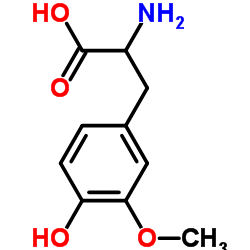
(DL)-3-O-Methyldopa structure
|
Common Name | (DL)-3-O-Methyldopa | ||
|---|---|---|---|---|
| CAS Number | 7636-26-2 | Molecular Weight | 211.214 | |
| Density | 1.3±0.1 g/cm3 | Boiling Point | 407.3±45.0 °C at 760 mmHg | |
| Molecular Formula | C10H13NO4 | Melting Point | N/A | |
| MSDS | N/A | Flash Point | 200.1±28.7 °C | |
|
Cysteinyl-glycine reduction as marker for levodopa-induced oxidative stress in Parkinson's disease patients.
Mov. Disord 26 , 543-546, (2011) Oxidative stress is influenced by the thiol homeostasis, which determines the redox milieu. One of its components is Cysteinyl-glycine (Cys-Gly) generation, as its metabolic precursor is the free radicals scavenging glutathione. Levodopa is under suspicion to... |
|
|
Pharmacokinetic-pharmacodynamic modeling of levodopa in patients with advanced Parkinson disease.
Clin. Neuropharmacol. 33(3) , 135-41, (2010) The aims of the present study were to investigate the pharmacokinetic and pharmacodynamic (pk/pd) relationship of levodopa (l-dopa) in patients with advanced Parkinson disease (PD) and also to evaluate the effect of tolcapone on the pk/pd analysis of l-dopa i... |
|
|
Levodopa infusion combined with entacapone or tolcapone in Parkinson disease: a pilot trial.
Eur. J. Neurol. 19(6) , 820-6, (2012) Catechol-O-methyltransferase inhibitors may be used to decrease levodopa requirement. The objective was to investigate whether the levodopa/carbidopa intestinal gel infusion dose can be reduced by 20% without worsening of motor fluctuations and levodopa conce... |
|
|
Comparison of 200 mg retarded release levodopa/carbidopa - with 150 mg levodopa/carbidopa/entacapone application: pharmacokinetics and efficacy in patients with Parkinson's disease.
J. Neural Transm. Gen. Sect. 114(11) , 1457-62, (2007) The interval of line tracing performance is more associated to basal ganglia function due to the dependence on bradykinesia and rigidity. The other component of this task, the precision of execution of complex movement sequences, is more related to attention.... |
|
|
Pharmacokinetic-pharmacodynamic interaction between nebicapone and controlled-release levodopa/benserazide: a single-center, Phase I, double-blind, randomized, placebo-controlled, four-way crossover study in healthy subjects.
Clin. Ther. 31(10) , 2258-71, (2009) Nebicapone is a reversible catechol-O-methyltransferase (COMT) inhibitor. Coadministration of a COMT inhibitor with levodopa and a dopa-decarboxylase inhibitor (carbidopa or benserazide) increases levodopa exposure and its therapeutic effect.The primary objec... |
|
|
The role of 3-O-methyldopa in the side effects of L-dopa.
Neurochem. Res. 33(3) , 401-11, (2008) Long-term treatment of L-dopa for Parkinson's disease (PD) patients induces adverse effects, including dyskinesia, on-off and wearing-off symptoms. However, the cause of these side effects has not been established to date. In the present study, therefore, 3-O... |
|
|
Acute levodopa administration reduces cortisol release in patients with Parkinson's disease.
J. Neural Transm. Gen. Sect. 114(3) , 347-50, (2007) Levodopa (LD) application improves motor symptoms in patients with Parkinson's disease (PD) patients. Little is known on further effects of LD, which induced lower plasma levels of cortisol and lower serotonergic activity in certain brain areas of fish. Objec... |
|
|
Inhibition of catechol-O-methyltransferase modifies acute homocysteine rise during repeated levodopa application in patients with Parkinson's disease.
Naunyn Schmiedebergs Arch. Pharmacol. 383(6) , 627-33, (2011) Elevation of plasma total homocysteine concentrations were observed in levodopa/dopa decarboxylase inhibitor (DDI)-treated patients with Parkinson's disease (PD). Degradation of levodopa to 3-O-methyldopa via the enzyme catechol-O-methyltransferase (COMT) is ... |
|
|
Catechol-O-methyltransferase inhibition improves levodopa-associated strength increase in patients with Parkinson disease.
Clin. Neuropharmacol. 31(3) , 134-40, (2008) A matter of debate is the impact of levodopa (LD) application in patients with Parkinson disease (PD) on altered force development and coordination, which are also influenced by the strength of muscles used. The objectives were to compare the motor response, ... |
|
|
Methyl group-donating vitamins elevate 3-O-methyldopa in patients with Parkinson disease.
Clin. Neuropharmacol. 36(2) , 52-4, (2013) Levodopa (LD)/dopa decarboxylase inhibitor application increases 3-O-methyldopa (3-OMD) concentrations in association with methyl group transfers, which demand for the conversion of methionine to homocysteine. This accompanying reaction is partially reversibl... |